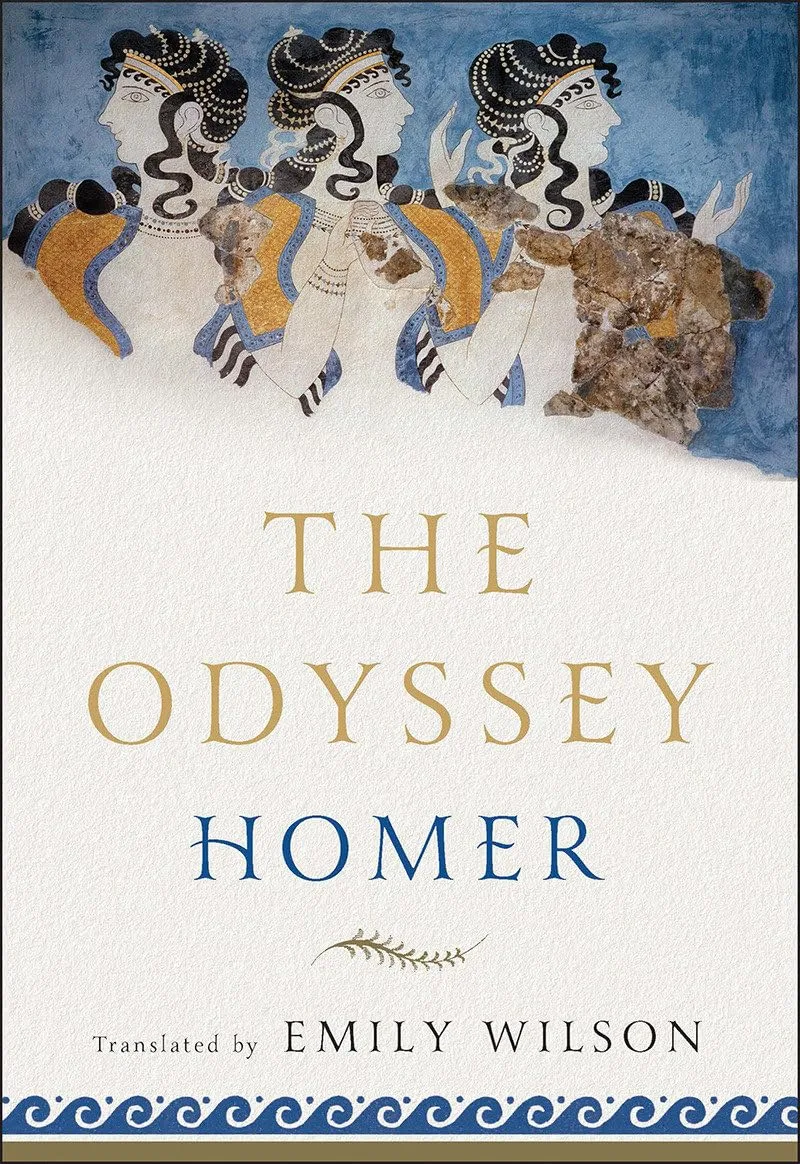
The Odyssey
Paperback
• 592 Pages
• GBP 14.99
• English
• 9780393356250
No ratings yet
| Publisher | W. W. Norton & Company |
|---|---|
| ISBN13 | 9780393356250 |
| ASIN/SKU | 0393356256 |
| Book Format | Paperback |
| Language | English |
| Pages | 592 |
| List Price | GBP 14.99 |
| Publishing Date | 06/11/2018 |
| Dimensions | 14.73 x 3.05 x 21.08 cm |
| Weight | 1.05 kg |
| Book Code | BD00069610 |
Buy this Book
Amazon Stores
Ebook Stores
Other Stores
Discover The Odyssey by Homer Homer. This book is published by W. W. Norton and Company in Paperback format, ISBN 9780393356250, ASIN 0393356256, under Literature and Fiction, Classical, Early and Medieval Poetry.
Book Description
The first great adventure story in the Western canon, The Odyssey is a poem about violence and the aftermath of war; about wealth, poverty and power; about marriage, family and identity; and about travellers, hospitality and the changing meanings of home in a strange world.
This vivid new translation the first by a woman matches the number of lines in the Greek original, striding at Homer's sprightly pace. Emily Wilson employs elemental, resonant language and a five-beat line to produce a translation with an enchanting "rhythm and rumble" that avoids proclaiming its own grandeur. An engrossing tale told in a compelling new voice that allows contemporary readers to luxuriate in Homer's descriptions and similes and to thrill at the tension and excitement of its hero's adventures, Wilson recaptures what is "epic" about this wellspring of world literature.
This vivid new translation the first by a woman matches the number of lines in the Greek original, striding at Homer's sprightly pace. Emily Wilson employs elemental, resonant language and a five-beat line to produce a translation with an enchanting "rhythm and rumble" that avoids proclaiming its own grandeur. An engrossing tale told in a compelling new voice that allows contemporary readers to luxuriate in Homer's descriptions and similes and to thrill at the tension and excitement of its hero's adventures, Wilson recaptures what is "epic" about this wellspring of world literature.
Author Biography
Emily Wilson grew up in Oxford, UK, and studied Classics at Balliol College, and English Literature at Corpus Christi College. Her PhD. is from Yale in Classics and Comparative Literature. She is currently a Professor of Classical Studies at the University of Pennsylvania. She is interested in literature, story-telling and how ideas and culture play out through narrative and in words, and in the music of language. She cares about poetry, drama and philosophy of all eras, especially ancient Greek, Roman and early modern. She has written books on tragedy and "overliving", the long afterlife of the death of Socrates, and a life of Seneca. She has also done several verse translations of classical verse drama and epic, including Seneca's tragedies, four plays of Euripides, and Homer's Odyssey.
Her approach to translation is discussed here: http://poems.com/special_features/prose/essay_wilson_odyssey.php
Homer was probably born around 725BC on the Coast of Asia Minor, now the coast of Turkey, but then really a part of Greece. Homer was the first Greek writer whose work survives.
He was one of a long line of bards, or poets, who worked in the oral tradition. Homer and other bards of the time could recite, or chant, long epic poems. Both works attributed to Homer - The Iliad and The Odyssey - are over ten thousand lines long in the original. Homer must have had an amazing memory but was helped by the formulaic poetry style of the time.
In The Iliad Homer sang of death and glory, of a few days in the struggle between the Greeks and the Trojans. Mortal men played out their fate under the gaze of the gods. The Odyssey is the original collection of tall traveller's tales. Odysseus, on his way home from the Trojan War, encounters all kinds of marvels from one-eyed giants to witches and beautiful temptresses. His adventures are many and memorable before he gets back to Ithaca and his faithful wife Penelope.
We can never be certain that both these stories belonged to Homer. In fact 'Homer' may not be a real name but a kind of nickname meaning perhaps 'the hostage' or 'the blind one'. Whatever the truth of their origin, the two stories, developed around three thousand years ago, may well still be read in three thousand years' time.
Profiled here: https://www.nytimes.com/2017/11/02/magazine/the-first-woman-to-translate-the-odyssey-into-english.html
Her approach to translation is discussed here: http://poems.com/special_features/prose/essay_wilson_odyssey.php
Homer was probably born around 725BC on the Coast of Asia Minor, now the coast of Turkey, but then really a part of Greece. Homer was the first Greek writer whose work survives.
He was one of a long line of bards, or poets, who worked in the oral tradition. Homer and other bards of the time could recite, or chant, long epic poems. Both works attributed to Homer - The Iliad and The Odyssey - are over ten thousand lines long in the original. Homer must have had an amazing memory but was helped by the formulaic poetry style of the time.
In The Iliad Homer sang of death and glory, of a few days in the struggle between the Greeks and the Trojans. Mortal men played out their fate under the gaze of the gods. The Odyssey is the original collection of tall traveller's tales. Odysseus, on his way home from the Trojan War, encounters all kinds of marvels from one-eyed giants to witches and beautiful temptresses. His adventures are many and memorable before he gets back to Ithaca and his faithful wife Penelope.
We can never be certain that both these stories belonged to Homer. In fact 'Homer' may not be a real name but a kind of nickname meaning perhaps 'the hostage' or 'the blind one'. Whatever the truth of their origin, the two stories, developed around three thousand years ago, may well still be read in three thousand years' time.
Profiled here: https://www.nytimes.com/2017/11/02/magazine/the-first-woman-to-translate-the-odyssey-into-english.html
Editorial Reviews
A masterpiece of translation.--Rowan Williams, University of Cambridge
A revelation. Never have I been so aware at once of the beauty of the poetry, the physicality of Homer's world, and the moral ambiguity of those who inhabit it.--Susan Chira
Emily Wilson's crisp and musical version is a cultural landmark.... This translation will change the way the poem is read in English.--Charlotte Higgins
Emily Wilson has given us a staggeringly superior translation--true, poetic, lively and readable, and always closely engaged with the original Greek--that brings to life the fascinating variety of voices in Homer's great epic.--Richard F. Thomas, Harvard University
"All the artistic choices work. I must admit when I heard we were reviewing The Odyssey, I thought 'Oh no, it's going to be wordy and dull'...but it wasn't, it really felt fresh and alive and exciting."
--Sophie Hannah, BBC Radio 4, Saturday Review
"Wilson's translation is a superb achievement and a striking departure from the tradition of Homeric translation into English... [She] has produced a wonderfully distinctive and modern version of the poem."
--London Evening Standard
"The real reason why Emily Wilson's version of this nearly three millennia-old poem is so important is that it combines intellectual authority with addictive readability."
--Edith Hall, The Telegraph
"Wilson, the first woman to translate the text into English, does a magnificent job of bringing this archaic poem to a new audience. Fresh, crisp and thoughtful, the translation reflects smart choices across the board...Homer has long deserved better, as have his readers. Now we have it."
--i Paper
"...this is a really significant literary moment."
--Mark Haddon, author of The Curious Incident of the Dog in the Nighttime
"...this instantly hot-wired me into tears."
--Sarah Perry, author of The Essex Serpent
"When I first read these lines...I was floored. I d never read an "Odyssey" that sounded like this. It had such directness, the lines feeling not as if they were being fed into iambic pentameter because of some strategic decision but because the meter was a natural mode for its speaker."
--The New York Times Magazine
"Its cast of clever, bewitching queens and goddesses certainly suggests a feminine touch. And in Emily Wilson proves an appropriately beguiling female translator...This is certainly an Odyssey for our moment...[a] swift, unornamented text."
--The Spectator
"Wilson's Odyssey feels like a restoration of an old, familiar building that had over the years been encrusted with too much gilt. Wilson translates as though translation is a moral choice you owe fidelity not to the author, nor to the protagonist, but to the truth behind the words and the times. She scrapes away at old encrusted layers, until she exposes what lies beneath."
--Financial Times
"It is immensely satisfying to see The Odyssey in the hands of such a careful and creative scholar who can pore over the semantic nuances of Homer's Greek as well as those of her own English. Considerations of gender aside, perhaps Wilson's greatest achievement is to disprove the increasingly held view that versions of ancient texts require an established poet to be parachuted in, like a literary James Bond, to rescue their English lines from the prosaic. For a translation of The Odyssey that knows what it is talking about and sings as it speaks, this is the one to read."
--New Statesman
"...[a] sprightly rendering...The result is a perceptive reading of The Odys --Susan Wise Bauer, author of The History of the Ancient World
"This "lean, fleet-footed" translation - the first ever by a woman - aims to bring the ancient epic to new life...[It avoids] showy poetics for resonant language for today..." --The Bookseller
Emily Wilson is the first woman to translate The Odyssey into English, and her fine, plain language makes this ancient and compelling story hum with new life... Wilson is a brilliant companion on the decade-long journ
A revelation. Never have I been so aware at once of the beauty of the poetry, the physicality of Homer's world, and the moral ambiguity of those who inhabit it.--Susan Chira
Emily Wilson's crisp and musical version is a cultural landmark.... This translation will change the way the poem is read in English.--Charlotte Higgins
Emily Wilson has given us a staggeringly superior translation--true, poetic, lively and readable, and always closely engaged with the original Greek--that brings to life the fascinating variety of voices in Homer's great epic.--Richard F. Thomas, Harvard University
"All the artistic choices work. I must admit when I heard we were reviewing The Odyssey, I thought 'Oh no, it's going to be wordy and dull'...but it wasn't, it really felt fresh and alive and exciting."
--Sophie Hannah, BBC Radio 4, Saturday Review
"Wilson's translation is a superb achievement and a striking departure from the tradition of Homeric translation into English... [She] has produced a wonderfully distinctive and modern version of the poem."
--London Evening Standard
"The real reason why Emily Wilson's version of this nearly three millennia-old poem is so important is that it combines intellectual authority with addictive readability."
--Edith Hall, The Telegraph
"Wilson, the first woman to translate the text into English, does a magnificent job of bringing this archaic poem to a new audience. Fresh, crisp and thoughtful, the translation reflects smart choices across the board...Homer has long deserved better, as have his readers. Now we have it."
--i Paper
"...this is a really significant literary moment."
--Mark Haddon, author of The Curious Incident of the Dog in the Nighttime
"...this instantly hot-wired me into tears."
--Sarah Perry, author of The Essex Serpent
"When I first read these lines...I was floored. I d never read an "Odyssey" that sounded like this. It had such directness, the lines feeling not as if they were being fed into iambic pentameter because of some strategic decision but because the meter was a natural mode for its speaker."
--The New York Times Magazine
"Its cast of clever, bewitching queens and goddesses certainly suggests a feminine touch. And in Emily Wilson proves an appropriately beguiling female translator...This is certainly an Odyssey for our moment...[a] swift, unornamented text."
--The Spectator
"Wilson's Odyssey feels like a restoration of an old, familiar building that had over the years been encrusted with too much gilt. Wilson translates as though translation is a moral choice you owe fidelity not to the author, nor to the protagonist, but to the truth behind the words and the times. She scrapes away at old encrusted layers, until she exposes what lies beneath."
--Financial Times
"It is immensely satisfying to see The Odyssey in the hands of such a careful and creative scholar who can pore over the semantic nuances of Homer's Greek as well as those of her own English. Considerations of gender aside, perhaps Wilson's greatest achievement is to disprove the increasingly held view that versions of ancient texts require an established poet to be parachuted in, like a literary James Bond, to rescue their English lines from the prosaic. For a translation of The Odyssey that knows what it is talking about and sings as it speaks, this is the one to read."
--New Statesman
"...[a] sprightly rendering...The result is a perceptive reading of The Odys --Susan Wise Bauer, author of The History of the Ancient World
"This "lean, fleet-footed" translation - the first ever by a woman - aims to bring the ancient epic to new life...[It avoids] showy poetics for resonant language for today..." --The Bookseller
Emily Wilson is the first woman to translate The Odyssey into English, and her fine, plain language makes this ancient and compelling story hum with new life... Wilson is a brilliant companion on the decade-long journ
Book Summary
Book Summary will be added soon…
Sample Chapters
Sample Chapters will be added soon…
Reader Reviews
No reviews yet.
The Odyssey