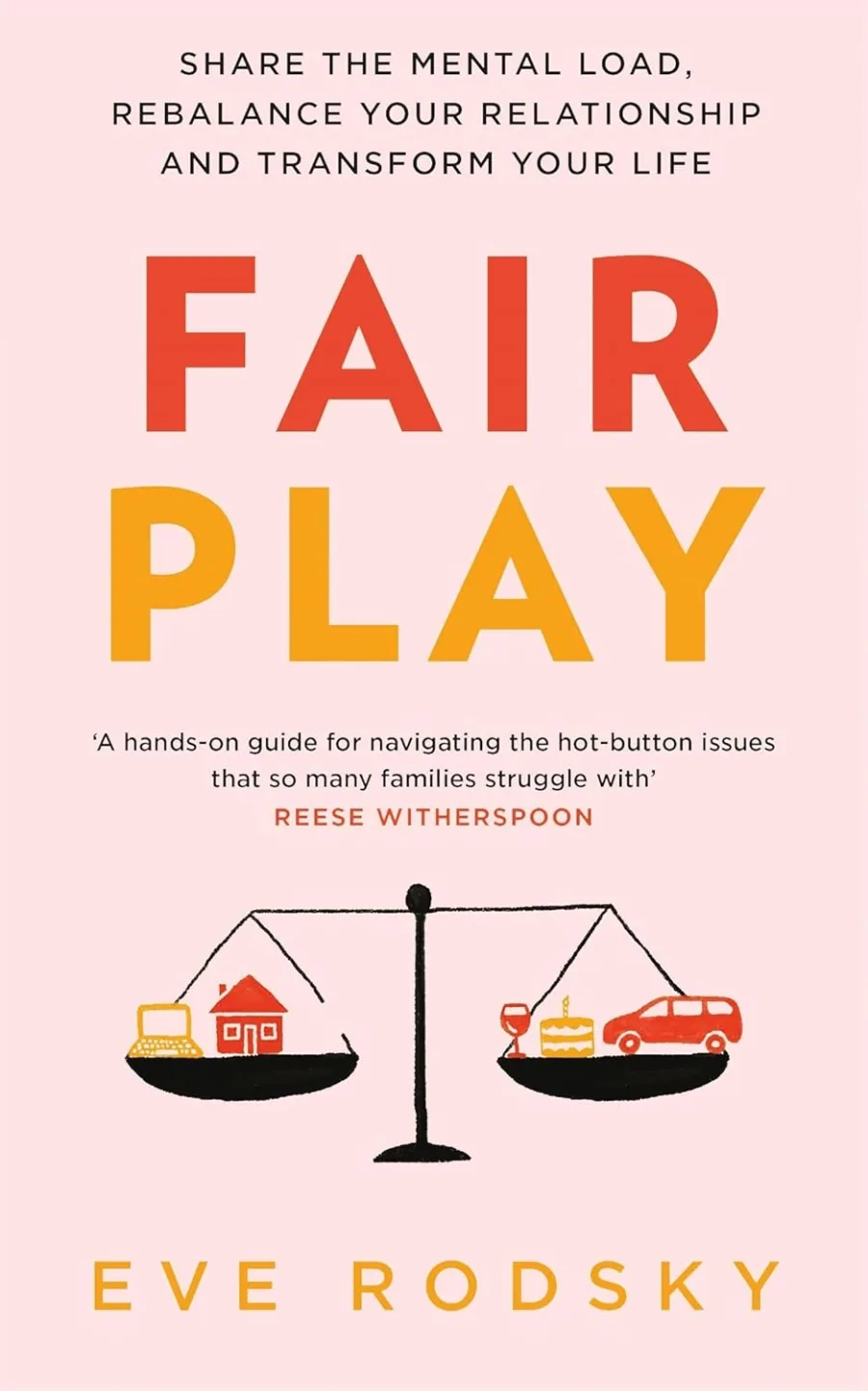
Fair Play
Paperback
• 352 Pages
• GBP 11.63
• English
• 9781529400212
No ratings yet
| Publisher | Quercus |
|---|---|
| ISBN13 | 9781529400212 |
| ASIN/SKU | 152940021X |
| Book Format | Paperback |
| Language | English |
| Pages | 352 |
| List Price | GBP 11.63 |
| Publishing Date | 05/01/2021 |
| Book Code | BD00069306 |
Buy this Book
Amazon Stores
Ebook Stores
Other Stores
Discover Fair Play by Eve Rodsky. This book is published by Quercus in Paperback format, ISBN 9781529400212, ASIN 152940021X, under Parenting and Relationships, Marriage Relationships.
Book Description
Do you find yourself taking on the lion's share of all the thankless, invisible but time-consuming work in the home? FAIR PLAY is the first book that shows you that there can be a different way: a way to get more done, with less fuss, in a way that feels more balanced.
Eve Rodsky is changing society one relationship at a time, by coming up with a 21st-century solution to an age-old problem: women shouldering the brunt of domestic responsibilities, the mental load, the emotional labour. Everything that is required to keep the fridge full, the children's homework in their bags, and the household running. The unequal division of all this invisible work in relationships is a recipe for disaster, but no one has offered a real solution to this dilemma, until now.
Eve Rodsky was tired of always being the one who has to remember to buy loo roll, or to book the family's dentist appointments, or to send the thank you cards - all while working full time. So Eve decided to do what she does every day as an organisational management consultant: Organise. She conducted original research with more than 500 couples to figure out WHAT the invisible work in a family actually is and HOW to get it done effectively and all in a way that makes relationships even stronger. FAIR PLAY identifies the 100 main tasks in any relationship, and then divides those tasks fairly (not necessarily equally) so that both parties contribute their fair share.
If we don't learn to rebalance our home life and reclaim some time to develop the skills and passions that keep us unique, then we risk losing our right to be interesting, not just to our partner, but to ourselves. Getting this right isn't a luxury, it's a necessity for a happy, lasting partnership. Part how-to guide for couples, part modern relationship manifesto, FAIR PLAY offers an innovative system with a completely original lexicon to discuss how relationships actually work ... and how we can make them work better.
Eve Rodsky is changing society one relationship at a time, by coming up with a 21st-century solution to an age-old problem: women shouldering the brunt of domestic responsibilities, the mental load, the emotional labour. Everything that is required to keep the fridge full, the children's homework in their bags, and the household running. The unequal division of all this invisible work in relationships is a recipe for disaster, but no one has offered a real solution to this dilemma, until now.
Eve Rodsky was tired of always being the one who has to remember to buy loo roll, or to book the family's dentist appointments, or to send the thank you cards - all while working full time. So Eve decided to do what she does every day as an organisational management consultant: Organise. She conducted original research with more than 500 couples to figure out WHAT the invisible work in a family actually is and HOW to get it done effectively and all in a way that makes relationships even stronger. FAIR PLAY identifies the 100 main tasks in any relationship, and then divides those tasks fairly (not necessarily equally) so that both parties contribute their fair share.
If we don't learn to rebalance our home life and reclaim some time to develop the skills and passions that keep us unique, then we risk losing our right to be interesting, not just to our partner, but to ourselves. Getting this right isn't a luxury, it's a necessity for a happy, lasting partnership. Part how-to guide for couples, part modern relationship manifesto, FAIR PLAY offers an innovative system with a completely original lexicon to discuss how relationships actually work ... and how we can make them work better.
Author Biography
This was a book I was born to write. I grew up on the lower east side of New York City with my mother Terry and my brother Josh. I saw my mother struggle as a single mom trying to do it all. I vowed that when I grew up, I would have an equal partner in life . . . and I did! I marked up his operating agreements as he grew a new business and he help me secure my dream job in philanthropy. We took turns making dinner and doing laundry. It felt great and fair.
Cut to two kids later and I found myself sobbing on the side of the road because of a text my husband sent me: “I’m surprised you didn’t get blueberries.” As I sat in my car, I thought to myself: I’m so overwhelmed I can’t even manage a grocery list (when I used to manage a team of employees)—and more importantly, when did I become the default for every single household and childcare task . . . including apparently being the fulfiller of my husband’s smoothie needs? This was not how I envisioned my life. I knew something had to change. So I embarked on a quest to find a solution for domestic rebalance not only for my marriage but for couples everywhere.
I started my journey into the “gendered division of labor” (and other related phrases like “emotional labor” and the “second shift”) by reading every book and article I could get my hands on. I was aware that women shoulder about two-thirds of the work required to run a home and raise a family but I wasn’t sure why. Early on in my research, I came across an article titled “Invisible Work,” written in 1987 by sociologist Arlene Kaplan Daniels. In it she argues that women’s unpaid “invisible” work in the home is often not seen as “work” at all and is significantly devalued. The article had a real impact on me and informed my initial quest—which was to make the invisible domestic tasks I did visible to my husband. My thinking was that it is impossible to value what’s invisible and I believed visibility would equal value. So I created a “Sh*t I Do” spreadsheet. With the help of women across the country, I catalogued every single action I took in service of my family that had a quantifiable time component. But here’s the thing—while the “Shit I Do” list illuminated how much invisible work women were doing for their families, the list also seemed to provoke more rage (and scorekeeping!) than change. I soon realized that my expertise in family mediation, law, and organizational management could be applied to this problem—to create a system to promote sustainable change and get past the resentment and rage. Fair Play is a system tested by couples from all walks of life. At its core is a card game—where couples each hold domestic task cards representing all that it takes to run a home and raise a family.
Cut to two kids later and I found myself sobbing on the side of the road because of a text my husband sent me: “I’m surprised you didn’t get blueberries.” As I sat in my car, I thought to myself: I’m so overwhelmed I can’t even manage a grocery list (when I used to manage a team of employees)—and more importantly, when did I become the default for every single household and childcare task . . . including apparently being the fulfiller of my husband’s smoothie needs? This was not how I envisioned my life. I knew something had to change. So I embarked on a quest to find a solution for domestic rebalance not only for my marriage but for couples everywhere.
I started my journey into the “gendered division of labor” (and other related phrases like “emotional labor” and the “second shift”) by reading every book and article I could get my hands on. I was aware that women shoulder about two-thirds of the work required to run a home and raise a family but I wasn’t sure why. Early on in my research, I came across an article titled “Invisible Work,” written in 1987 by sociologist Arlene Kaplan Daniels. In it she argues that women’s unpaid “invisible” work in the home is often not seen as “work” at all and is significantly devalued. The article had a real impact on me and informed my initial quest—which was to make the invisible domestic tasks I did visible to my husband. My thinking was that it is impossible to value what’s invisible and I believed visibility would equal value. So I created a “Sh*t I Do” spreadsheet. With the help of women across the country, I catalogued every single action I took in service of my family that had a quantifiable time component. But here’s the thing—while the “Shit I Do” list illuminated how much invisible work women were doing for their families, the list also seemed to provoke more rage (and scorekeeping!) than change. I soon realized that my expertise in family mediation, law, and organizational management could be applied to this problem—to create a system to promote sustainable change and get past the resentment and rage. Fair Play is a system tested by couples from all walks of life. At its core is a card game—where couples each hold domestic task cards representing all that it takes to run a home and raise a family.
Editorial Reviews
I'm so impressed with the Fair Play handbook.
Not only did Eve break down every task
that a couple is responsible for, but she managed
to create a system where dividing those
tasks is fun, insightful, and gratifying. Her
approach is filled with love, humor, wisdom,
and the idea that if we can work together
and acknowledge each other's strengths and
weaknesses, we can build better, stronger,
and longer-lasting relationships.
-- Reese Witherspoon
Fair Play is a game-changing guide to reclaiming
more time in our lives by dividing
domestic work in a deceptively simple new
way. This system of dealing virtual 'cards' to
share the work it takes to run a household is
revolutionary and can help you succeed and
truly thrive in all aspects of your life!
-- Arianna Huffington, founder and CEO Thrive Global
Fair Play gives us permission to create our
own values that introduce equity into our
households. Imagine what could be different
about you, your relationships, and the world,
if we collectively decided to play fair.
-- Alexis Jemal, JD, LCSW, PhD, assistant professor, Silberman School of Social Work, Hunter College
There are three 'people' in every busy relationship:
Person A, Person B, and the system
that governs them. When things feel overwhelming,
most people point at themselves
or their partner to explain it, but more often
than not the system itself is the problem.
This is brilliantly illustrated in Fair Play,
where Eve Rodsky makes the existing system
visible and provides a clear path to build
a new one that enables readers to focus on
what their family values most.
-- Greg McKeown, author of Essentialism
Fair Play is what every busy parent needs to
shed resentment, move beyond blame, and
reconnect with each other. By easing the
home burdens and working collaboratively,
parents will fi nd the key to a happier marriage
and more family joy.
-- Tovah Klein, PhD, author of How Toddlers Thrive
If your family is struggling to achieve a
happy division of household labor, read this
book. Fair Play offers practical tools for
maximizing peace and minimizing resentment-
while freeing up all parties to pursue.
Not only did Eve break down every task
that a couple is responsible for, but she managed
to create a system where dividing those
tasks is fun, insightful, and gratifying. Her
approach is filled with love, humor, wisdom,
and the idea that if we can work together
and acknowledge each other's strengths and
weaknesses, we can build better, stronger,
and longer-lasting relationships.
-- Reese Witherspoon
Fair Play is a game-changing guide to reclaiming
more time in our lives by dividing
domestic work in a deceptively simple new
way. This system of dealing virtual 'cards' to
share the work it takes to run a household is
revolutionary and can help you succeed and
truly thrive in all aspects of your life!
-- Arianna Huffington, founder and CEO Thrive Global
Fair Play gives us permission to create our
own values that introduce equity into our
households. Imagine what could be different
about you, your relationships, and the world,
if we collectively decided to play fair.
-- Alexis Jemal, JD, LCSW, PhD, assistant professor, Silberman School of Social Work, Hunter College
There are three 'people' in every busy relationship:
Person A, Person B, and the system
that governs them. When things feel overwhelming,
most people point at themselves
or their partner to explain it, but more often
than not the system itself is the problem.
This is brilliantly illustrated in Fair Play,
where Eve Rodsky makes the existing system
visible and provides a clear path to build
a new one that enables readers to focus on
what their family values most.
-- Greg McKeown, author of Essentialism
Fair Play is what every busy parent needs to
shed resentment, move beyond blame, and
reconnect with each other. By easing the
home burdens and working collaboratively,
parents will fi nd the key to a happier marriage
and more family joy.
-- Tovah Klein, PhD, author of How Toddlers Thrive
If your family is struggling to achieve a
happy division of household labor, read this
book. Fair Play offers practical tools for
maximizing peace and minimizing resentment-
while freeing up all parties to pursue.
Book Summary
Book Summary will be added soon…
Sample Chapters
Sample Chapters will be added soon…
Reader Reviews
No reviews yet.
Fair Play