
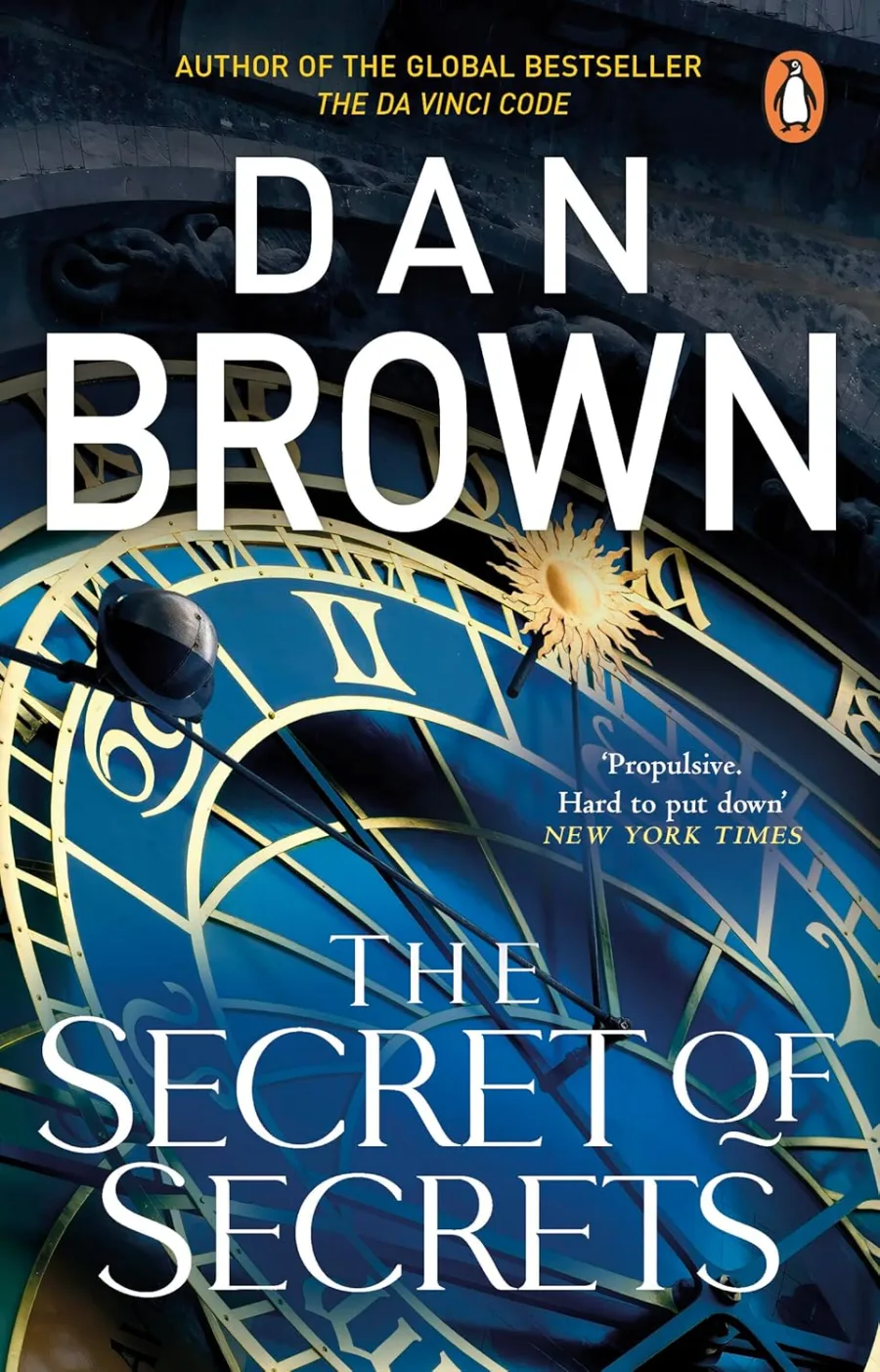
The Secret of Secrets
eBook
• 681 Pages
• GBP 6.99
• English
• 9781473589681
No ratings yet
| Publisher | Transworld Digital |
|---|---|
| ISBN13 | 9781473589681 |
| ASIN/SKU | B0DSWC1YYL |
| Book Format | eBook |
| Language | English |
| Pages | 681 |
| List Price | GBP 6.99 |
| Publishing Date | 09/09/2025 |
| Book Code | BD00067152 |
Buy this Book
Amazon Stores
Ebook Stores
Other Stores
Discover The Secret of Secrets by Dan Brown. This book is published by Transworld Digital in eBook format, ISBN 9781473589681, ASIN B0DSWC1YYL, under Mystery, Thriller and Suspense, Espionage Thrillers, Spy Stories and Tales of Intrigue.
Book Description
Accompanying celebrated academic, Katherine Solomon, to a lecture she’s been invited to give in Prague, Robert Langdon’s world spirals out of control when she disappears without trace from their hotel room. Far from home and out of his comfort zone, Langdon must pit his wits against forces unknown to recover the woman he loves.
But Prague is an old and dangerous place, steeped in folklore and mystery. Little can Langdon know that he is being stalked by a spectre from that dark past. He must use all of his arcane knowledge to navigate a shadow city hiding in plain sight, a city which has successfully kept its secrets for centuries and will not readily give them up...
Dan Brown returns with his first novel in more than eight years - guaranteed to have you at the edge of your seat. This time, Robert Langdon is up against a deadly conspiracy that will test him to the limits - and take him to the edge of losing everything.
But Prague is an old and dangerous place, steeped in folklore and mystery. Little can Langdon know that he is being stalked by a spectre from that dark past. He must use all of his arcane knowledge to navigate a shadow city hiding in plain sight, a city which has successfully kept its secrets for centuries and will not readily give them up...
Dan Brown returns with his first novel in more than eight years - guaranteed to have you at the edge of your seat. This time, Robert Langdon is up against a deadly conspiracy that will test him to the limits - and take him to the edge of losing everything.
Author Biography
Dan Brown is the author of eight #1 bestselling novels, including The Da Vinci Code, which has become one of the bestselling novels of all time as well as the subject of intellectual debate among readers and scholars. Brown’s novels are published in 56 languages around the world with over 250 million copies in print.
Brown was named one of the 100 Most Influential People in the World by TIME Magazine, whose editors credited him with “keeping the publishing industry afloat; renewed interest in Leonardo da Vinci and early Christian history; spiking tourism to Paris and Rome; a growing membership in secret societies; the ire of Cardinals in Rome; eight books denying the claims of the novel and seven guides to read along with it; a flood of historical thrillers; and a major motion picture franchise.”
The son of a mathematics teacher and a church organist, Brown was raised on a prep school campus where he developed a fascination with the paradoxical interplay between science and religion. These themes eventually formed the backdrop for his books. He is a graduate of Amherst College and Phillips Exeter Academy, where he later returned to teach English before focusing his attention full time to writing. He lives in New England.
Brown was named one of the 100 Most Influential People in the World by TIME Magazine, whose editors credited him with “keeping the publishing industry afloat; renewed interest in Leonardo da Vinci and early Christian history; spiking tourism to Paris and Rome; a growing membership in secret societies; the ire of Cardinals in Rome; eight books denying the claims of the novel and seven guides to read along with it; a flood of historical thrillers; and a major motion picture franchise.”
The son of a mathematics teacher and a church organist, Brown was raised on a prep school campus where he developed a fascination with the paradoxical interplay between science and religion. These themes eventually formed the backdrop for his books. He is a graduate of Amherst College and Phillips Exeter Academy, where he later returned to teach English before focusing his attention full time to writing. He lives in New England.
Editorial Reviews
Editorial Reviews will be added soon…
Book Summary
The Secret of Secrets by Dan Brown is a fast-paced thriller that blends mystery, history, science, religion, and symbolism in the style that has made the author famous around the world. The novel follows Harvard professor Robert Langdon as he becomes entangled in another dangerous adventure involving hidden knowledge, powerful organizations, and long-buried secrets that could reshape humanity's understanding of the past and the future. Like Brown's previous novels, the story combines real historical references with fictional events, creating a suspenseful narrative that keeps readers questioning what is fact and what is imagination.
The novel begins with Langdon being drawn into an unexpected situation after receiving an invitation connected to a groundbreaking discovery. What initially appears to be an academic event quickly turns into a life-threatening mystery when violence erupts and the people involved become targets. Langdon soon realizes that the discovery is linked to an ancient secret that many powerful individuals and organizations have spent centuries trying to protect or suppress. With little time to understand what is happening, he is forced to flee while trying to uncover the truth before it disappears forever.
As Langdon follows a trail of clues, he finds himself solving complex puzzles hidden in historical artifacts, architecture, ancient manuscripts, and symbolic works of art. His expertise in religious iconography and symbolism allows him to recognize patterns that others overlook. Each clue reveals another layer of the mystery, leading him across famous locations rich in history and culture. The settings are described in vivid detail, making the journey feel as much like an exploration of human civilization as a thrilling chase.
Throughout the story, Langdon is joined by intelligent allies who possess specialized knowledge in fields such as science, technology, archaeology, and linguistics. Together they attempt to interpret mysterious codes while avoiding dangerous enemies who are determined to stop them. Their collaboration highlights the importance of combining different forms of knowledge to solve problems that cannot be understood from a single perspective. Trust, however, becomes a recurring challenge, as not everyone is who they claim to be, and hidden motives constantly threaten the group's survival.
One of the novel's central ideas is the relationship between science and faith. Rather than presenting these two perspectives as direct opposites, the story explores how both seek answers to humanity's biggest questions. Scientific discoveries challenge traditional beliefs, while ancient spiritual traditions offer interpretations that cannot always be measured through experiments alone. Brown encourages readers to consider whether knowledge and belief can coexist instead of competing with one another. The mystery gradually reveals that some of history's greatest secrets may exist in the space where science, philosophy, and religion intersect.
The title, The Secret of Secrets, reflects the search for knowledge that has been hidden across generations. The novel examines humanity's endless desire to understand where we come from, what our purpose is, and whether there are truths that have been deliberately concealed. Characters throughout the story are motivated by curiosity, ambition, fear, or a desire for power, showing that knowledge itself is neither good nor evil. Instead, the consequences depend on how people choose to use it. Some characters believe that revealing the truth would benefit humanity, while others fear that certain discoveries could create chaos if they became public.
As the investigation progresses, Langdon uncovers connections between ancient civilizations, forgotten societies, religious traditions, and modern scientific research. Brown blends historical facts with imaginative fiction, encouraging readers to explore real historical topics long after finishing the novel. Symbols that initially appear unrelated gradually fit together like pieces of a giant puzzle. Every discovery raises new questions, keeping the suspense alive while revealing the remarkable ways in which ideas can survive across centuries through art, myths, architecture, and literature.
The novel also explores themes of secrecy and control. Powerful institutions often justify keeping information hidden by claiming it protects society, while others argue that knowledge should always be freely available. This conflict creates moral dilemmas for the characters, who must decide whether exposing the truth is worth the risks involved. Brown does not present easy answers but instead invites readers to think critically about authority, censorship, and humanity's responsibility when handling transformative discoveries.
The pacing remains consistently fast, with chapters ending on suspenseful moments that encourage readers to continue. Unexpected twists, hidden identities, betrayals, and carefully timed revelations ensure that the mystery continues evolving until the final chapters. Brown's writing balances action with intellectual challenges, making the novel appealing to readers who enjoy both adventure and thought-provoking ideas. The puzzles are not merely obstacles but essential parts of the story, requiring logical reasoning, historical knowledge, and careful observation.
Another important theme is the enduring power of curiosity. Langdon's greatest strength is not physical ability but his willingness to ask questions and search for meaning beneath the surface. His respect for history and his ability to connect seemingly unrelated ideas demonstrate that understanding often comes from patience, observation, and open-minded thinking rather than quick conclusions. The novel suggests that humanity's greatest achievements have often resulted from individuals who dared to question accepted beliefs.
By the conclusion, many of the mysteries are resolved, but the novel leaves readers reflecting on larger philosophical questions about truth, knowledge, and the future of civilization. The ending emphasizes that every answer leads to new questions and that the pursuit of understanding is an endless journey rather than a final destination. Brown reinforces the idea that history is filled with hidden stories waiting to be uncovered and that curiosity remains one of humanity's most powerful qualities.
Overall, The Secret of Secrets is an engaging blend of historical fiction, mystery, adventure, and intellectual exploration. Through Robert Langdon's investigation, Dan Brown creates a story that entertains while encouraging readers to think deeply about history, science, religion, and the hidden connections that shape human civilization. The novel combines suspense, memorable locations, complex puzzles, and philosophical themes into a compelling narrative that celebrates the timeless human desire to seek truth, even when that truth is hidden beneath centuries of secrecy.
The novel begins with Langdon being drawn into an unexpected situation after receiving an invitation connected to a groundbreaking discovery. What initially appears to be an academic event quickly turns into a life-threatening mystery when violence erupts and the people involved become targets. Langdon soon realizes that the discovery is linked to an ancient secret that many powerful individuals and organizations have spent centuries trying to protect or suppress. With little time to understand what is happening, he is forced to flee while trying to uncover the truth before it disappears forever.
As Langdon follows a trail of clues, he finds himself solving complex puzzles hidden in historical artifacts, architecture, ancient manuscripts, and symbolic works of art. His expertise in religious iconography and symbolism allows him to recognize patterns that others overlook. Each clue reveals another layer of the mystery, leading him across famous locations rich in history and culture. The settings are described in vivid detail, making the journey feel as much like an exploration of human civilization as a thrilling chase.
Throughout the story, Langdon is joined by intelligent allies who possess specialized knowledge in fields such as science, technology, archaeology, and linguistics. Together they attempt to interpret mysterious codes while avoiding dangerous enemies who are determined to stop them. Their collaboration highlights the importance of combining different forms of knowledge to solve problems that cannot be understood from a single perspective. Trust, however, becomes a recurring challenge, as not everyone is who they claim to be, and hidden motives constantly threaten the group's survival.
One of the novel's central ideas is the relationship between science and faith. Rather than presenting these two perspectives as direct opposites, the story explores how both seek answers to humanity's biggest questions. Scientific discoveries challenge traditional beliefs, while ancient spiritual traditions offer interpretations that cannot always be measured through experiments alone. Brown encourages readers to consider whether knowledge and belief can coexist instead of competing with one another. The mystery gradually reveals that some of history's greatest secrets may exist in the space where science, philosophy, and religion intersect.
The title, The Secret of Secrets, reflects the search for knowledge that has been hidden across generations. The novel examines humanity's endless desire to understand where we come from, what our purpose is, and whether there are truths that have been deliberately concealed. Characters throughout the story are motivated by curiosity, ambition, fear, or a desire for power, showing that knowledge itself is neither good nor evil. Instead, the consequences depend on how people choose to use it. Some characters believe that revealing the truth would benefit humanity, while others fear that certain discoveries could create chaos if they became public.
As the investigation progresses, Langdon uncovers connections between ancient civilizations, forgotten societies, religious traditions, and modern scientific research. Brown blends historical facts with imaginative fiction, encouraging readers to explore real historical topics long after finishing the novel. Symbols that initially appear unrelated gradually fit together like pieces of a giant puzzle. Every discovery raises new questions, keeping the suspense alive while revealing the remarkable ways in which ideas can survive across centuries through art, myths, architecture, and literature.
The novel also explores themes of secrecy and control. Powerful institutions often justify keeping information hidden by claiming it protects society, while others argue that knowledge should always be freely available. This conflict creates moral dilemmas for the characters, who must decide whether exposing the truth is worth the risks involved. Brown does not present easy answers but instead invites readers to think critically about authority, censorship, and humanity's responsibility when handling transformative discoveries.
The pacing remains consistently fast, with chapters ending on suspenseful moments that encourage readers to continue. Unexpected twists, hidden identities, betrayals, and carefully timed revelations ensure that the mystery continues evolving until the final chapters. Brown's writing balances action with intellectual challenges, making the novel appealing to readers who enjoy both adventure and thought-provoking ideas. The puzzles are not merely obstacles but essential parts of the story, requiring logical reasoning, historical knowledge, and careful observation.
Another important theme is the enduring power of curiosity. Langdon's greatest strength is not physical ability but his willingness to ask questions and search for meaning beneath the surface. His respect for history and his ability to connect seemingly unrelated ideas demonstrate that understanding often comes from patience, observation, and open-minded thinking rather than quick conclusions. The novel suggests that humanity's greatest achievements have often resulted from individuals who dared to question accepted beliefs.
By the conclusion, many of the mysteries are resolved, but the novel leaves readers reflecting on larger philosophical questions about truth, knowledge, and the future of civilization. The ending emphasizes that every answer leads to new questions and that the pursuit of understanding is an endless journey rather than a final destination. Brown reinforces the idea that history is filled with hidden stories waiting to be uncovered and that curiosity remains one of humanity's most powerful qualities.
Overall, The Secret of Secrets is an engaging blend of historical fiction, mystery, adventure, and intellectual exploration. Through Robert Langdon's investigation, Dan Brown creates a story that entertains while encouraging readers to think deeply about history, science, religion, and the hidden connections that shape human civilization. The novel combines suspense, memorable locations, complex puzzles, and philosophical themes into a compelling narrative that celebrates the timeless human desire to seek truth, even when that truth is hidden beneath centuries of secrecy.
Sample Chapters
Sample Chapters will be added soon…
Reader Reviews
No reviews yet.
The Secret of Secrets
Download Cover Image
Do you want to download the full cover image for The Secret of Secrets?