
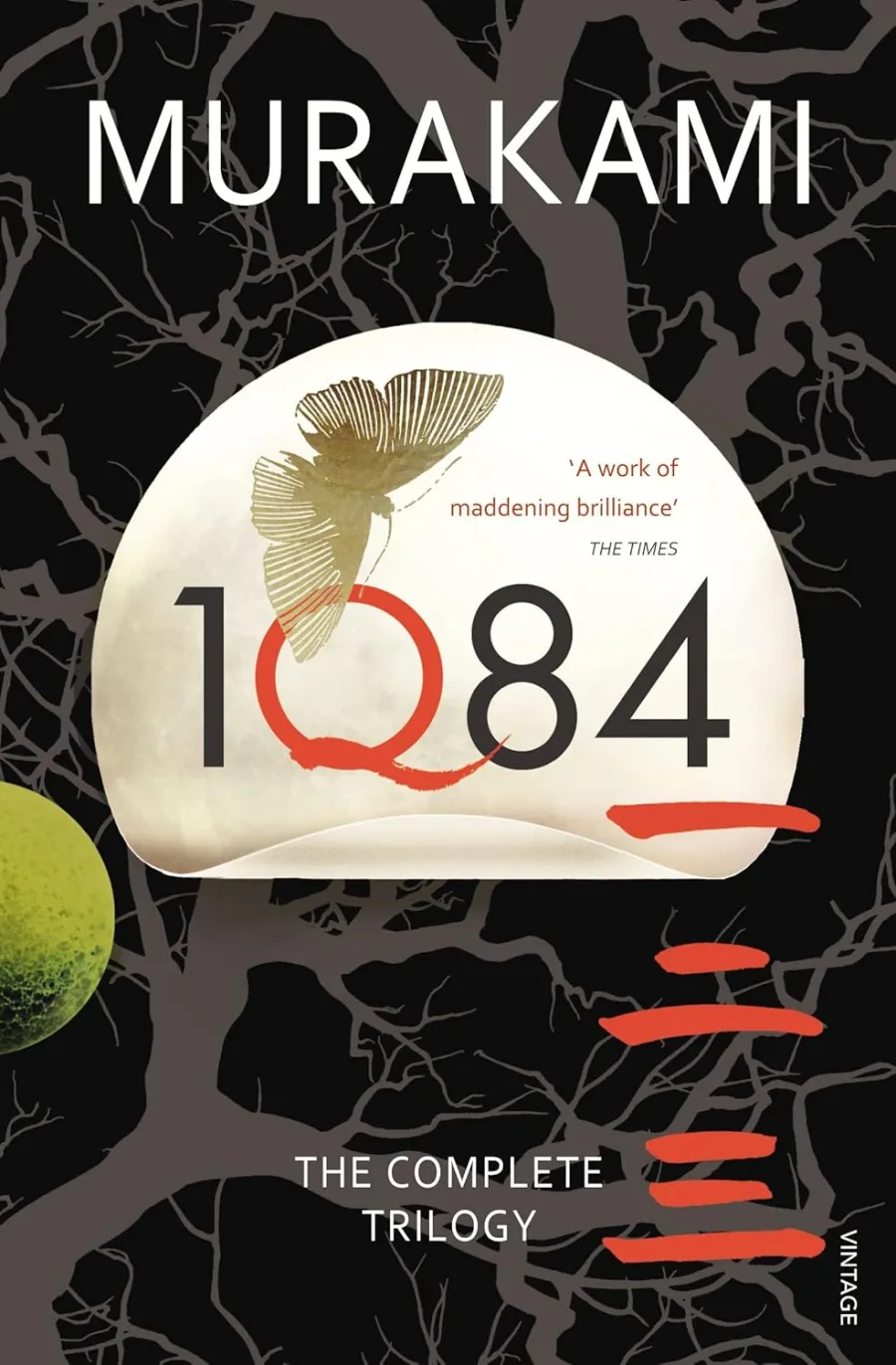
1Q84: The Complete Trilogy
eBook
• 1332 Pages
• GBP 0.99
• English
• 9781529198553
No ratings yet
| Publisher | Vintage Digital |
|---|---|
| ISBN13 | 9781529198553 |
| ASIN/SKU | B09TGQY46G |
| Book Format | eBook |
| Language | English |
| Pages | 1332 |
| List Price | GBP 0.99 |
| Publishing Date | 10/03/2026 |
| Book Code | BD00067119 |
Buy this Book
Amazon Stores
Ebook Stores
Other Stores
Discover 1Q84: The Complete Trilogy by Haruki Murakami. This book is published by Vintage Digital in eBook format, ISBN 9781529198553, ASIN B09TGQY46G, under Romance, Science Fiction.
Book Description
In 1978, Haruki Murakami was twenty-nine and running a jazz bar in downtown Tokyo. One April day, the impulse to write a novel came to him suddenly while watching a baseball game. That first novel, Hear the Wind Sing, won a new writers' award and was published the following year. More followed, including A Wild Sheep Chase and Hard-Boiled Wonderland and the End of the World, but it was Norwegian Wood, published in 1987, that turned Murakami from a writer into a phenomenon.
In works such as The Wind-Up Bird Chronicle, 1Q84, What I Talk About When I Talk About Running and Men Without Women, Murakami's distinctive blend of the mysterious and the everyday, of melancholy and humour, continues to enchant readers, ensuring his place as one of the world's most acclaimed and well-loved writers.
In works such as The Wind-Up Bird Chronicle, 1Q84, What I Talk About When I Talk About Running and Men Without Women, Murakami's distinctive blend of the mysterious and the everyday, of melancholy and humour, continues to enchant readers, ensuring his place as one of the world's most acclaimed and well-loved writers.
Author Biography
In 1978, Haruki Murakami was twenty-nine and running a jazz bar in downtown Tokyo. One April day, the impulse to write a novel came to him suddenly while watching a baseball game. That first novel, Hear the Wind Sing, won a new writers' award and was published the following year. More followed, including A Wild Sheep Chase and Hard-Boiled Wonderland and the End of the World, but it was Norwegian Wood, published in 1987, that turned Murakami from a writer into a phenomenon.
In works such as The Wind-Up Bird Chronicle, 1Q84, What I Talk About When I Talk About Running and Men Without Women, Murakami's distinctive blend of the mysterious and the everyday, of melancholy and humour, continues to enchant readers, ensuring his place as one of the world's most acclaimed and well-loved writers.
In works such as The Wind-Up Bird Chronicle, 1Q84, What I Talk About When I Talk About Running and Men Without Women, Murakami's distinctive blend of the mysterious and the everyday, of melancholy and humour, continues to enchant readers, ensuring his place as one of the world's most acclaimed and well-loved writers.
Editorial Reviews
Murakami's magnum opus — Japan Times
1Q84 has a range and sophistication that surpasses anything else in his oeuvre. It is his most achieved novel; an epic in which form and content are neatly aligned... So like Murakami himself, I'll borrow from Orwell: 1Q84 is quite simply doubleplusgood — Independent on Sunday
1Q84 reads like a cross between Stieg Larsson and Roberto Bolano... In its bones, this novel is a thriller — Daily Telegraph
Eerie, suspenseful and packed full of gorgeous ordinary details and provocative extraordinary events, Murakami takes weighty themes and delivers a compulsive tale that is funny, fresh and intensely surreal. Unmissable. — Marie Claire
It is a work of maddening brilliance and gripping originality, deceptively casual in style, but vibrating with wit, intellect and ambition — The Times
Which other author can remind you simultaneously of Fyodor Dostoyevsky and JK Rowling, not merely within the same chapter but on the same page? Viewed through the "post-modern" lens, his exemplary blend of a light touch and weighty themes, of high literature and popular entertainment, ticks every box. Posh and pop, sublimity and superficiality, history and fantasy, trash and transcendence: they switch positions and then fuse — Independent
A postmodernist mélange of fantasy worlds, dystopias, alternate realities and genre pastiches, all overlaid on an unsuspecting contemporary Japan. They are the sort of fiction that usually attracts a cult following, but Mr Murakami's cult spreads across the globe — Wall Street Journal
A surreal twist on the formula of David Nicholl's One Day; fate preventing two soulmates from getting together from getting together for decades... Stieg Larsson enthusiasts may enjoy the novel too as Aomame could be Lisbeth Salader's Japanese cousin... What makes Murakami cool as well as popular is has metaphysical mischievousness, his playing around with the idea of alternate realities... Every time you open 1Q84, you get the sensation of falling down the rabbit hole, into a unique and addictive world — Sunday Express
The novel of the year... such are Murakami's gifts, both in terms of his imagination and his skills as a writer, that the near-magical world he conjures seems real and tangible — Word
His default setting as a writer lies in documenting a muted alienation - Kafka with an iPod - and solace, in his books, tends to be found in the sudden human connection of sex and longing, but mostly his characters, like his readers, are left to figure things out on their own with shifting and partial information to go on — Observer
1Q84 has a range and sophistication that surpasses anything else in his oeuvre. It is his most achieved novel; an epic in which form and content are neatly aligned... So like Murakami himself, I'll borrow from Orwell: 1Q84 is quite simply doubleplusgood — Independent on Sunday
1Q84 reads like a cross between Stieg Larsson and Roberto Bolano... In its bones, this novel is a thriller — Daily Telegraph
Eerie, suspenseful and packed full of gorgeous ordinary details and provocative extraordinary events, Murakami takes weighty themes and delivers a compulsive tale that is funny, fresh and intensely surreal. Unmissable. — Marie Claire
It is a work of maddening brilliance and gripping originality, deceptively casual in style, but vibrating with wit, intellect and ambition — The Times
Which other author can remind you simultaneously of Fyodor Dostoyevsky and JK Rowling, not merely within the same chapter but on the same page? Viewed through the "post-modern" lens, his exemplary blend of a light touch and weighty themes, of high literature and popular entertainment, ticks every box. Posh and pop, sublimity and superficiality, history and fantasy, trash and transcendence: they switch positions and then fuse — Independent
A postmodernist mélange of fantasy worlds, dystopias, alternate realities and genre pastiches, all overlaid on an unsuspecting contemporary Japan. They are the sort of fiction that usually attracts a cult following, but Mr Murakami's cult spreads across the globe — Wall Street Journal
A surreal twist on the formula of David Nicholl's One Day; fate preventing two soulmates from getting together from getting together for decades... Stieg Larsson enthusiasts may enjoy the novel too as Aomame could be Lisbeth Salader's Japanese cousin... What makes Murakami cool as well as popular is has metaphysical mischievousness, his playing around with the idea of alternate realities... Every time you open 1Q84, you get the sensation of falling down the rabbit hole, into a unique and addictive world — Sunday Express
The novel of the year... such are Murakami's gifts, both in terms of his imagination and his skills as a writer, that the near-magical world he conjures seems real and tangible — Word
His default setting as a writer lies in documenting a muted alienation - Kafka with an iPod - and solace, in his books, tends to be found in the sudden human connection of sex and longing, but mostly his characters, like his readers, are left to figure things out on their own with shifting and partial information to go on — Observer
Book Summary
1Q84: The Complete Trilogy by Haruki Murakami is a sprawling and imaginative novel that blends mystery, romance, fantasy, and psychological drama into a deeply emotional story. Set primarily in Tokyo during 1984, the novel gradually shifts into an alternate version of reality that one of its main characters calls "1Q84," with the "Q" standing for a question mark. It represents a world that looks almost identical to the familiar one but contains subtle yet unsettling differences. Through this strange setting, Murakami explores themes of love, loneliness, memory, fate, identity, and the invisible forces that shape people's lives.
The story follows two central characters, Aomame and Tengo, whose lives seem separate at first but become increasingly connected as the novel unfolds. Aomame is a fitness instructor who also carries out secret missions as an assassin, targeting men who have committed terrible acts of abuse against women. Calm, intelligent, and highly disciplined, she believes she is delivering justice where the legal system has failed. Her life changes dramatically after a mysterious taxi driver advises her to take an emergency stairway off a crowded expressway. This seemingly ordinary decision leads her into a slightly altered version of reality. She begins noticing strange inconsistencies, including differences in police equipment and the appearance of two moons in the night sky. Realizing that she has somehow entered another world, she names it 1Q84.
Tengo, meanwhile, is a mathematics teacher and aspiring novelist. Quiet and thoughtful, he spends much of his time balancing his teaching career with his dream of becoming a writer. His editor offers him an unusual opportunity: to rewrite a manuscript titled Air Chrysalis, written by a shy seventeen-year-old girl named Fuka-Eri. Although the story is rough and incomplete, it possesses an extraordinary imagination. Tengo transforms the manuscript into a polished novel, and it becomes a literary sensation. However, this success also pulls him into a web of mysteries connected to Fuka-Eri, her past, and a strange religious organization known as Sakigake.
As Tengo investigates further, he discovers that Air Chrysalis is far more than fiction. The novel describes mysterious supernatural beings called the Little People, who seem capable of influencing reality itself. The boundary between imagination and truth gradually disappears, and Tengo realizes that by rewriting the manuscript, he may have helped reshape the world around him. The Little People remain one of the novel's most mysterious elements, never fully explained, embodying forces that exist beyond ordinary human understanding.
Aomame's path also becomes entangled with Sakigake. She is assigned to assassinate the cult's powerful Leader, who possesses unusual abilities and maintains a disturbing influence over his followers. As she gets closer to him, she learns that the Leader has a complicated relationship with the Little People and the strange events transforming the world. Their confrontation becomes one of the novel's most significant moments, forcing Aomame to make difficult moral choices while deepening the mystery surrounding 1Q84.
Running beneath these supernatural events is the enduring connection between Aomame and Tengo. As children, they briefly held hands in elementary school, creating a bond that neither of them ever forgot. Though they have spent decades apart, each quietly carries the memory of the other throughout adulthood. Neither has been able to form truly satisfying relationships because they continue searching, consciously or unconsciously, for the person who once gave them hope. Their longing becomes the emotional heart of the novel, giving warmth and humanity to an otherwise surreal story.
The narrative also introduces several memorable supporting characters. Ushikawa, an unconventional private investigator, begins searching for both Aomame and Tengo. Though he initially appears unsettling and even comic, he develops into a surprisingly complex figure whose investigation reveals many hidden connections. Fuka-Eri remains an enigmatic presence, offering clues without ever fully explaining the mysteries surrounding her. Dowager, Tamaru, and other secondary characters each contribute to the themes of justice, loyalty, survival, and the hidden struggles people carry beneath ordinary lives.
As the story progresses, the tension steadily increases. Aomame hides in a safe apartment while waiting for the right moment to reunite with Tengo, believing that powerful enemies are searching for her. Tengo continues trying to understand the strange reality surrounding him while caring for his aging father, whose declining health forces him to confront painful memories from childhood. Throughout these experiences, Murakami explores how memory shapes identity and how the past continues to influence the present, even when people try to escape it.
The world of 1Q84 grows increasingly dreamlike, yet the emotional stakes remain grounded in the characters' desire for connection and meaning. Murakami mixes ordinary daily routines with surreal events so naturally that readers are encouraged to question what is real and what exists only within the imagination. Music, literature, nature, and silence all become important symbols, creating an atmosphere that is both peaceful and unsettling.
In the final part of the trilogy, Aomame and Tengo move ever closer to each other despite numerous dangers and obstacles. Their search becomes not only a physical journey but also a spiritual one, as they attempt to find certainty within a world that constantly shifts around them. The mysteries of the Little People and the alternate reality are never explained in complete detail, allowing the novel to retain its dreamlike quality. Instead of offering simple answers, Murakami emphasizes emotional truth over logical certainty.
Ultimately, 1Q84 is less about solving supernatural mysteries than about exploring the enduring power of love, hope, and human connection. Through its blend of magical realism, suspense, philosophical reflection, and deeply personal storytelling, the novel suggests that even in a confusing and uncertain world, the bonds formed between people can become a guiding force. Rich with symbolism and unforgettable imagery, the trilogy invites readers to embrace ambiguity while believing that compassion, courage, and love can help people find their way through even the strangest realities.
The story follows two central characters, Aomame and Tengo, whose lives seem separate at first but become increasingly connected as the novel unfolds. Aomame is a fitness instructor who also carries out secret missions as an assassin, targeting men who have committed terrible acts of abuse against women. Calm, intelligent, and highly disciplined, she believes she is delivering justice where the legal system has failed. Her life changes dramatically after a mysterious taxi driver advises her to take an emergency stairway off a crowded expressway. This seemingly ordinary decision leads her into a slightly altered version of reality. She begins noticing strange inconsistencies, including differences in police equipment and the appearance of two moons in the night sky. Realizing that she has somehow entered another world, she names it 1Q84.
Tengo, meanwhile, is a mathematics teacher and aspiring novelist. Quiet and thoughtful, he spends much of his time balancing his teaching career with his dream of becoming a writer. His editor offers him an unusual opportunity: to rewrite a manuscript titled Air Chrysalis, written by a shy seventeen-year-old girl named Fuka-Eri. Although the story is rough and incomplete, it possesses an extraordinary imagination. Tengo transforms the manuscript into a polished novel, and it becomes a literary sensation. However, this success also pulls him into a web of mysteries connected to Fuka-Eri, her past, and a strange religious organization known as Sakigake.
As Tengo investigates further, he discovers that Air Chrysalis is far more than fiction. The novel describes mysterious supernatural beings called the Little People, who seem capable of influencing reality itself. The boundary between imagination and truth gradually disappears, and Tengo realizes that by rewriting the manuscript, he may have helped reshape the world around him. The Little People remain one of the novel's most mysterious elements, never fully explained, embodying forces that exist beyond ordinary human understanding.
Aomame's path also becomes entangled with Sakigake. She is assigned to assassinate the cult's powerful Leader, who possesses unusual abilities and maintains a disturbing influence over his followers. As she gets closer to him, she learns that the Leader has a complicated relationship with the Little People and the strange events transforming the world. Their confrontation becomes one of the novel's most significant moments, forcing Aomame to make difficult moral choices while deepening the mystery surrounding 1Q84.
Running beneath these supernatural events is the enduring connection between Aomame and Tengo. As children, they briefly held hands in elementary school, creating a bond that neither of them ever forgot. Though they have spent decades apart, each quietly carries the memory of the other throughout adulthood. Neither has been able to form truly satisfying relationships because they continue searching, consciously or unconsciously, for the person who once gave them hope. Their longing becomes the emotional heart of the novel, giving warmth and humanity to an otherwise surreal story.
The narrative also introduces several memorable supporting characters. Ushikawa, an unconventional private investigator, begins searching for both Aomame and Tengo. Though he initially appears unsettling and even comic, he develops into a surprisingly complex figure whose investigation reveals many hidden connections. Fuka-Eri remains an enigmatic presence, offering clues without ever fully explaining the mysteries surrounding her. Dowager, Tamaru, and other secondary characters each contribute to the themes of justice, loyalty, survival, and the hidden struggles people carry beneath ordinary lives.
As the story progresses, the tension steadily increases. Aomame hides in a safe apartment while waiting for the right moment to reunite with Tengo, believing that powerful enemies are searching for her. Tengo continues trying to understand the strange reality surrounding him while caring for his aging father, whose declining health forces him to confront painful memories from childhood. Throughout these experiences, Murakami explores how memory shapes identity and how the past continues to influence the present, even when people try to escape it.
The world of 1Q84 grows increasingly dreamlike, yet the emotional stakes remain grounded in the characters' desire for connection and meaning. Murakami mixes ordinary daily routines with surreal events so naturally that readers are encouraged to question what is real and what exists only within the imagination. Music, literature, nature, and silence all become important symbols, creating an atmosphere that is both peaceful and unsettling.
In the final part of the trilogy, Aomame and Tengo move ever closer to each other despite numerous dangers and obstacles. Their search becomes not only a physical journey but also a spiritual one, as they attempt to find certainty within a world that constantly shifts around them. The mysteries of the Little People and the alternate reality are never explained in complete detail, allowing the novel to retain its dreamlike quality. Instead of offering simple answers, Murakami emphasizes emotional truth over logical certainty.
Ultimately, 1Q84 is less about solving supernatural mysteries than about exploring the enduring power of love, hope, and human connection. Through its blend of magical realism, suspense, philosophical reflection, and deeply personal storytelling, the novel suggests that even in a confusing and uncertain world, the bonds formed between people can become a guiding force. Rich with symbolism and unforgettable imagery, the trilogy invites readers to embrace ambiguity while believing that compassion, courage, and love can help people find their way through even the strangest realities.
Sample Chapters
Sample Chapters will be added soon…
Reader Reviews
No reviews yet.
1Q84: The Complete Trilogy
Download Cover Image
Do you want to download the full cover image for 1Q84: The Complete Trilogy?