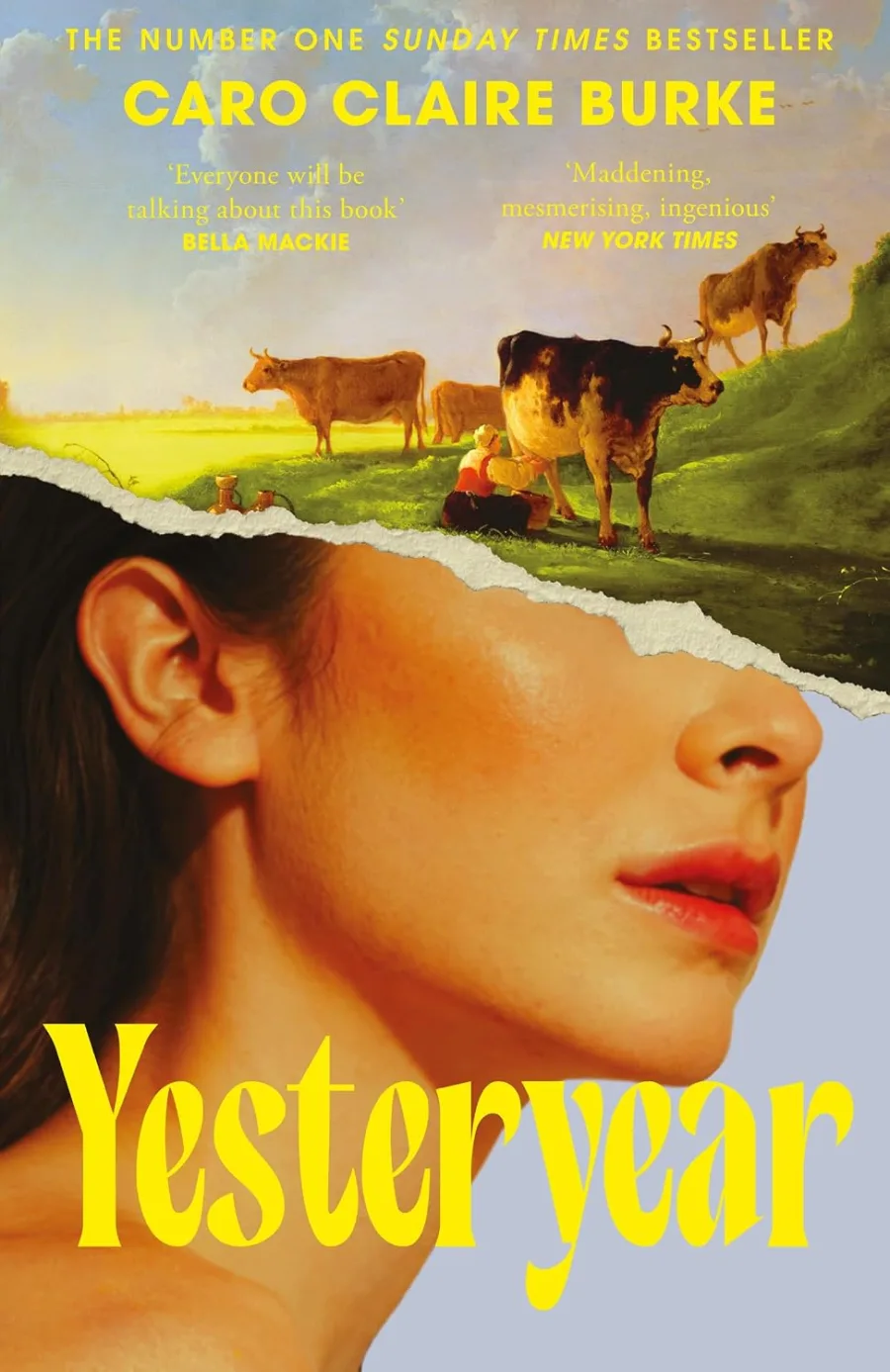
Yesteryear
eBook
• 390 Pages
• GBP 9.99
• English
• 9780008742782
No ratings yet
| Publisher | Fourth Estate |
|---|---|
| ISBN13 | 9780008742782 |
| ASIN/SKU | B0FM6KK5PT |
| Book Format | eBook |
| Language | English |
| Pages | 390 |
| List Price | GBP 9.99 |
| Publishing Date | 07/04/2026 |
| Book Code | BD00067100 |
Buy this Book
Amazon Stores
Ebook Stores
Other Stores
Discover Yesteryear by Caro Claire Burke. This book is published by Fourth Estate in eBook format, ISBN 9780008742782, ASIN B0FM6KK5PT, under Humor and Entertainment, Fiction.
Book Description
THE SUNDAY TIMES NUMBER ONE BESTSELLER
'EVERYONE WILL BE TALKING ABOUT THIS BOOK’ – BELLA MACKIE
'NIGHTMARISH, SHOCKING, BRILLIANT’ – STYLIST
'MADDENING, MESMERISING, INGENIOUS’ – NEW YORK TIMES
'INTELLIGENT, INCISIVE, INSANELY READABLE’ – JENNIE GODFREY
'DERANGED, DARING, CLEVERLY WRITTEN’ – VOGUE
'My name is Natalie Heller Mills, and I was perfect at being alive…'
Natalie lives a traditional lifestyle – and her followers are sick with envy. Her charming farmhouse on her working ranch is artfully cluttered, her husband is a handsome cowboy, her homemade sourdough boules are each more beautiful than the last. So what if there are nannies and producers and industrial-grade ovens behind the scenes? What her followers don’t know won’t hurt them.
Then, one morning, Natalie wakes up in a strange, horrible version of reality. Her home, her husband, her children—they’re all familiar, but something’s off. Is this a hoax? A reality show? A test from God? Natalie knows just two things for sure: this isn't her perfect life, and she must escape, by any means possible.
As darkly funny as it is shocking and gripping, Yesteryear is an electrifying examination of tradition, fame, faith and the grand performance of womanhood, from a thrilling new talent in fiction.
NOW BEING ADAPTED INTO A MAJOR FILM STARRING ANNE HATHAWAY
‘WICKEDLY FUNNY, FRIGHTENINGLY PERCEPTIVE' ABIGAIL DEAN
'INVENTIVE, ADDICTIVE, A WILD RIDE' ASHLEY AUDRAIN
'SHOT THROUGH WITH HUMOUR, LACED WITH DARKNESS' CLARE MACKINTOSH
'THE STEPFORD WIVES MEETS THE HANDMAID'S TALE' HANNAH DEITCH
Caro Claire Burke's book 'Yesteryear' was a Sunday Times bestseller w/c 2026-04-13.
'EVERYONE WILL BE TALKING ABOUT THIS BOOK’ – BELLA MACKIE
'NIGHTMARISH, SHOCKING, BRILLIANT’ – STYLIST
'MADDENING, MESMERISING, INGENIOUS’ – NEW YORK TIMES
'INTELLIGENT, INCISIVE, INSANELY READABLE’ – JENNIE GODFREY
'DERANGED, DARING, CLEVERLY WRITTEN’ – VOGUE
'My name is Natalie Heller Mills, and I was perfect at being alive…'
Natalie lives a traditional lifestyle – and her followers are sick with envy. Her charming farmhouse on her working ranch is artfully cluttered, her husband is a handsome cowboy, her homemade sourdough boules are each more beautiful than the last. So what if there are nannies and producers and industrial-grade ovens behind the scenes? What her followers don’t know won’t hurt them.
Then, one morning, Natalie wakes up in a strange, horrible version of reality. Her home, her husband, her children—they’re all familiar, but something’s off. Is this a hoax? A reality show? A test from God? Natalie knows just two things for sure: this isn't her perfect life, and she must escape, by any means possible.
As darkly funny as it is shocking and gripping, Yesteryear is an electrifying examination of tradition, fame, faith and the grand performance of womanhood, from a thrilling new talent in fiction.
NOW BEING ADAPTED INTO A MAJOR FILM STARRING ANNE HATHAWAY
‘WICKEDLY FUNNY, FRIGHTENINGLY PERCEPTIVE' ABIGAIL DEAN
'INVENTIVE, ADDICTIVE, A WILD RIDE' ASHLEY AUDRAIN
'SHOT THROUGH WITH HUMOUR, LACED WITH DARKNESS' CLARE MACKINTOSH
'THE STEPFORD WIVES MEETS THE HANDMAID'S TALE' HANNAH DEITCH
Caro Claire Burke's book 'Yesteryear' was a Sunday Times bestseller w/c 2026-04-13.
Author Biography
Caro Claire Burke received her Master’s in Fine Arts from the Bennington Writing Seminars. She is the co-host of Diabolical Lies, a politics and culture podcast. Yesteryear is her first novel.
Editorial Reviews
'Everyone will be talking about this book' Bella Mackie
'Daring, deranged, cleverly written' Vogue
'Maddening and mesmerizing. The premise is an ingenious, exquisite, be-careful-what-you-wish-for. Draws to a dizzying conclusion, I didn’t see the twist coming' New York Times
'Tense, intriguing, funny and conversation-starting' Sunday Times Culture
‘Intelligent, incisive and insanely readable’ Jennie Godfrey
‘Perceptive, timely, exquisitely written. An outstanding and utterly unique take on how we live today’ Joanna Cannon
‘An absolutely unhinged novel’ Roxane Gay
'Witty and thought-provoking, this is the book that will be everywhere' Independent
'A piece of howling feminist rage. Nightmarish, shocking, brilliant' Stylist
'A bold and biting satire, will have you gasping right to the final page' Nita Prose
'Highly original and utterly addictive' Louise O'Neill
‘Unapologetically political fiction in the tradition of The Stepford Wives or The Handmaid’s Tale. Enraging, thrilling – grimly funny but intensely humane’ Hannah Deitch
‘Wickedly funny, beautifully written, and frighteningly perceptive.’ Abigail Dean
‘Inventive, addictive and funny. A dark, biting social commentary and a wild, thought-provoking ride’ Ashley Audrain
‘Shot through with humour and laced with darkness’ Clare Mackintosh
‘Insanely good, fresh, sharp and spiky. It reminded me of Gone Girl, with its unreliable, intensely unlikeable narrator, amazing twist and needlepoint observations’ Stacey Halls
‘Deliciously topical, with a chef’s kiss of a twist’ Pandora Sykes
'Original, biting, propulsive and unhinged' Red
'Funny, terrifying and original' Woman & Home
'Crazy and completely addictive' Prima
'Mind-bending, propulsive, thought-provoking' Good Housekeeping
'A dark comedy and a delicious satire that will keep you guessing' Heat
‘Unpredictable, original and beautifully written. I couldn’t guess the genius ending’ Adele Parks
'An intoxicating fever dream through the lens of a thrillingly complex protagonist.' Hannah Beer
'Daring, deranged, cleverly written' Vogue
'Maddening and mesmerizing. The premise is an ingenious, exquisite, be-careful-what-you-wish-for. Draws to a dizzying conclusion, I didn’t see the twist coming' New York Times
'Tense, intriguing, funny and conversation-starting' Sunday Times Culture
‘Intelligent, incisive and insanely readable’ Jennie Godfrey
‘Perceptive, timely, exquisitely written. An outstanding and utterly unique take on how we live today’ Joanna Cannon
‘An absolutely unhinged novel’ Roxane Gay
'Witty and thought-provoking, this is the book that will be everywhere' Independent
'A piece of howling feminist rage. Nightmarish, shocking, brilliant' Stylist
'A bold and biting satire, will have you gasping right to the final page' Nita Prose
'Highly original and utterly addictive' Louise O'Neill
‘Unapologetically political fiction in the tradition of The Stepford Wives or The Handmaid’s Tale. Enraging, thrilling – grimly funny but intensely humane’ Hannah Deitch
‘Wickedly funny, beautifully written, and frighteningly perceptive.’ Abigail Dean
‘Inventive, addictive and funny. A dark, biting social commentary and a wild, thought-provoking ride’ Ashley Audrain
‘Shot through with humour and laced with darkness’ Clare Mackintosh
‘Insanely good, fresh, sharp and spiky. It reminded me of Gone Girl, with its unreliable, intensely unlikeable narrator, amazing twist and needlepoint observations’ Stacey Halls
‘Deliciously topical, with a chef’s kiss of a twist’ Pandora Sykes
'Original, biting, propulsive and unhinged' Red
'Funny, terrifying and original' Woman & Home
'Crazy and completely addictive' Prima
'Mind-bending, propulsive, thought-provoking' Good Housekeeping
'A dark comedy and a delicious satire that will keep you guessing' Heat
‘Unpredictable, original and beautifully written. I couldn’t guess the genius ending’ Adele Parks
'An intoxicating fever dream through the lens of a thrillingly complex protagonist.' Hannah Beer
Book Summary
Yesteryear by Caro Claire Burke is a thought-provoking psychological thriller that blends satire, suspense, and speculative fiction to examine the gap between the lives people present online and the realities they hide. The novel follows Natalie Heller Mills, a wildly successful social media influencer who has built a multimillion-dollar brand around the image of the perfect "tradwife"—a woman devoted to traditional family values, homemaking, and rural living. To millions of followers, Natalie appears to have the ideal life, but behind the carefully edited videos and photographs lies a world of deception, exhaustion, and emotional emptiness. When her life suddenly transforms into the harsh reality of the nineteenth century, she is forced to confront everything she has spent years pretending to believe.
Natalie lives on a large Idaho ranch with her husband, Caleb, and their growing family. Every day she films herself baking bread, tending animals, sewing clothes, and presenting an image of effortless domestic perfection. Her followers admire her simple lifestyle and see her as a model wife and mother. In truth, much of what appears on camera is carefully staged. The household relies on hired staff, modern technology, and a production team that hides the realities of maintaining the image Natalie sells online. She constantly worries about pleasing her audience while privately struggling with stress, resentment, and the pressure of sustaining an impossible standard.
Natalie's marriage is equally complicated. Caleb benefits from the success of their online empire, but their relationship has become strained by ambition, financial pressure, and the demands of living every moment as a public performance. Rather than sharing genuine intimacy, they spend much of their time protecting the brand that supports their lavish lifestyle. Natalie begins questioning whether she is living according to her own beliefs or simply playing a role that has become impossible to escape. As scandals threaten to expose the truth behind her carefully constructed image, the cracks in her life become impossible to ignore.
Everything changes when Natalie wakes up to discover that the world around her has transformed. Instead of her comfortable modern farmhouse, she finds herself in a rough pioneer cabin in the year 1855. The conveniences she once took for granted have disappeared. There are no cameras, electricity, grocery stores, or medical care. Even more disturbing, everyone around her behaves as though this harsh existence has always been her reality. Natalie cannot tell whether she has traveled through time, lost her mind, become part of an elaborate deception, or entered some form of living nightmare. The uncertainty creates an atmosphere of constant tension, leaving both Natalie and the reader unsure of what is truly happening.
Life in the nineteenth century quickly proves nothing like the romantic image Natalie promoted online. Every task requires exhausting physical labor. Food is difficult to obtain, illness is dangerous, childbirth is terrifying, and survival depends on relentless work rather than attractive photographs. Women possess few legal rights and are expected to endure hardship without complaint. The freedom Natalie once enjoyed disappears almost overnight as she experiences the reality behind the lifestyle she had previously presented as beautiful and desirable. The contrast between fantasy and reality becomes one of the novel's most powerful themes.
As Natalie struggles to survive, the story alternates between her frightening present and the events that shaped her rise as an influencer. These flashbacks reveal how her online empire was built through calculated marketing, selective storytelling, and the willingness to hide uncomfortable truths. Readers gradually learn that Natalie compromised many of her own values in pursuit of fame, financial success, and public admiration. The glamorous life she created required constant performance, leaving little room for honesty or genuine happiness. Each revelation deepens the understanding of how far she drifted from the person she once hoped to become.
The novel also examines the impact of curated identities on families. Natalie's children grow up surrounded by cameras and expectations, often becoming part of the content that keeps the business profitable. Her husband and those closest to her are similarly affected by the pressure to maintain appearances. As the story unfolds, Natalie begins recognizing how her obsession with perfection has influenced the people she loves. She is forced to confront uncomfortable questions about motherhood, authenticity, ambition, and the cost of turning private life into public entertainment.
Throughout the narrative, Burke keeps readers questioning what is real. The strange circumstances surrounding Natalie's new world create psychological suspense that extends beyond the historical setting. Every clue raises new possibilities without providing immediate answers. Natalie herself becomes an unreliable narrator as fear, guilt, and confusion blur the line between memory and reality. The mystery surrounding her situation drives the story forward while allowing the author to explore larger themes about identity, belief, and self-deception.
As Natalie confronts increasingly difficult challenges, she slowly begins to see the difference between performing strength and actually developing it. The hardships she endures strip away the image she carefully cultivated, leaving only the person beneath the performance. She is forced to examine her own choices honestly, acknowledging the compromises she made and the consequences they had for herself and others. Whether her experience is supernatural, psychological, or symbolic becomes less important than the transformation taking place within her. Survival depends not on maintaining appearances but on accepting uncomfortable truths.
By the novel's conclusion, the mystery surrounding Natalie's experience reaches a dramatic resolution that redefines much of what came before. Without relying solely on shocking twists, Burke emphasizes the emotional consequences of self-deception and the dangers of building an identity around public approval rather than personal conviction. Natalie emerges profoundly changed, having gained a far more honest understanding of herself and the world she once tried to simplify for an audience.
Yesteryear is both an engrossing psychological thriller and a sharp social satire. Caro Claire Burke uses an imaginative premise to challenge romantic ideas about the past while exposing the pressures of influencer culture, performative lifestyles, and unrealistic expectations placed on women. Through Natalie's unsettling journey, the novel explores themes of authenticity, gender roles, family, ambition, and personal responsibility. It reminds readers that carefully curated images rarely reflect the whole truth, and that genuine freedom begins only when people stop performing the lives they think others want to see.
Natalie lives on a large Idaho ranch with her husband, Caleb, and their growing family. Every day she films herself baking bread, tending animals, sewing clothes, and presenting an image of effortless domestic perfection. Her followers admire her simple lifestyle and see her as a model wife and mother. In truth, much of what appears on camera is carefully staged. The household relies on hired staff, modern technology, and a production team that hides the realities of maintaining the image Natalie sells online. She constantly worries about pleasing her audience while privately struggling with stress, resentment, and the pressure of sustaining an impossible standard.
Natalie's marriage is equally complicated. Caleb benefits from the success of their online empire, but their relationship has become strained by ambition, financial pressure, and the demands of living every moment as a public performance. Rather than sharing genuine intimacy, they spend much of their time protecting the brand that supports their lavish lifestyle. Natalie begins questioning whether she is living according to her own beliefs or simply playing a role that has become impossible to escape. As scandals threaten to expose the truth behind her carefully constructed image, the cracks in her life become impossible to ignore.
Everything changes when Natalie wakes up to discover that the world around her has transformed. Instead of her comfortable modern farmhouse, she finds herself in a rough pioneer cabin in the year 1855. The conveniences she once took for granted have disappeared. There are no cameras, electricity, grocery stores, or medical care. Even more disturbing, everyone around her behaves as though this harsh existence has always been her reality. Natalie cannot tell whether she has traveled through time, lost her mind, become part of an elaborate deception, or entered some form of living nightmare. The uncertainty creates an atmosphere of constant tension, leaving both Natalie and the reader unsure of what is truly happening.
Life in the nineteenth century quickly proves nothing like the romantic image Natalie promoted online. Every task requires exhausting physical labor. Food is difficult to obtain, illness is dangerous, childbirth is terrifying, and survival depends on relentless work rather than attractive photographs. Women possess few legal rights and are expected to endure hardship without complaint. The freedom Natalie once enjoyed disappears almost overnight as she experiences the reality behind the lifestyle she had previously presented as beautiful and desirable. The contrast between fantasy and reality becomes one of the novel's most powerful themes.
As Natalie struggles to survive, the story alternates between her frightening present and the events that shaped her rise as an influencer. These flashbacks reveal how her online empire was built through calculated marketing, selective storytelling, and the willingness to hide uncomfortable truths. Readers gradually learn that Natalie compromised many of her own values in pursuit of fame, financial success, and public admiration. The glamorous life she created required constant performance, leaving little room for honesty or genuine happiness. Each revelation deepens the understanding of how far she drifted from the person she once hoped to become.
The novel also examines the impact of curated identities on families. Natalie's children grow up surrounded by cameras and expectations, often becoming part of the content that keeps the business profitable. Her husband and those closest to her are similarly affected by the pressure to maintain appearances. As the story unfolds, Natalie begins recognizing how her obsession with perfection has influenced the people she loves. She is forced to confront uncomfortable questions about motherhood, authenticity, ambition, and the cost of turning private life into public entertainment.
Throughout the narrative, Burke keeps readers questioning what is real. The strange circumstances surrounding Natalie's new world create psychological suspense that extends beyond the historical setting. Every clue raises new possibilities without providing immediate answers. Natalie herself becomes an unreliable narrator as fear, guilt, and confusion blur the line between memory and reality. The mystery surrounding her situation drives the story forward while allowing the author to explore larger themes about identity, belief, and self-deception.
As Natalie confronts increasingly difficult challenges, she slowly begins to see the difference between performing strength and actually developing it. The hardships she endures strip away the image she carefully cultivated, leaving only the person beneath the performance. She is forced to examine her own choices honestly, acknowledging the compromises she made and the consequences they had for herself and others. Whether her experience is supernatural, psychological, or symbolic becomes less important than the transformation taking place within her. Survival depends not on maintaining appearances but on accepting uncomfortable truths.
By the novel's conclusion, the mystery surrounding Natalie's experience reaches a dramatic resolution that redefines much of what came before. Without relying solely on shocking twists, Burke emphasizes the emotional consequences of self-deception and the dangers of building an identity around public approval rather than personal conviction. Natalie emerges profoundly changed, having gained a far more honest understanding of herself and the world she once tried to simplify for an audience.
Yesteryear is both an engrossing psychological thriller and a sharp social satire. Caro Claire Burke uses an imaginative premise to challenge romantic ideas about the past while exposing the pressures of influencer culture, performative lifestyles, and unrealistic expectations placed on women. Through Natalie's unsettling journey, the novel explores themes of authenticity, gender roles, family, ambition, and personal responsibility. It reminds readers that carefully curated images rarely reflect the whole truth, and that genuine freedom begins only when people stop performing the lives they think others want to see.
Sample Chapters
Sample Chapters will be added soon…
Reader Reviews
No reviews yet.
Yesteryear