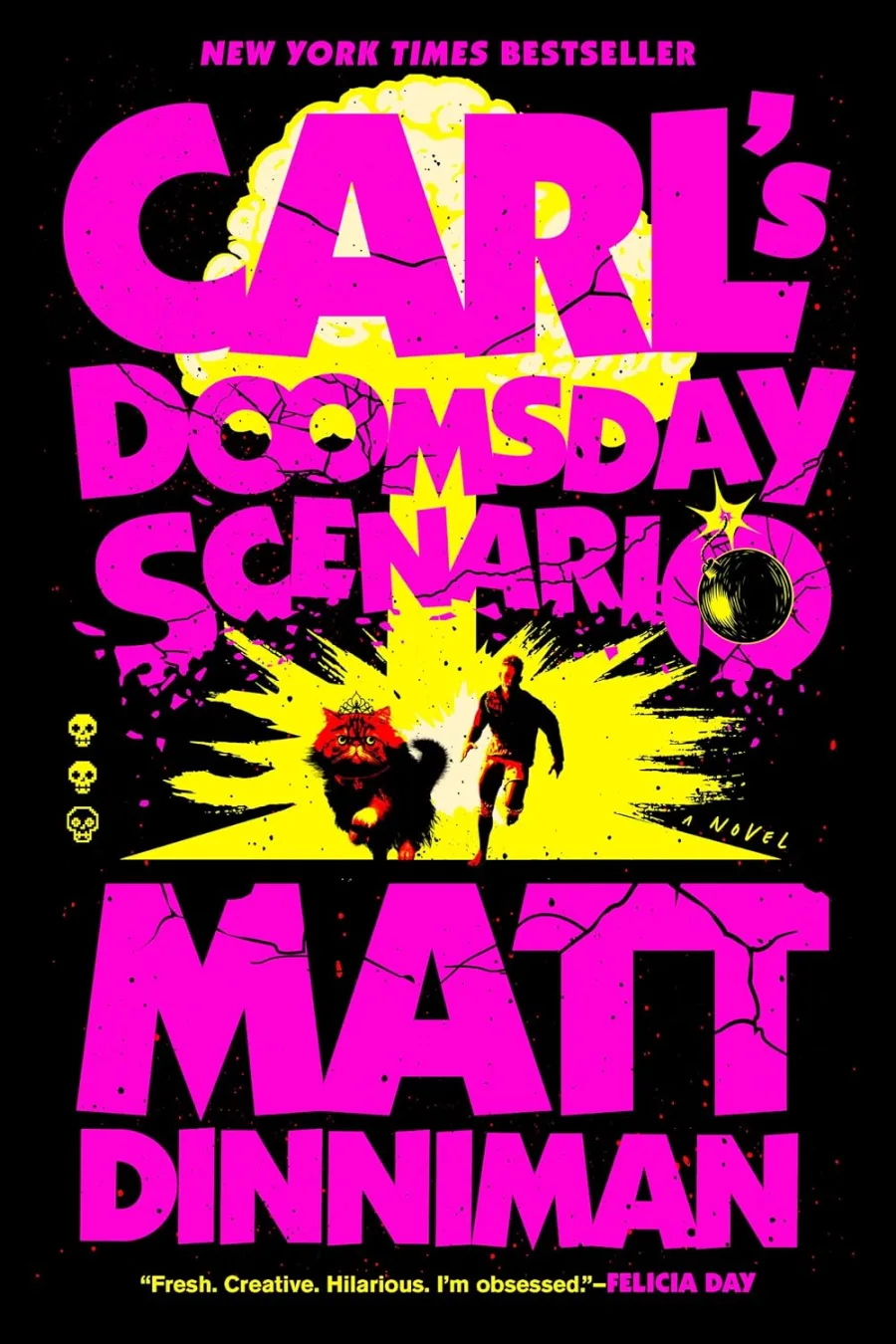
Carl's Doomsday Scenario
Paperback
• 400 Pages
• CAD 29.00
• English
• 9780593820278
No ratings yet
| Publisher | Ace |
|---|---|
| ISBN13 | 9780593820278 |
| ASIN/SKU | 0593820274 |
| Book Format | Paperback |
| Language | English |
| Pages | 400 |
| List Price | CAD 29.00 |
| Publishing Date | 04/08/2026 |
| Dimensions | 13.89 x 2.01 x 20.85 cm |
| Weight | 331 g |
| Book Code | BD00066667 |
Buy this Book
Amazon Stores
Ebook Stores
Other Stores
Discover Carl's Doomsday Scenario by Matt Dinniman. This book is published by Ace in Paperback format, ISBN 9780593820278, ASIN 0593820274, under Science Fiction and Fantasy, Science Fiction History and Criticism, Military Fantasy.
Book Description
NEW YORK TIMES BESTSELLER • Join Carl and his ex-girlfriend’s cat, Princess Donut, as they fight fantastical creatures and deadly mobs to make it to the next level and build the kind of fan following the dungeon masters can’t ignore in the second book in the smash-hit Dungeon Crawler Carl series—now with bonus material exclusive to this print edition.
“Greetings, Crawlers! The training levels have concluded. Now the games may truly begin.”
The aliens have come, and they’ve transformed Earth into a multilevel, video game–like dungeon. It’s the newest season of the galaxy’s most watched game show, Dungeon Crawler World. Now on the third floor, Carl and Donut have to fight harder than ever. They’ve already proven that a Coast Guard vet and once-and-forever feline royalty are an almost unstoppable team. Their ratings are off the charts. Viewers can’t get enough. But the dungeon gets more dangerous each day, and now there’s a whole new problem to deal with: Quests.
They call it the Over City. A sprawling, once-thriving metropolis devastated by a mysterious calamity. But these streets are far from abandoned. An undead circus trawls the ruins. Murdered women rain from the sky. An ancient spell is finally ready to reveal its dark purpose. Can Carl and Donut solve the mystery in time?
And can Carl finally find some pants?
Includes part two of the exclusive bonus story “Backstage at the Pineapple Cabaret.”
“Greetings, Crawlers! The training levels have concluded. Now the games may truly begin.”
The aliens have come, and they’ve transformed Earth into a multilevel, video game–like dungeon. It’s the newest season of the galaxy’s most watched game show, Dungeon Crawler World. Now on the third floor, Carl and Donut have to fight harder than ever. They’ve already proven that a Coast Guard vet and once-and-forever feline royalty are an almost unstoppable team. Their ratings are off the charts. Viewers can’t get enough. But the dungeon gets more dangerous each day, and now there’s a whole new problem to deal with: Quests.
They call it the Over City. A sprawling, once-thriving metropolis devastated by a mysterious calamity. But these streets are far from abandoned. An undead circus trawls the ruins. Murdered women rain from the sky. An ancient spell is finally ready to reveal its dark purpose. Can Carl and Donut solve the mystery in time?
And can Carl finally find some pants?
Includes part two of the exclusive bonus story “Backstage at the Pineapple Cabaret.”
Author Biography
Matt Dinniman is a writer and artist from Gig Harbor, Washington. He is the author of the NYTs best-selling Dungeon Crawler Carl series along with several other books about the end of the world. He doesn't really hate Cocker Spaniels, and he plays bass in a metal band.
Editorial Reviews
Praise for Dungeon Crawler Carl
“Fresh. Creative. Hilarious. I'm obsessed…Princess Donut is my queen.” – Actor, producer and New York Times bestselling author Felicia Day
"Dungeon Crawler Carl is legit awesome."– #1 New York Times bestselling author Brandon Sanderson
"A dangerously addicting tale of chaos and mayhem. I’m thoroughly hooked!”– #1 New York Times bestselling author Callie Hart
“Welcome to your newest obsession…the highly addictive, hilarious series continues to draw in new fans.” – USA Today
"This series has no goddamn business burying so much depth and emotion and complexity under its bawdy, gory surface, but it does so anyway. What a wild-ass and unexpected delight." – New York Times bestselling author Scott Lynch
“[A] comically cosmic adventure series…often laugh-out-loud funny…Grind your way to dungeon mastery alongside Carl and Princess Donut.” – The Wall Street Journal
"This is the book for anyone who ever wondered what it would be like to be a role player in a game with the best game master ever...Once you start, you won't put it down." - Patricia Briggs, #1 New York Times bestselling author of the Mercy Thompson series
“Dungeon Crawler Carl is the best start to a series I’ve read this year. I wish I’d tried it sooner.” – Will Wight, author of the Cradle series
"When it came time to pick a race, Dinniman and Dungeon Crawler Carl decided he would continue to appear as a human, and that’s what this series has blossomed into, something profoundly and endearingly human.” – Slate
"If there's a better LitRPG than Dungeon Crawler Carl, I haven't read it." - Shirtaloon, author of He Who Fights Monsters
“Dungeon Crawler Carl is just one big smile all the way through. Put on your best pair of boxer shorts and sit back for a truly fun and enjoyable read.”—New York Times bestselling author Kevin J. Anderson
“To describe the Dungeon Crawler Carl series, and the first book in particular, one must blend the darkest, grittiest science fiction with the humour of Hitchhiker's Guide to the Galaxy. It mixes fun, whimsical absurdity, and serious, dark themes with dire consequences…it is so spectacularly good that I cannot recommend it highly enough.” - Grimdark Magazine
“Dinniman’s Douglas-Adams-but-playing-D&D romp was so much fun that I immediately went out and got the next two books…genuinely joyful.” – LitHub.com
“Fresh. Creative. Hilarious. I'm obsessed…Princess Donut is my queen.” – Actor, producer and New York Times bestselling author Felicia Day
"Dungeon Crawler Carl is legit awesome."– #1 New York Times bestselling author Brandon Sanderson
"A dangerously addicting tale of chaos and mayhem. I’m thoroughly hooked!”– #1 New York Times bestselling author Callie Hart
“Welcome to your newest obsession…the highly addictive, hilarious series continues to draw in new fans.” – USA Today
"This series has no goddamn business burying so much depth and emotion and complexity under its bawdy, gory surface, but it does so anyway. What a wild-ass and unexpected delight." – New York Times bestselling author Scott Lynch
“[A] comically cosmic adventure series…often laugh-out-loud funny…Grind your way to dungeon mastery alongside Carl and Princess Donut.” – The Wall Street Journal
"This is the book for anyone who ever wondered what it would be like to be a role player in a game with the best game master ever...Once you start, you won't put it down." - Patricia Briggs, #1 New York Times bestselling author of the Mercy Thompson series
“Dungeon Crawler Carl is the best start to a series I’ve read this year. I wish I’d tried it sooner.” – Will Wight, author of the Cradle series
"When it came time to pick a race, Dinniman and Dungeon Crawler Carl decided he would continue to appear as a human, and that’s what this series has blossomed into, something profoundly and endearingly human.” – Slate
"If there's a better LitRPG than Dungeon Crawler Carl, I haven't read it." - Shirtaloon, author of He Who Fights Monsters
“Dungeon Crawler Carl is just one big smile all the way through. Put on your best pair of boxer shorts and sit back for a truly fun and enjoyable read.”—New York Times bestselling author Kevin J. Anderson
“To describe the Dungeon Crawler Carl series, and the first book in particular, one must blend the darkest, grittiest science fiction with the humour of Hitchhiker's Guide to the Galaxy. It mixes fun, whimsical absurdity, and serious, dark themes with dire consequences…it is so spectacularly good that I cannot recommend it highly enough.” - Grimdark Magazine
“Dinniman’s Douglas-Adams-but-playing-D&D romp was so much fun that I immediately went out and got the next two books…genuinely joyful.” – LitHub.com
Book Summary
Matt Dinniman’s Carl’s Doomsday Scenario is the second novel in the wildly inventive Dungeon Crawler Carl series, a LitRPG science-fiction and fantasy adventure that combines apocalyptic survival, video-game mechanics, dark comedy, horror, and surprisingly emotional character development. Originally published in 2021 and later republished in print, the novel continues immediately after Dungeon Crawler Carl, placing Carl and Princess Donut on the dungeon’s third floor, where the introductory training levels are over and the real competition begins. The basic premise remains wonderfully absurd and terrifying: aliens have destroyed Earth and transformed what remains into a gigantic, multilevel dungeon that functions as a galaxy-wide reality television show. Human survivors are forced to fight monsters, complete quests, gain levels, and entertain an enormous intergalactic audience simply to stay alive.
At the beginning of Carl’s Doomsday Scenario, Carl is no longer an ordinary man desperately trying to understand what has happened to him. He is becoming a genuine force within Dungeon Crawler World. His partnership with Princess Donut, his ex-girlfriend’s extraordinarily intelligent and increasingly famous cat, has already made them one of the most entertaining crawler teams in the competition. Their ratings are rising, viewers are becoming emotionally invested in them, and the people running the dungeon are beginning to recognize that Carl and Donut are not behaving like predictable contestants. Yet fame offers little protection. The dungeon is specifically designed to kill crawlers, and every new level introduces greater dangers, more complicated rules, and enemies capable of destroying even experienced survivors.
The third floor is known as the Over City, a vast ruined metropolis that was once prosperous but has been devastated by a mysterious catastrophe. It is a perfect setting for Dinniman’s particular blend of horror and comedy. The city appears abandoned, but it is filled with monsters, strange inhabitants, deadly quests, and remnants of a much larger story. There is an undead circus, bizarre supernatural activity, murdered women falling from the sky, and an ancient spell whose purpose gradually becomes clearer. The official description presents the Over City as a place where the streets may look empty but are anything but safe. Carl and Donut are therefore not simply fighting their way through a dungeon. They are entering a mystery that has its own history, politics, characters, and hidden rules.
One of the most enjoyable aspects of Carl’s Doomsday Scenario is the way Dinniman expands the game's mechanics. Carl and Donut must make decisions about their races and classes, choices that affect their abilities and future development. Carl chooses the Primal Compensated Anarchist class, while Donut develops a class connected to her previous life as a feline celebrity. These choices are funny on the surface, but they also reinforce one of the series' central ideas: identity has become something that can literally be modified, quantified, and exploited. The characters are simultaneously people and game pieces. They have personalities and histories, but the dungeon system reduces those qualities to statistics, skills, classes, achievements, and entertainment value.
Carl’s relationship with Mordecai, his dungeon guide, becomes particularly important as the story develops. Mordecai understands the dungeon's rules far better than Carl does, and his advice is often extremely practical: avoid unnecessary quests, focus on survival, level efficiently, and do not become distracted by problems that are not essential to reaching the next floor. Naturally, Carl does almost the opposite. The novel repeatedly demonstrates that Carl is incapable of simply walking away when he sees something wrong. This becomes one of the defining tensions of the story. The rational choice is often to survive at any cost, but Carl continues to make choices based on loyalty, fairness, anger, or compassion.
That conflict becomes central when Carl and Donut become involved in the quests surrounding the Over City. They encounter characters whose problems are far more complicated than the straightforward “kill the monster and collect the reward” structure of a conventional video game. Carl is warned not to become entangled in questlines because they can consume valuable time and resources, but he cannot resist investigating what is happening. One major storyline involves Signet and Grimaldi, whose relationship and conflict become entangled with the bizarre supernatural machinery of the dungeon. Reviews of the novel highlight how Carl eventually exploits the rules and the show's commercial incentives to influence what happens to these characters.
This is where Carl’s Doomsday Scenario begins to reveal its deeper themes. The dungeon is not merely a game. It is a gigantic entertainment industry in which suffering has been turned into content. The crawlers are real people, but their deaths are consumed as entertainment by spectators across the galaxy. Their trauma generates ratings. Their victories create advertising opportunities. Their personalities become marketable brands. Their tragedies become storylines. Dinniman takes the familiar concept of reality television and pushes it to a horrifying extreme: what if the contestants really could die, and what if the producers cared more about ratings than human life?
Carl increasingly recognizes the injustice of this system. He may not yet have a fully developed political philosophy, but he understands that something is fundamentally wrong with the arrangement. The more successful he becomes, the more he sees behind the curtain. He begins to understand that the dungeon masters, corporations, producers, sponsors, and other powerful entities manipulate the rules for their own purposes. The show may appear to be governed by a fixed system, but Carl repeatedly discovers that the people behind that system can bend, exploit, or reinterpret it.
Princess Donut provides the perfect counterbalance to Carl. She is vain, theatrical, intelligent, demanding, and frequently hilarious, but she is also becoming a genuinely formidable crawler. Her transformation from pampered house cat into a sentient dungeon celebrity is one of the series’ most entertaining ideas. Yet Dinniman never makes her merely a joke. Donut develops her own loyalties, fears, ambitions, and moral instincts. Her relationship with Carl gradually becomes one of the emotional anchors of the series. They argue constantly, but they also depend upon one another completely. In a world where almost everything familiar has disappeared, their partnership becomes a form of family.
Mongo, the strange dinosaur-like creature associated with Donut, adds another layer to that unconventional family. Mongo is both terrifying and adorable, which perfectly fits Dinniman’s tonal approach. The characters can move from a horrifying encounter to a ridiculous exchange within the same sequence, and the humor does not erase the danger. Instead, it makes the emotional stakes more complicated. Readers can laugh at the absurdity of the situation while simultaneously worrying about whether these characters will survive it. Reviews of the novel particularly note the warmth of the Carl-Donut-Mongo relationship beneath the series’ brutality.
As Carl and his companions investigate the Over City, they encounter the story's darker central mystery. Corpses begin falling from the sky, and what initially seems like random horror gradually points toward a deliberate supernatural scheme. The mystery involves Miss Quill and her attempts to use the bodies of murdered women in connection with an undead husband and a powerful soul-based mechanism. The purpose of this scheme is far more devastating than Carl initially realizes. The dungeon's apparent side quests are therefore connected to a threat capable of destroying enormous numbers of people.
The book becomes increasingly chaotic as Carl and Donut attempt to stop this plan. Their actions are not clean or elegant. Carl improvises, takes enormous risks, makes use of explosives, and repeatedly finds himself in situations where the distinction between a brilliant strategy and complete insanity becomes difficult to identify. This is one of Dinniman’s greatest strengths as a writer. Carl does not behave like a conventional heroic fantasy protagonist. He is frequently confused, angry, frightened, and sarcastic. He survives because he learns quickly, because he has useful allies, because he understands that rules can sometimes be manipulated, and because he is willing to do things that more cautious characters would never consider.
The climactic events surrounding the soul crystal demonstrate how far the stakes have risen. Carl and Donut ultimately risk themselves to prevent a catastrophic explosion. Carl manages to contain the exploding soul crystal inside an enchanted glass box and place it into his inventory, transforming it into an item with an appropriately terrifying name: Carl’s Doomsday Scenario. The weapon has the destructive potential to level an entire city. The title therefore has a literal meaning within the story, but it also captures the novel's larger escalation. Carl has reached a point where his own survival strategy has created something potentially catastrophic.
The consequences are immediate. A secondary explosion involving Remex leaves the survivors with only a short window to escape. Carl and Donut lead other crawlers toward the stairwell while the unstable dungeon environment begins to collapse around them. Equipment fails, magical objects become unreliable, and even Donut's precious tiara disappears during the chaos. Carl nevertheless continues trying to save people who are not technically his responsibility. This is a crucial part of his character development. He is no longer simply trying to survive for himself and Donut. He increasingly understands that survival has a moral dimension.
The escape becomes one of the novel's most dramatic sequences. Carl manages to help dozens of crawlers and thousands of NPCs survive the disaster, but the reward for this achievement is deeply revealing. Instead of being celebrated by the corporation running the dungeon, Carl and his allies discover that the powerful interests behind the show can veto rewards and manipulate recognition. Their accomplishments are valuable only insofar as they serve the entertainment machine. The message is unmistakable: doing the right thing does not necessarily produce a fair reward in an unfair system.
The final stages of the novel also show how famous Carl and Donut have become. They enter the top ten crawler rankings, attracting more attention from the show's producers and competitors. Their success creates new dangers because other crawlers recognize that Donut is an exceptionally valuable partner. Odette, the popular dungeon television host, warns Carl that Hekla intends to separate Donut from him and may even kill Carl to accomplish that goal. Fame, which initially seemed like a possible advantage, has therefore become another threat.
One of the most important themes in Carl’s Doomsday Scenario is the conflict between survival and morality. In a conventional video game, the objective is simple: win. In Carl's situation, however, winning often requires making choices that could cost other people their lives. The easiest path is frequently to ignore strangers, avoid quests, and focus entirely on personal advancement. Carl repeatedly refuses to do that. His decisions are inefficient, dangerous, and sometimes infuriating, but they are also what make him human. His growing rebellion against the dungeon's logic becomes more important than simply gaining another level.
The novel also explores the relationship between entertainment and suffering. Dungeon Crawler World presents destruction as spectacle. The audience sees the crawlers' adventures as thrilling television, while the crawlers experience them as terror. Carl gradually realizes that his audience's fascination is itself part of the machinery imprisoning him. Yet he also learns to exploit that machinery. If the producers want a dramatic story, he can give them one. If viewers care about him and Donut, their popularity can become leverage. This creates one of the series' most interesting contradictions: Carl must participate in the entertainment system in order to undermine it.
Dinniman’s writing style is another major reason the novel works so well. Carl’s Doomsday Scenario combines gruesome violence with absurd humor, elaborate game mechanics with emotional character moments, and cosmic science fiction with intentionally ridiculous details. The result is a story that can feel simultaneously like a survival horror novel, a comedy, a video game, and a television satire. Reviews frequently praise this balance of brutality and humor, while noting that beneath the absurdity lies a genuine emotional cost.
For readers searching for a Carl’s Doomsday Scenario book summary, Dungeon Crawler Carl Book 2 explained, the third-floor Over City storyline, Carl and Princess Donut’s relationship, the meaning of Carl’s Doomsday Scenario, or recommendations for funny LitRPG and progression fantasy novels, this installment is especially important because it expands the series far beyond its initial survival premise. The first book introduces the nightmare; the second begins revealing the machinery behind it. Carl learns that the dungeon is not just a place filled with monsters. It is an ecosystem of corporations, entertainment networks, NPC civilizations, competing crawlers, magical systems, political interests, and hidden agendas.
Ultimately, Carl’s Doomsday Scenario succeeds because it understands that the best LitRPG stories need more than levels, statistics, monsters, and loot. The game mechanics provide the structure, but the emotional core comes from the people trapped inside the game. Carl is becoming stronger, but more importantly, he is becoming more aware. Princess Donut is becoming more powerful while also becoming more emotionally attached to the strange family she has found. The dungeon is becoming larger and more complicated, while the moral question at its center becomes clearer: how do you remain a decent person when the world rewards you for becoming ruthless?
The ending leaves Carl and Donut alive but in an increasingly dangerous position. They have survived the third floor, helped other survivors, become major celebrities, attracted powerful enemies, and acquired an almost unimaginably destructive weapon. They are heading into the next level with greater knowledge but also greater exposure. Carl has discovered that the game can be manipulated, but he has also attracted the attention of the people who control it. The training wheels are officially off, and the future levels promise even greater danger.
In the end, Carl’s Doomsday Scenario is much more than another monster-filled installment in a popular LitRPG series. It is a darkly funny story about survival, friendship, exploitation, loyalty, and rebellion. Matt Dinniman takes the familiar idea of a video-game dungeon and turns it into a disturbing examination of what happens when entertainment becomes more valuable than human life. Carl's greatest achievement is not simply defeating monsters or gaining levels. It is his refusal to accept that survival requires him to stop caring about other people. Beneath all the explosions, undead creatures, bizarre quests, talking cats, leveling systems, and outrageous jokes, that stubborn humanity is what gives Carl’s Doomsday Scenario its emotional power—and what makes Carl and Princess Donut such compelling characters to follow into the increasingly dangerous floors ahead.
At the beginning of Carl’s Doomsday Scenario, Carl is no longer an ordinary man desperately trying to understand what has happened to him. He is becoming a genuine force within Dungeon Crawler World. His partnership with Princess Donut, his ex-girlfriend’s extraordinarily intelligent and increasingly famous cat, has already made them one of the most entertaining crawler teams in the competition. Their ratings are rising, viewers are becoming emotionally invested in them, and the people running the dungeon are beginning to recognize that Carl and Donut are not behaving like predictable contestants. Yet fame offers little protection. The dungeon is specifically designed to kill crawlers, and every new level introduces greater dangers, more complicated rules, and enemies capable of destroying even experienced survivors.
The third floor is known as the Over City, a vast ruined metropolis that was once prosperous but has been devastated by a mysterious catastrophe. It is a perfect setting for Dinniman’s particular blend of horror and comedy. The city appears abandoned, but it is filled with monsters, strange inhabitants, deadly quests, and remnants of a much larger story. There is an undead circus, bizarre supernatural activity, murdered women falling from the sky, and an ancient spell whose purpose gradually becomes clearer. The official description presents the Over City as a place where the streets may look empty but are anything but safe. Carl and Donut are therefore not simply fighting their way through a dungeon. They are entering a mystery that has its own history, politics, characters, and hidden rules.
One of the most enjoyable aspects of Carl’s Doomsday Scenario is the way Dinniman expands the game's mechanics. Carl and Donut must make decisions about their races and classes, choices that affect their abilities and future development. Carl chooses the Primal Compensated Anarchist class, while Donut develops a class connected to her previous life as a feline celebrity. These choices are funny on the surface, but they also reinforce one of the series' central ideas: identity has become something that can literally be modified, quantified, and exploited. The characters are simultaneously people and game pieces. They have personalities and histories, but the dungeon system reduces those qualities to statistics, skills, classes, achievements, and entertainment value.
Carl’s relationship with Mordecai, his dungeon guide, becomes particularly important as the story develops. Mordecai understands the dungeon's rules far better than Carl does, and his advice is often extremely practical: avoid unnecessary quests, focus on survival, level efficiently, and do not become distracted by problems that are not essential to reaching the next floor. Naturally, Carl does almost the opposite. The novel repeatedly demonstrates that Carl is incapable of simply walking away when he sees something wrong. This becomes one of the defining tensions of the story. The rational choice is often to survive at any cost, but Carl continues to make choices based on loyalty, fairness, anger, or compassion.
That conflict becomes central when Carl and Donut become involved in the quests surrounding the Over City. They encounter characters whose problems are far more complicated than the straightforward “kill the monster and collect the reward” structure of a conventional video game. Carl is warned not to become entangled in questlines because they can consume valuable time and resources, but he cannot resist investigating what is happening. One major storyline involves Signet and Grimaldi, whose relationship and conflict become entangled with the bizarre supernatural machinery of the dungeon. Reviews of the novel highlight how Carl eventually exploits the rules and the show's commercial incentives to influence what happens to these characters.
This is where Carl’s Doomsday Scenario begins to reveal its deeper themes. The dungeon is not merely a game. It is a gigantic entertainment industry in which suffering has been turned into content. The crawlers are real people, but their deaths are consumed as entertainment by spectators across the galaxy. Their trauma generates ratings. Their victories create advertising opportunities. Their personalities become marketable brands. Their tragedies become storylines. Dinniman takes the familiar concept of reality television and pushes it to a horrifying extreme: what if the contestants really could die, and what if the producers cared more about ratings than human life?
Carl increasingly recognizes the injustice of this system. He may not yet have a fully developed political philosophy, but he understands that something is fundamentally wrong with the arrangement. The more successful he becomes, the more he sees behind the curtain. He begins to understand that the dungeon masters, corporations, producers, sponsors, and other powerful entities manipulate the rules for their own purposes. The show may appear to be governed by a fixed system, but Carl repeatedly discovers that the people behind that system can bend, exploit, or reinterpret it.
Princess Donut provides the perfect counterbalance to Carl. She is vain, theatrical, intelligent, demanding, and frequently hilarious, but she is also becoming a genuinely formidable crawler. Her transformation from pampered house cat into a sentient dungeon celebrity is one of the series’ most entertaining ideas. Yet Dinniman never makes her merely a joke. Donut develops her own loyalties, fears, ambitions, and moral instincts. Her relationship with Carl gradually becomes one of the emotional anchors of the series. They argue constantly, but they also depend upon one another completely. In a world where almost everything familiar has disappeared, their partnership becomes a form of family.
Mongo, the strange dinosaur-like creature associated with Donut, adds another layer to that unconventional family. Mongo is both terrifying and adorable, which perfectly fits Dinniman’s tonal approach. The characters can move from a horrifying encounter to a ridiculous exchange within the same sequence, and the humor does not erase the danger. Instead, it makes the emotional stakes more complicated. Readers can laugh at the absurdity of the situation while simultaneously worrying about whether these characters will survive it. Reviews of the novel particularly note the warmth of the Carl-Donut-Mongo relationship beneath the series’ brutality.
As Carl and his companions investigate the Over City, they encounter the story's darker central mystery. Corpses begin falling from the sky, and what initially seems like random horror gradually points toward a deliberate supernatural scheme. The mystery involves Miss Quill and her attempts to use the bodies of murdered women in connection with an undead husband and a powerful soul-based mechanism. The purpose of this scheme is far more devastating than Carl initially realizes. The dungeon's apparent side quests are therefore connected to a threat capable of destroying enormous numbers of people.
The book becomes increasingly chaotic as Carl and Donut attempt to stop this plan. Their actions are not clean or elegant. Carl improvises, takes enormous risks, makes use of explosives, and repeatedly finds himself in situations where the distinction between a brilliant strategy and complete insanity becomes difficult to identify. This is one of Dinniman’s greatest strengths as a writer. Carl does not behave like a conventional heroic fantasy protagonist. He is frequently confused, angry, frightened, and sarcastic. He survives because he learns quickly, because he has useful allies, because he understands that rules can sometimes be manipulated, and because he is willing to do things that more cautious characters would never consider.
The climactic events surrounding the soul crystal demonstrate how far the stakes have risen. Carl and Donut ultimately risk themselves to prevent a catastrophic explosion. Carl manages to contain the exploding soul crystal inside an enchanted glass box and place it into his inventory, transforming it into an item with an appropriately terrifying name: Carl’s Doomsday Scenario. The weapon has the destructive potential to level an entire city. The title therefore has a literal meaning within the story, but it also captures the novel's larger escalation. Carl has reached a point where his own survival strategy has created something potentially catastrophic.
The consequences are immediate. A secondary explosion involving Remex leaves the survivors with only a short window to escape. Carl and Donut lead other crawlers toward the stairwell while the unstable dungeon environment begins to collapse around them. Equipment fails, magical objects become unreliable, and even Donut's precious tiara disappears during the chaos. Carl nevertheless continues trying to save people who are not technically his responsibility. This is a crucial part of his character development. He is no longer simply trying to survive for himself and Donut. He increasingly understands that survival has a moral dimension.
The escape becomes one of the novel's most dramatic sequences. Carl manages to help dozens of crawlers and thousands of NPCs survive the disaster, but the reward for this achievement is deeply revealing. Instead of being celebrated by the corporation running the dungeon, Carl and his allies discover that the powerful interests behind the show can veto rewards and manipulate recognition. Their accomplishments are valuable only insofar as they serve the entertainment machine. The message is unmistakable: doing the right thing does not necessarily produce a fair reward in an unfair system.
The final stages of the novel also show how famous Carl and Donut have become. They enter the top ten crawler rankings, attracting more attention from the show's producers and competitors. Their success creates new dangers because other crawlers recognize that Donut is an exceptionally valuable partner. Odette, the popular dungeon television host, warns Carl that Hekla intends to separate Donut from him and may even kill Carl to accomplish that goal. Fame, which initially seemed like a possible advantage, has therefore become another threat.
One of the most important themes in Carl’s Doomsday Scenario is the conflict between survival and morality. In a conventional video game, the objective is simple: win. In Carl's situation, however, winning often requires making choices that could cost other people their lives. The easiest path is frequently to ignore strangers, avoid quests, and focus entirely on personal advancement. Carl repeatedly refuses to do that. His decisions are inefficient, dangerous, and sometimes infuriating, but they are also what make him human. His growing rebellion against the dungeon's logic becomes more important than simply gaining another level.
The novel also explores the relationship between entertainment and suffering. Dungeon Crawler World presents destruction as spectacle. The audience sees the crawlers' adventures as thrilling television, while the crawlers experience them as terror. Carl gradually realizes that his audience's fascination is itself part of the machinery imprisoning him. Yet he also learns to exploit that machinery. If the producers want a dramatic story, he can give them one. If viewers care about him and Donut, their popularity can become leverage. This creates one of the series' most interesting contradictions: Carl must participate in the entertainment system in order to undermine it.
Dinniman’s writing style is another major reason the novel works so well. Carl’s Doomsday Scenario combines gruesome violence with absurd humor, elaborate game mechanics with emotional character moments, and cosmic science fiction with intentionally ridiculous details. The result is a story that can feel simultaneously like a survival horror novel, a comedy, a video game, and a television satire. Reviews frequently praise this balance of brutality and humor, while noting that beneath the absurdity lies a genuine emotional cost.
For readers searching for a Carl’s Doomsday Scenario book summary, Dungeon Crawler Carl Book 2 explained, the third-floor Over City storyline, Carl and Princess Donut’s relationship, the meaning of Carl’s Doomsday Scenario, or recommendations for funny LitRPG and progression fantasy novels, this installment is especially important because it expands the series far beyond its initial survival premise. The first book introduces the nightmare; the second begins revealing the machinery behind it. Carl learns that the dungeon is not just a place filled with monsters. It is an ecosystem of corporations, entertainment networks, NPC civilizations, competing crawlers, magical systems, political interests, and hidden agendas.
Ultimately, Carl’s Doomsday Scenario succeeds because it understands that the best LitRPG stories need more than levels, statistics, monsters, and loot. The game mechanics provide the structure, but the emotional core comes from the people trapped inside the game. Carl is becoming stronger, but more importantly, he is becoming more aware. Princess Donut is becoming more powerful while also becoming more emotionally attached to the strange family she has found. The dungeon is becoming larger and more complicated, while the moral question at its center becomes clearer: how do you remain a decent person when the world rewards you for becoming ruthless?
The ending leaves Carl and Donut alive but in an increasingly dangerous position. They have survived the third floor, helped other survivors, become major celebrities, attracted powerful enemies, and acquired an almost unimaginably destructive weapon. They are heading into the next level with greater knowledge but also greater exposure. Carl has discovered that the game can be manipulated, but he has also attracted the attention of the people who control it. The training wheels are officially off, and the future levels promise even greater danger.
In the end, Carl’s Doomsday Scenario is much more than another monster-filled installment in a popular LitRPG series. It is a darkly funny story about survival, friendship, exploitation, loyalty, and rebellion. Matt Dinniman takes the familiar idea of a video-game dungeon and turns it into a disturbing examination of what happens when entertainment becomes more valuable than human life. Carl's greatest achievement is not simply defeating monsters or gaining levels. It is his refusal to accept that survival requires him to stop caring about other people. Beneath all the explosions, undead creatures, bizarre quests, talking cats, leveling systems, and outrageous jokes, that stubborn humanity is what gives Carl’s Doomsday Scenario its emotional power—and what makes Carl and Princess Donut such compelling characters to follow into the increasingly dangerous floors ahead.
Sample Chapters
Sample Chapters will be added soon…
Reader Reviews
No reviews yet.
Carl's Doomsday Scenario
Download Cover Image
Do you want to download the full cover image for Carl's Doomsday Scenario?