
Professor Poppy's Fully Illustrated 100,000 WHY Encyclopedia - Kids General Knowledge Vol. 1
Paperback
• 157 Pages
• CAD 16.97
• English
• 9781997925606
No ratings yet
| Publisher | Poppy Publishing |
|---|---|
| ISBN13 | 9781997925606 |
| ASIN/SKU | 1997925605 |
| Book Format | Paperback |
| Language | English |
| Pages | 157 |
| List Price | CAD 16.97 |
| Publishing Date | 04/05/2026 |
| Dimensions | 15.24 x 0.91 x 22.86 cm |
| Weight | 220 g |
| Book Code | BD00066653 |
Buy this Book
Amazon Stores
Ebook Stores
Other Stores
Discover Professor Poppy's Fully Illustrated 100,000 WHY Encyclopedia - Kids General Knowledge Vol. 1 by Professor Poppy. This book is published by Poppy Publishing in Paperback format, ISBN 9781997925606, ASIN 1997925605, under Children's Books, Children's Books on Engineering, Children's Books on Botany.
Book Description
#1 Bestseller in US, UK, Canada. *Updated edition with high quality black and white illustrations/pictures.*
A fully illustrated WHY encyclopedia for curious kids who want to see how the world works.
Do your kids ask endless WHY questions about science, space, animals, history, nature, the human body, technology, and everyday life?
Most children’s WHY books give short answers, tiny pictures, or long walls of text. This one is different.
Professor Poppy’s Fully Illustrated 100,000 WHY Encyclopedia turns big questions into visual answers children can actually see, understand, and remember.
Every page is built around one clear WHY question, one easy to follow explanation, and one museum-grade black and white illustration that brings the answer to life.
This is not a text heavy reference book with a few small pictures added in. It is a fully illustrated learning experience designed for curious readers ages 7+
Open any page and your child will find a big question worth exploring:
Science: Why does a magnet attract metal? Why does a candle flame point upward?
Space: Why does the Moon not fall to Earth? Why can a black hole trap even light?
Animals: Why do elephants never forget? Why do dogs wag their tails?
History: Why did the Egyptians build pyramids? Why did knights wear armor in battles?
Nature: Why do leaves change color in autumn? Why do volcanoes erupt?
Human Body: Why does your heart never get tired? Why do you dream when you sleep?
Planet Earth: Why is the Dead Sea so salty? Why do earthquakes happen?
Technology: Why can a submarine sink and float? Why does food get hot in a microwave so fast?
Food and Plants: Why does bread rise when you bake it? Why do onions make you cry?
Human Mind: Why do optical illusions fool your brain? Why do smells trigger memories?
Each answer is written in clear, age appropriate language and paired with a full visual explanation. Children are not just memorizing facts. They are seeing how ideas work.
A fully illustrated WHY encyclopedia for curious kids who want to see how the world works.
Do your kids ask endless WHY questions about science, space, animals, history, nature, the human body, technology, and everyday life?
Most children’s WHY books give short answers, tiny pictures, or long walls of text. This one is different.
Professor Poppy’s Fully Illustrated 100,000 WHY Encyclopedia turns big questions into visual answers children can actually see, understand, and remember.
Every page is built around one clear WHY question, one easy to follow explanation, and one museum-grade black and white illustration that brings the answer to life.
This is not a text heavy reference book with a few small pictures added in. It is a fully illustrated learning experience designed for curious readers ages 7+
Open any page and your child will find a big question worth exploring:
Science: Why does a magnet attract metal? Why does a candle flame point upward?
Space: Why does the Moon not fall to Earth? Why can a black hole trap even light?
Animals: Why do elephants never forget? Why do dogs wag their tails?
History: Why did the Egyptians build pyramids? Why did knights wear armor in battles?
Nature: Why do leaves change color in autumn? Why do volcanoes erupt?
Human Body: Why does your heart never get tired? Why do you dream when you sleep?
Planet Earth: Why is the Dead Sea so salty? Why do earthquakes happen?
Technology: Why can a submarine sink and float? Why does food get hot in a microwave so fast?
Food and Plants: Why does bread rise when you bake it? Why do onions make you cry?
Human Mind: Why do optical illusions fool your brain? Why do smells trigger memories?
Each answer is written in clear, age appropriate language and paired with a full visual explanation. Children are not just memorizing facts. They are seeing how ideas work.
Author Biography
I have always loved books that make big ideas feel simple. Growing up, I often wished complex topics were explained in a clearer, more visual, and more interesting way. That is why I write books that help curious readers understand the world without feeling overwhelmed.
Through the 'Young Explorer Series' for children, tweens and teens and the 'Big Book Of' series for adults, I focus on carefully researched nonfiction that is clear, engaging, and meaningful. I spend a great deal of time checking facts, organizing ideas, and presenting information in a way readers can connect with, remember, and enjoy. My goal is simple: to make learning feel useful, interesting, and worth coming back to.
Through the 'Young Explorer Series' for children, tweens and teens and the 'Big Book Of' series for adults, I focus on carefully researched nonfiction that is clear, engaging, and meaningful. I spend a great deal of time checking facts, organizing ideas, and presenting information in a way readers can connect with, remember, and enjoy. My goal is simple: to make learning feel useful, interesting, and worth coming back to.
Editorial Reviews
Editorial Reviews will be added soon…
Book Summary
Professor Poppy’s “Fully Illustrated 100,000 WHY Encyclopedia - Kids General Knowledge Vol. 1” serves as a vibrant, comprehensive lifeline for parents and a captivating gateway for perpetually curious children. Designed specifically to address the exhausting but wonderful phase of childhood where every statement is met with a resounding "why," this encyclopedia transforms complex worldly phenomena into digestible, engaging lessons. The book is anchored by the warm, authoritative persona of Professor Poppy, a guide who navigates young readers through the mysteries of the universe with endless patience and enthusiasm. Instead of presenting dry facts, the book treats every question as an exciting investigation, encouraging children to view the world as a giant puzzle waiting to be solved. As the first volume in a broader series, it establishes a foundational broad-strokes approach to general knowledge, sweeping across multiple disciplines to ensure that there is something to capture the imagination of every type of learner.
At the core of the encyclopedia is its exploration of the natural world and the universe beyond our atmosphere. Professor Poppy tackles the grand, existential questions that children often ponder when looking up at the sky. Readers are guided through the mechanics of our solar system, learning exactly why the moon seems to change shape, why the sky appears blue during the day but red at sunset, and what makes stars twinkle. The explanations strip away heavy academic jargon, replacing it with relatable analogies. For instance, gravity might be explained as an invisible magnet holding everything to the ground, making astrophysics accessible to a child's mind. By grounding these massive concepts in everyday observations, the book demystifies space and Earth sciences, turning abstract ideas into concrete understanding.
Moving closer to home, the book delves deeply into the animal kingdom and the environment. Children are naturally fascinated by animals, and Professor Poppy capitalizes on this by answering the highly specific, quirky questions kids love to ask. The encyclopedia explains evolutionary biology and animal behavior in simple terms, detailing why tigers have stripes, why birds migrate, and how fish breathe underwater. It also addresses botanical and environmental mysteries, such as why leaves change color in the fall or what makes volcanoes erupt. These sections do more than just provide trivia; they gently introduce fundamental scientific principles like adaptation, ecosystems, and the water cycle. By understanding the "why" behind an animal's appearance or a plant's behavior, children learn to appreciate the delicate balance of nature and the interconnectedness of all living things.
Equally fascinating to young readers is the exploration of the human body, a subject the encyclopedia handles with both humor and scientific accuracy. Professor Poppy addresses the relatable, everyday bodily functions that kids find endlessly amusing and perplexing. The book answers questions like why we hiccup, what causes goosebumps, why we need to sleep, and how our eyes see color. This section acts as a gentle introduction to human anatomy and biology, helping children understand the complex machinery of their own bodies. It empowers them with knowledge about health and physiology, turning mundane experiences like getting a scrape or feeling hungry into fascinating biological processes. The reassuring tone ensures that bodily functions are normalized and understood rather than feared or simply laughed at.
A defining feature of the book, as promised by its title, is its heavy reliance on illustrations. The visual component is not merely decorative; it is a crucial educational tool that works in tandem with the text. Every page is bursting with colorful, detailed, and often humorous artwork that breaks down complex mechanisms into visual steps. Whether it is a cross-section of the Earth showing its molten core, a whimsical diagram of the digestive system, or a vibrant depiction of a rainforest canopy, the illustrations do the heavy lifting in explaining difficult concepts. For visual learners, or for younger children who are still developing their reading comprehension skills, these illustrations are the primary entry point into the material, making the encyclopedia an immersive, multi-sensory experience.
Beyond the specific facts it imparts, Professor Poppy’s encyclopedia actively cultivates a growth mindset. The underlying philosophy of the book is that questioning is the highest form of intelligence. By validating a child's curiosity and taking their questions seriously, the book builds intellectual confidence. It teaches children how to seek out information and shows them that learning is not a chore confined to a classroom, but a lifelong, joyful pursuit. The format encourages both independent exploration and shared reading experiences. A child can flip through the pages, drawn in by a specific picture, or a parent can use it as a bedtime read, exploring one "why" question a night without feeling overwhelmed.
Ultimately, “Professor Poppy's Fully Illustrated 100,000 WHY Encyclopedia” is much more than a collection of random facts. It is a thoughtfully curated educational journey that respects the intelligence of its young audience. By providing clear, visually engaging, and scientifically accurate answers to the most common questions children ask, it quenches their immediate thirst for knowledge while simultaneously sparking a deeper, enduring curiosity about the world around them. It is an indispensable resource for any household, turning the challenging "why" phase into an enriching adventure of discovery.
At the core of the encyclopedia is its exploration of the natural world and the universe beyond our atmosphere. Professor Poppy tackles the grand, existential questions that children often ponder when looking up at the sky. Readers are guided through the mechanics of our solar system, learning exactly why the moon seems to change shape, why the sky appears blue during the day but red at sunset, and what makes stars twinkle. The explanations strip away heavy academic jargon, replacing it with relatable analogies. For instance, gravity might be explained as an invisible magnet holding everything to the ground, making astrophysics accessible to a child's mind. By grounding these massive concepts in everyday observations, the book demystifies space and Earth sciences, turning abstract ideas into concrete understanding.
Moving closer to home, the book delves deeply into the animal kingdom and the environment. Children are naturally fascinated by animals, and Professor Poppy capitalizes on this by answering the highly specific, quirky questions kids love to ask. The encyclopedia explains evolutionary biology and animal behavior in simple terms, detailing why tigers have stripes, why birds migrate, and how fish breathe underwater. It also addresses botanical and environmental mysteries, such as why leaves change color in the fall or what makes volcanoes erupt. These sections do more than just provide trivia; they gently introduce fundamental scientific principles like adaptation, ecosystems, and the water cycle. By understanding the "why" behind an animal's appearance or a plant's behavior, children learn to appreciate the delicate balance of nature and the interconnectedness of all living things.
Equally fascinating to young readers is the exploration of the human body, a subject the encyclopedia handles with both humor and scientific accuracy. Professor Poppy addresses the relatable, everyday bodily functions that kids find endlessly amusing and perplexing. The book answers questions like why we hiccup, what causes goosebumps, why we need to sleep, and how our eyes see color. This section acts as a gentle introduction to human anatomy and biology, helping children understand the complex machinery of their own bodies. It empowers them with knowledge about health and physiology, turning mundane experiences like getting a scrape or feeling hungry into fascinating biological processes. The reassuring tone ensures that bodily functions are normalized and understood rather than feared or simply laughed at.
A defining feature of the book, as promised by its title, is its heavy reliance on illustrations. The visual component is not merely decorative; it is a crucial educational tool that works in tandem with the text. Every page is bursting with colorful, detailed, and often humorous artwork that breaks down complex mechanisms into visual steps. Whether it is a cross-section of the Earth showing its molten core, a whimsical diagram of the digestive system, or a vibrant depiction of a rainforest canopy, the illustrations do the heavy lifting in explaining difficult concepts. For visual learners, or for younger children who are still developing their reading comprehension skills, these illustrations are the primary entry point into the material, making the encyclopedia an immersive, multi-sensory experience.
Beyond the specific facts it imparts, Professor Poppy’s encyclopedia actively cultivates a growth mindset. The underlying philosophy of the book is that questioning is the highest form of intelligence. By validating a child's curiosity and taking their questions seriously, the book builds intellectual confidence. It teaches children how to seek out information and shows them that learning is not a chore confined to a classroom, but a lifelong, joyful pursuit. The format encourages both independent exploration and shared reading experiences. A child can flip through the pages, drawn in by a specific picture, or a parent can use it as a bedtime read, exploring one "why" question a night without feeling overwhelmed.
Ultimately, “Professor Poppy's Fully Illustrated 100,000 WHY Encyclopedia” is much more than a collection of random facts. It is a thoughtfully curated educational journey that respects the intelligence of its young audience. By providing clear, visually engaging, and scientifically accurate answers to the most common questions children ask, it quenches their immediate thirst for knowledge while simultaneously sparking a deeper, enduring curiosity about the world around them. It is an indispensable resource for any household, turning the challenging "why" phase into an enriching adventure of discovery.
Sample Chapters
Sample Chapters will be added soon…
Reader Reviews
No reviews yet.
Professor Poppy's Fully Illustrated 100,000 WHY Encyclopedia - Kids General Knowledge Vol. 1
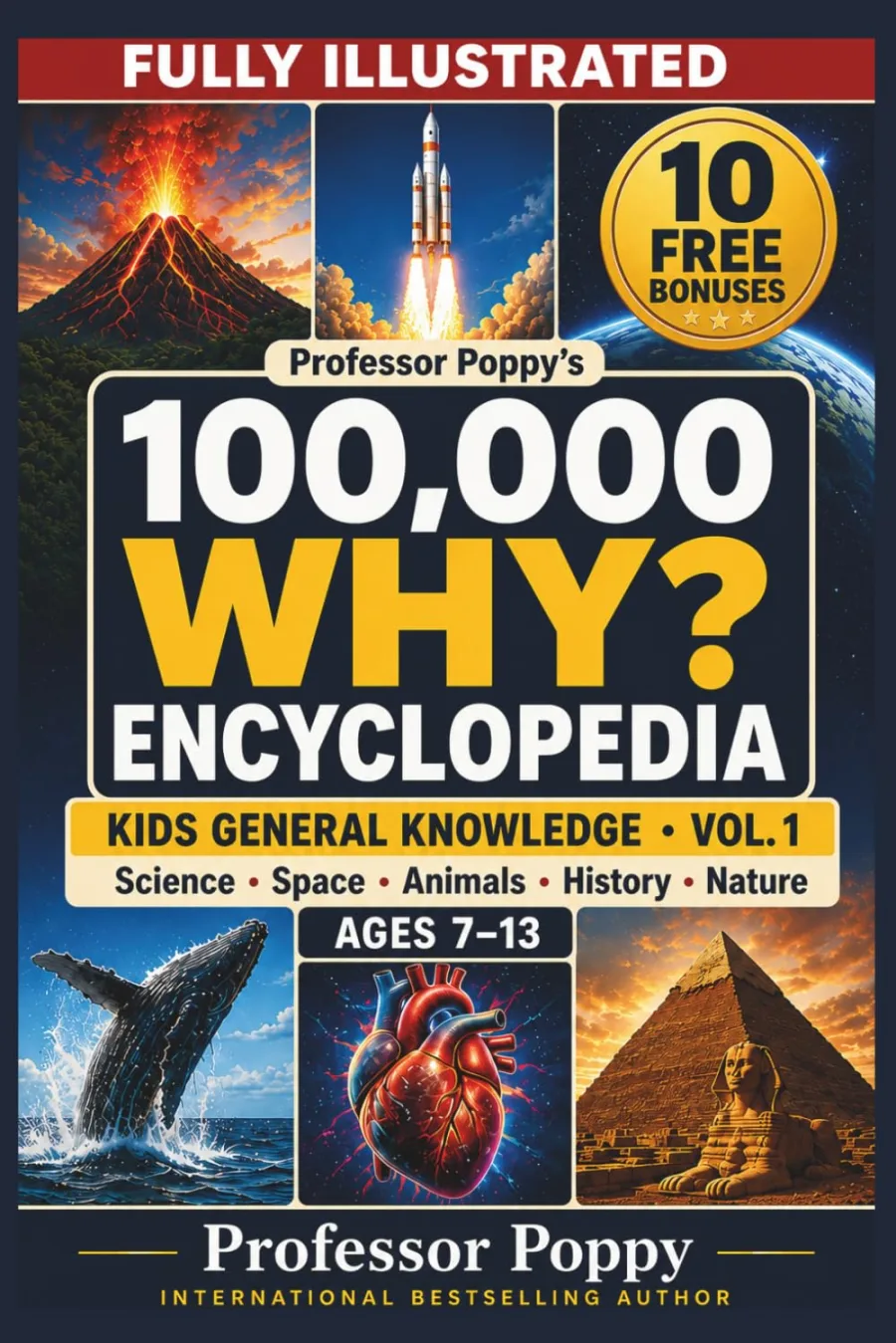
Download Cover Image
Do you want to download the full cover image for Professor Poppy's Fully Illustrated 100,000 WHY Encyclopedia - Kids General Knowledge Vol. 1?