Pricklepaper's Letter Magic
Paperback
• 32 Pages
• USD 7.59
• English
• 9781836009726
No ratings yet
| Publisher | words & pictures |
|---|---|
| ISBN13 | 9781836009726 |
| ASIN/SKU | 1836009720 |
| Book Format | Paperback |
| Language | English |
| Pages | 32 |
| List Price | USD 7.59 |
| Publishing Date | 24/09/2026 |
| Dimensions | 15.24 x 1.22 x 21.39 cm |
| Weight | 350 g |
| Book Code | BD00066636 |
Buy this Book
Amazon Stores
Ebook Stores
Other Stores
Discover Pricklepaper's Letter Magic by Tom Read Wilson. This book is published by words and pictures in Paperback format, ISBN 9781836009726, ASIN 1836009720, under Children's Books, Fiction.
Book Description
Join Pricklepaper the litter-picking hedgehog on his evening rounds, sharing the letters he finds and discovering that small acts of generosity can lead to something even more magical in return.
Pricklepaper the hedgehog loves collecting scraps of paper in the park – especially when the letters he finds spell a new word that makes him feel all warm and snuggly!
On his way home after a successful night collecting, Pricklepaper encounters some friends in need. He lends his ear and offers advice to each of his friends and discovers some of the letters he has collected on his quills might just be the solution to their problems . . .
Pricklepaper is happy he was able to help his friends, but when he gets home, he is sad. He has given away his precious letters which spelled out a fun new word, and now the leftover letters stuck to his quills make no sense at all!
But then, as he places the remaining letters on the floor, he realises he now has a brand-new word – L.O.V.E.
From actor, author, TV presenter and celebrated wordsmith, Tom Read Wilson, Pricklepaper's Letter Magic is built around delightful rhyme and wordplay, offering the pleasure of spotting patterns and seeing how small changes in language – and good deeds – can make a meaningful difference.
Brought to life with adorable, timeless full-colour illustrations by Rebecca Bagley, this rewarding picture book invites children to both celebrate sharing and kindness, and engage playfully with words.
Pricklepaper the hedgehog loves collecting scraps of paper in the park – especially when the letters he finds spell a new word that makes him feel all warm and snuggly!
On his way home after a successful night collecting, Pricklepaper encounters some friends in need. He lends his ear and offers advice to each of his friends and discovers some of the letters he has collected on his quills might just be the solution to their problems . . .
Pricklepaper is happy he was able to help his friends, but when he gets home, he is sad. He has given away his precious letters which spelled out a fun new word, and now the leftover letters stuck to his quills make no sense at all!
But then, as he places the remaining letters on the floor, he realises he now has a brand-new word – L.O.V.E.
From actor, author, TV presenter and celebrated wordsmith, Tom Read Wilson, Pricklepaper's Letter Magic is built around delightful rhyme and wordplay, offering the pleasure of spotting patterns and seeing how small changes in language – and good deeds – can make a meaningful difference.
Brought to life with adorable, timeless full-colour illustrations by Rebecca Bagley, this rewarding picture book invites children to both celebrate sharing and kindness, and engage playfully with words.
Author Biography
Author Biography will be added soon…
Editorial Reviews
Editorial Reviews will be added soon…
Book Summary
Pricklepaper’s Letter Magic by Tom Read Wilson, illustrated by Rebecca Bagley, is a gentle and imaginative children’s picture book about kindness, sharing, friendship, words, and the surprising ways in which small acts of generosity can create something much more valuable than the thing being given away. At the centre of the story is Pricklepaper, a friendly hedgehog who spends his evenings collecting scraps of paper in the park. What makes his collection special is that the scraps are not merely rubbish to him. The letters printed on them can be rearranged to form words, and Pricklepaper takes great pleasure in discovering these little linguistic treasures. The book combines playful word games with a warm emotional message, showing children that words can be rearranged to create meaning just as human actions can transform an ordinary moment into something beautiful.
Pricklepaper is an unusual little hero because he finds happiness in something that most creatures would probably ignore. While other animals might simply walk past scraps of paper lying in the park, Pricklepaper notices them. He collects them carefully and brings them together because he enjoys discovering what their letters can say. There is something wonderfully childlike about this habit. Children often find fascination in ordinary things: a strange-shaped stone, a colourful leaf, a discarded button, or a letter written on a piece of paper. Pricklepaper's world encourages that same sense of curiosity. To him, letters are tiny pieces of possibility. Put them together in one way and they create one word; arrange them differently and they can create something entirely new.
His collecting also gives the story an environmental dimension. Pricklepaper is a litter-picking hedgehog, so his nightly activity helps make the park cleaner while giving him something he loves doing. The book therefore presents care for the environment in a natural and appealing way rather than turning it into a formal lesson. Pricklepaper simply enjoys looking after his surroundings. His helpfulness is part of his personality, and this becomes important as the story progresses. The act of picking up litter becomes connected with another kind of care: noticing when somebody else needs help.
Pricklepaper is especially excited when the letters he collects form a new word that gives him a warm, comfortable feeling. The words are not presented merely as vocabulary exercises. They have emotional meaning for him. Discovering a word becomes a small adventure, and the process of putting letters together teaches children that language can be playful. The story encourages readers to look at letters not as isolated symbols but as building blocks that can express ideas, feelings, and relationships. This wordplay is one of the book's defining features, and it reflects Tom Read Wilson's well-known enthusiasm for language. The publisher describes the book as being built around rhyme and wordplay, with the pleasure of spotting patterns and discovering how small changes in language can create meaningful differences.
After his successful evening of collecting, Pricklepaper begins making his way home. This is where the story changes from a simple tale about collecting letters into a story about friendship and generosity. Along the way, Pricklepaper encounters friends who are experiencing problems. Instead of ignoring them because he is eager to get home and enjoy his newly collected letters, he stops to listen. He lends them his ear, offers advice, and tries to understand what they need. His first response is not to solve everything immediately but to listen. That simple act is important because it shows that kindness begins with paying attention to another person.
As Pricklepaper talks to his friends, he realizes that some of the letters attached to his quills may actually be useful to them. The letters that he had collected for his own enjoyment can be given away to help somebody else. This is the central turning point of the story. Pricklepaper has discovered something precious to himself, but he is willing to share it when he realizes that it can make a difference to another creature.
The idea is simple, but it carries an important emotional lesson for young readers. Sharing is not always easy when we genuinely value something. It is easy to give away something we no longer want, but generosity becomes more meaningful when we offer something that matters to us. Pricklepaper's letters are his treasures. He has spent time collecting them, arranging them, and enjoying the words they create. When he gives them to his friends, he is not simply getting rid of scraps. He is giving away something he loves.
The story handles this lesson gently rather than presenting Pricklepaper as perfectly selfless. After helping his friends, he eventually reaches home and realizes what his generosity has cost him. The letters that had spelled out his special new word are gone. He had given them away because his friends needed them, and now the remaining letters attached to his quills do not seem to make sense. Instead of feeling triumphant, Pricklepaper feels sad. His kindness has produced good results for others, but he is also experiencing the very human feeling of missing something he valued.
This emotional moment makes the story more believable and humane. The message is not that giving things away is always effortless or that a kind person should never feel disappointed. Pricklepaper is allowed to feel sad. He can be happy that he helped his friends while also wishing that he still had his special word. Both feelings can exist together. For children, this is an important emotional idea: doing the right thing does not necessarily mean that every difficult feeling disappears immediately.
When Pricklepaper looks at the letters that remain on his quills, however, the story takes its magical turn. At first, the leftover letters appear meaningless. The arrangement that once made sense has been broken apart. Pricklepaper cannot see a word in them. But when he places the remaining letters on the floor and looks at them again, he discovers something wonderful. The letters can be rearranged into a completely new word: L.O.V.E.
This final discovery gives the entire story its deeper meaning. Pricklepaper thought that by giving away his letters he had lost something precious. Instead, the letters he had left behind reveal a word that expresses exactly what his actions have demonstrated. Love is not something he has lost by sharing; in a sense, he has discovered it. His kindness toward his friends has transformed his collection of letters into a new and more meaningful message.
The word "LOVE" therefore functions as both a literal word puzzle and the emotional conclusion of the book. It is created from the remaining letters, but it also describes Pricklepaper's behaviour. He listens to his friends, takes their problems seriously, and gives them something that matters to him. The word that emerges at the end confirms that his actions have been expressions of care. The magic is not really contained in the scraps of paper. The magic lies in what Pricklepaper chooses to do with them.
This is why the book's title, Pricklepaper's Letter Magic, has more than one meaning. The letters appear magical because they can be rearranged into different words, but the deeper magic is the transformation that takes place through kindness. Something discarded becomes useful. Something private becomes shared. Something that seems lost becomes the beginning of something new. And a collection of ordinary letters ultimately creates the most emotionally important word in the story.
The structure also teaches children about the flexibility of language. Letters can change their meaning when they are rearranged. A group of symbols that appears meaningless in one order can become a recognizable and powerful word in another. This mirrors the book's emotional lesson. Circumstances can also change when viewed differently. Pricklepaper initially sees his remaining letters as useless because they no longer form the word he wanted. Only when he looks again does he recognize their new possibility.
In this way, the book quietly encourages resilience. When something does not work out as expected, there may still be another possibility waiting to be discovered. Pricklepaper does not magically get back what he gave away. Instead, he finds something different. The replacement is not identical to what he lost, but it is arguably more meaningful because it represents what happened during his journey home.
Friendship is another central theme. Pricklepaper does not help strangers simply because he wants to appear good. He takes time to listen to his friends and offers practical help. The story suggests that friendship involves noticing the needs of others and being willing to respond. Sometimes help may involve advice; sometimes it may involve sharing something; sometimes it may simply mean listening. Pricklepaper demonstrates all three.
The story also presents generosity as something that can have unexpected consequences. Pricklepaper gives his letters away because he wants to help, but the effect is not limited to the immediate problems of his friends. His generosity changes him as well. By helping others, he learns something about the value of what he has and discovers a new meaning in what remains. The act of giving therefore becomes transformative for both the giver and the recipients.
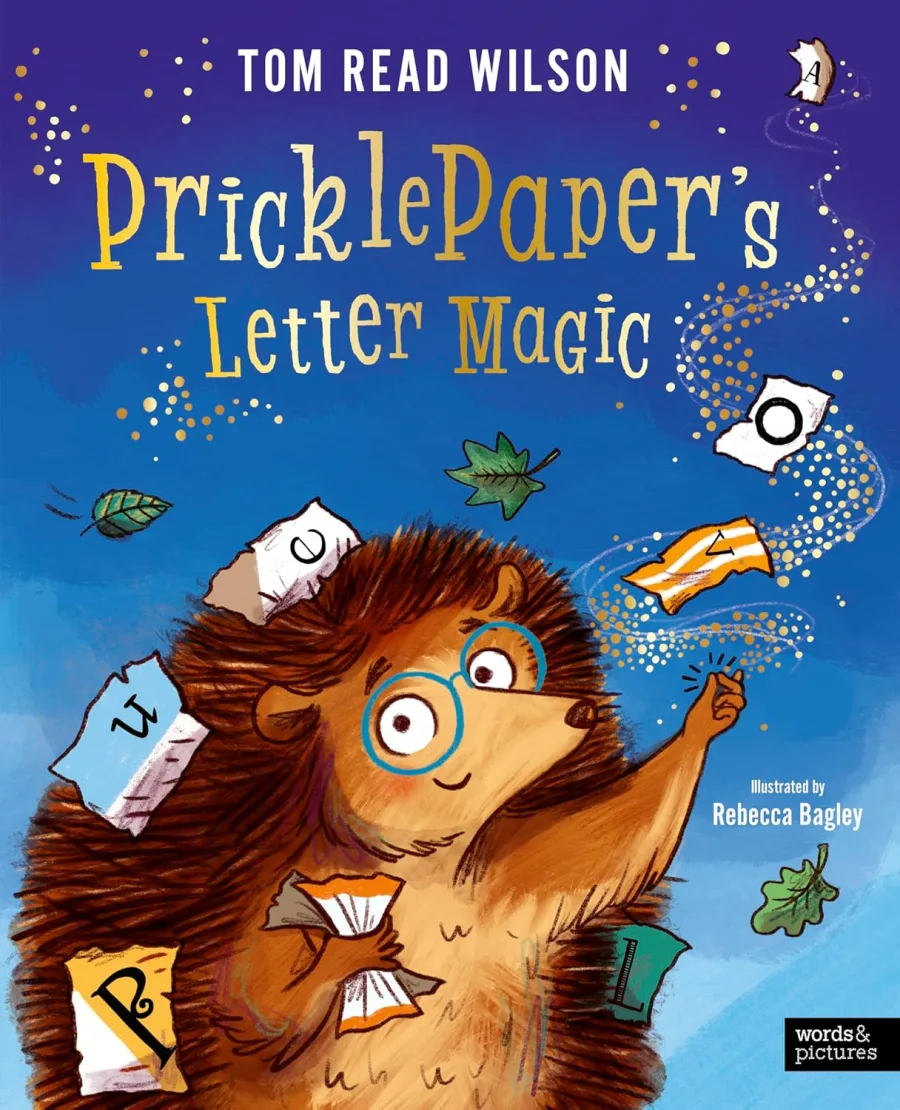
The illustrations by Rebecca Bagley play an important role in making this world appealing to young readers. The publisher describes them as adorable, timeless, full-colour illustrations. The visual style complements the gentle nature of the story and helps turn the abstract idea of letters into something children can see and follow. The physical appearance of the letters, the hedgehog, the park, and Pricklepaper's encounters with his friends all contribute to the book's playful atmosphere.
The book is also particularly suited to reading aloud. Its rhyme and wordplay create a natural rhythm, while the repeated attention to letters gives children opportunities to participate mentally in the story. Adults reading with children can encourage them to look for words, identify letters, rearrange combinations, and discuss the feelings behind Pricklepaper's actions. In that sense, the book works simultaneously as entertainment and as an introduction to the pleasure of language.
Tom Read Wilson's enthusiasm for words is central to the book's character. Wilson is known as a performer, television presenter, actor, singer, and self-described logophile, and his interest in language is reflected strongly in the story. Google Books describes him as a celebrated wordsmith, while the publisher emphasizes the book's use of rhyme and wordplay. The result is a children's story in which vocabulary does not feel like homework. Words become objects of discovery and sources of delight.
At the same time, the book avoids making language the only focus. The wordplay always serves the emotional story. The letters matter because they connect Pricklepaper with his friends. The eventual discovery of "LOVE" matters because the word expresses the lesson of the entire adventure. Children can therefore enjoy the story even if they are not consciously analyzing its linguistic structure.
Perhaps the most touching aspect of Pricklepaper's Letter Magic is that Pricklepaper does not set out to discover a grand lesson. He simply goes about his evening routine. He collects litter because he enjoys it. He collects letters because he loves words. He helps his friends because they need him. Only afterward does he discover that his ordinary acts have created something extraordinary.
This makes the story's message feel natural rather than preachy. Kindness is presented as something that can happen in everyday life. A person does not need to perform a heroic act to make a difference. Listening to a friend, offering advice, sharing something valuable, or helping someone solve a small problem can all be meaningful. The story celebrates these quiet forms of generosity.
Ultimately, Pricklepaper's Letter Magic is a warm story about the connection between language and kindness. Its clever central idea—that letters can be rearranged to make new words—becomes a metaphor for life itself. What appears to be an ending can become a beginning. What seems like a loss can reveal a new possibility. What looks like a handful of meaningless letters can become a word filled with emotional significance.
Pricklepaper begins his evening looking for words and ends it discovering something much larger than a word. He learns that the things we share can sometimes create more happiness than the things we keep. He learns that helping others can change the way we see what we have. Most importantly, his remaining letters spell LOVE, revealing the true meaning behind his journey.
The deepest message of the book is therefore beautifully simple: kindness creates its own kind of magic. We may give away a little of what belongs to us—our time, attention, possessions, patience, or knowledge—and feel that we have lost something. But generosity can produce something that cannot be measured in the same way. It can create friendship, gratitude, belonging, and love. Through a cheerful hedgehog, a collection of discarded letters, and a playful journey through the park, Tom Read Wilson turns this idea into an engaging and memorable story for children.
Pricklepaper's Letter Magic ultimately reminds young readers that words have power, but actions give those words their deepest meaning. Pricklepaper does not merely discover the word "LOVE"; he demonstrates it. That is the real magic of his letters, and it is what makes this gentle picture book more than a simple story about spelling. It becomes a celebration of curiosity, friendship, sharing, environmental care, and the extraordinary difference that a small act of kindness can make.
Pricklepaper is an unusual little hero because he finds happiness in something that most creatures would probably ignore. While other animals might simply walk past scraps of paper lying in the park, Pricklepaper notices them. He collects them carefully and brings them together because he enjoys discovering what their letters can say. There is something wonderfully childlike about this habit. Children often find fascination in ordinary things: a strange-shaped stone, a colourful leaf, a discarded button, or a letter written on a piece of paper. Pricklepaper's world encourages that same sense of curiosity. To him, letters are tiny pieces of possibility. Put them together in one way and they create one word; arrange them differently and they can create something entirely new.
His collecting also gives the story an environmental dimension. Pricklepaper is a litter-picking hedgehog, so his nightly activity helps make the park cleaner while giving him something he loves doing. The book therefore presents care for the environment in a natural and appealing way rather than turning it into a formal lesson. Pricklepaper simply enjoys looking after his surroundings. His helpfulness is part of his personality, and this becomes important as the story progresses. The act of picking up litter becomes connected with another kind of care: noticing when somebody else needs help.
Pricklepaper is especially excited when the letters he collects form a new word that gives him a warm, comfortable feeling. The words are not presented merely as vocabulary exercises. They have emotional meaning for him. Discovering a word becomes a small adventure, and the process of putting letters together teaches children that language can be playful. The story encourages readers to look at letters not as isolated symbols but as building blocks that can express ideas, feelings, and relationships. This wordplay is one of the book's defining features, and it reflects Tom Read Wilson's well-known enthusiasm for language. The publisher describes the book as being built around rhyme and wordplay, with the pleasure of spotting patterns and discovering how small changes in language can create meaningful differences.
After his successful evening of collecting, Pricklepaper begins making his way home. This is where the story changes from a simple tale about collecting letters into a story about friendship and generosity. Along the way, Pricklepaper encounters friends who are experiencing problems. Instead of ignoring them because he is eager to get home and enjoy his newly collected letters, he stops to listen. He lends them his ear, offers advice, and tries to understand what they need. His first response is not to solve everything immediately but to listen. That simple act is important because it shows that kindness begins with paying attention to another person.
As Pricklepaper talks to his friends, he realizes that some of the letters attached to his quills may actually be useful to them. The letters that he had collected for his own enjoyment can be given away to help somebody else. This is the central turning point of the story. Pricklepaper has discovered something precious to himself, but he is willing to share it when he realizes that it can make a difference to another creature.
The idea is simple, but it carries an important emotional lesson for young readers. Sharing is not always easy when we genuinely value something. It is easy to give away something we no longer want, but generosity becomes more meaningful when we offer something that matters to us. Pricklepaper's letters are his treasures. He has spent time collecting them, arranging them, and enjoying the words they create. When he gives them to his friends, he is not simply getting rid of scraps. He is giving away something he loves.
The story handles this lesson gently rather than presenting Pricklepaper as perfectly selfless. After helping his friends, he eventually reaches home and realizes what his generosity has cost him. The letters that had spelled out his special new word are gone. He had given them away because his friends needed them, and now the remaining letters attached to his quills do not seem to make sense. Instead of feeling triumphant, Pricklepaper feels sad. His kindness has produced good results for others, but he is also experiencing the very human feeling of missing something he valued.
This emotional moment makes the story more believable and humane. The message is not that giving things away is always effortless or that a kind person should never feel disappointed. Pricklepaper is allowed to feel sad. He can be happy that he helped his friends while also wishing that he still had his special word. Both feelings can exist together. For children, this is an important emotional idea: doing the right thing does not necessarily mean that every difficult feeling disappears immediately.
When Pricklepaper looks at the letters that remain on his quills, however, the story takes its magical turn. At first, the leftover letters appear meaningless. The arrangement that once made sense has been broken apart. Pricklepaper cannot see a word in them. But when he places the remaining letters on the floor and looks at them again, he discovers something wonderful. The letters can be rearranged into a completely new word: L.O.V.E.
This final discovery gives the entire story its deeper meaning. Pricklepaper thought that by giving away his letters he had lost something precious. Instead, the letters he had left behind reveal a word that expresses exactly what his actions have demonstrated. Love is not something he has lost by sharing; in a sense, he has discovered it. His kindness toward his friends has transformed his collection of letters into a new and more meaningful message.
The word "LOVE" therefore functions as both a literal word puzzle and the emotional conclusion of the book. It is created from the remaining letters, but it also describes Pricklepaper's behaviour. He listens to his friends, takes their problems seriously, and gives them something that matters to him. The word that emerges at the end confirms that his actions have been expressions of care. The magic is not really contained in the scraps of paper. The magic lies in what Pricklepaper chooses to do with them.
This is why the book's title, Pricklepaper's Letter Magic, has more than one meaning. The letters appear magical because they can be rearranged into different words, but the deeper magic is the transformation that takes place through kindness. Something discarded becomes useful. Something private becomes shared. Something that seems lost becomes the beginning of something new. And a collection of ordinary letters ultimately creates the most emotionally important word in the story.
The structure also teaches children about the flexibility of language. Letters can change their meaning when they are rearranged. A group of symbols that appears meaningless in one order can become a recognizable and powerful word in another. This mirrors the book's emotional lesson. Circumstances can also change when viewed differently. Pricklepaper initially sees his remaining letters as useless because they no longer form the word he wanted. Only when he looks again does he recognize their new possibility.
In this way, the book quietly encourages resilience. When something does not work out as expected, there may still be another possibility waiting to be discovered. Pricklepaper does not magically get back what he gave away. Instead, he finds something different. The replacement is not identical to what he lost, but it is arguably more meaningful because it represents what happened during his journey home.
Friendship is another central theme. Pricklepaper does not help strangers simply because he wants to appear good. He takes time to listen to his friends and offers practical help. The story suggests that friendship involves noticing the needs of others and being willing to respond. Sometimes help may involve advice; sometimes it may involve sharing something; sometimes it may simply mean listening. Pricklepaper demonstrates all three.
The story also presents generosity as something that can have unexpected consequences. Pricklepaper gives his letters away because he wants to help, but the effect is not limited to the immediate problems of his friends. His generosity changes him as well. By helping others, he learns something about the value of what he has and discovers a new meaning in what remains. The act of giving therefore becomes transformative for both the giver and the recipients.
The illustrations by Rebecca Bagley play an important role in making this world appealing to young readers. The publisher describes them as adorable, timeless, full-colour illustrations. The visual style complements the gentle nature of the story and helps turn the abstract idea of letters into something children can see and follow. The physical appearance of the letters, the hedgehog, the park, and Pricklepaper's encounters with his friends all contribute to the book's playful atmosphere.
The book is also particularly suited to reading aloud. Its rhyme and wordplay create a natural rhythm, while the repeated attention to letters gives children opportunities to participate mentally in the story. Adults reading with children can encourage them to look for words, identify letters, rearrange combinations, and discuss the feelings behind Pricklepaper's actions. In that sense, the book works simultaneously as entertainment and as an introduction to the pleasure of language.
Tom Read Wilson's enthusiasm for words is central to the book's character. Wilson is known as a performer, television presenter, actor, singer, and self-described logophile, and his interest in language is reflected strongly in the story. Google Books describes him as a celebrated wordsmith, while the publisher emphasizes the book's use of rhyme and wordplay. The result is a children's story in which vocabulary does not feel like homework. Words become objects of discovery and sources of delight.
At the same time, the book avoids making language the only focus. The wordplay always serves the emotional story. The letters matter because they connect Pricklepaper with his friends. The eventual discovery of "LOVE" matters because the word expresses the lesson of the entire adventure. Children can therefore enjoy the story even if they are not consciously analyzing its linguistic structure.
Perhaps the most touching aspect of Pricklepaper's Letter Magic is that Pricklepaper does not set out to discover a grand lesson. He simply goes about his evening routine. He collects litter because he enjoys it. He collects letters because he loves words. He helps his friends because they need him. Only afterward does he discover that his ordinary acts have created something extraordinary.
This makes the story's message feel natural rather than preachy. Kindness is presented as something that can happen in everyday life. A person does not need to perform a heroic act to make a difference. Listening to a friend, offering advice, sharing something valuable, or helping someone solve a small problem can all be meaningful. The story celebrates these quiet forms of generosity.
Ultimately, Pricklepaper's Letter Magic is a warm story about the connection between language and kindness. Its clever central idea—that letters can be rearranged to make new words—becomes a metaphor for life itself. What appears to be an ending can become a beginning. What seems like a loss can reveal a new possibility. What looks like a handful of meaningless letters can become a word filled with emotional significance.
Pricklepaper begins his evening looking for words and ends it discovering something much larger than a word. He learns that the things we share can sometimes create more happiness than the things we keep. He learns that helping others can change the way we see what we have. Most importantly, his remaining letters spell LOVE, revealing the true meaning behind his journey.
The deepest message of the book is therefore beautifully simple: kindness creates its own kind of magic. We may give away a little of what belongs to us—our time, attention, possessions, patience, or knowledge—and feel that we have lost something. But generosity can produce something that cannot be measured in the same way. It can create friendship, gratitude, belonging, and love. Through a cheerful hedgehog, a collection of discarded letters, and a playful journey through the park, Tom Read Wilson turns this idea into an engaging and memorable story for children.
Pricklepaper's Letter Magic ultimately reminds young readers that words have power, but actions give those words their deepest meaning. Pricklepaper does not merely discover the word "LOVE"; he demonstrates it. That is the real magic of his letters, and it is what makes this gentle picture book more than a simple story about spelling. It becomes a celebration of curiosity, friendship, sharing, environmental care, and the extraordinary difference that a small act of kindness can make.
Sample Chapters
Sample Chapters will be added soon…
Reader Reviews
No reviews yet.
Pricklepaper's Letter Magic
Download Cover Image
Do you want to download the full cover image for Pricklepaper's Letter Magic?