
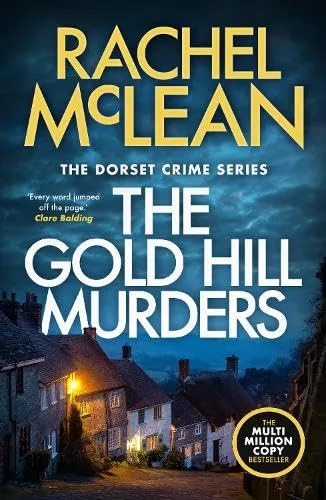
The Gold Hill Murders: 13 (Dorset Crime)
Paperback
• 364 Pages
• GBP 9.99
• English
• 9781835602713
No ratings yet
| Publisher | Ackroyd Publishing |
|---|---|
| ISBN13 | 9781835602713 |
| ASIN/SKU | 1835602711 |
| Book Format | Paperback |
| Language | English |
| Pages | 364 |
| List Price | GBP 9.99 |
| Publishing Date | 17/09/2026 |
| Dimensions | 12.9 x 2.2 x 19.8 cm |
| Weight | 301 g |
| Book Code | BD00055713 |
Buy this Book
Amazon Stores
Ebook Stores
Other Stores
Discover The Gold Hill Murders: 13 (Dorset Crime) by Rachel McLean. This book is published by Ackroyd Publishing in Paperback format, ISBN 9781835602713, ASIN 1835602711, under Mystery, Thriller and Suspense, Police Procedurals, Mysteries.
Book Description
DCI Lesley Clarke’s team is still reeling from the fallout of the Mudeford Spit case and the loss of a much-loved colleague. But there’s no time to adjust. On the very day that they’re commemorating their friend, a new case comes in – a homeless man found dead at Shaftesbury’s iconic Gold Hill. At first glance, the case looks straightforward: a drug addict, a tragic accident involving the flame he used to cook his next fix. But fire investigators are convinced this wasn’t an accidental death. Was the man really the nobody he appeared to be, or something more? And who could have staged such an elaborate attempt to fool investigators? Set against a backdrop of grief, tension between two key investigators and a blossoming romance for the newest member of the team, The Gold Hill Murders continues the million-selling Dorset Crime series with even more intrigue and drama.
Author Biography
Rachel McLean writes thrillers that make your pulse race and your brain tick. A proud indie author who manages her own publishing company, she has sold millions of copies digitally and hundreds of thousands in print, regularly topping the bestseller lists. She is the author of the Dorset Crime novels and five spin-off crime series, with beloved characters appearing in multiple series. In 2021, she won the Kindle Storyteller Award with The Corfe Castle Murders. She divides her time between Birmingham and Dorset and lives with her wife, three children and two cats Cagney and Lacey.
Editorial Reviews
Editorial Reviews will be added soon…
Book Summary
The Gold Hill Murders by Rachel McLean is the thirteenth novel in the author’s popular Dorset Crime series, featuring DCI Lesley Clarke and her Dorset Police Major Crimes Investigation Team. Published in September 2026, the novel combines a carefully constructed murder mystery with the continuing personal stories of the detectives who investigate it. Set in Shaftesbury, Dorset, and centred on the famous steep cobbled street of Gold Hill, the story begins with an apparently straightforward death that quickly becomes something much more disturbing.
The novel opens at a difficult moment for Lesley Clarke and her team. They are still dealing with the emotional consequences of the previous case at Mudeford Spit, particularly the loss of a much-loved colleague. Instead of having time to grieve properly, the investigators are confronted with another death. The timing is especially painful because the new case arrives on the very day the team is commemorating their lost friend. Their personal grief therefore becomes part of the atmosphere of the investigation. The detectives are professionals who must put their emotions aside and work, but the loss remains close to them.
The new case initially appears to be the kind of tragedy that might easily be overlooked. A homeless man has been found dead at Shaftesbury's iconic Gold Hill. At first glance, there seems to be an obvious explanation. The dead man appears to have been a drug addict, and the circumstances suggest that he may have accidentally set himself on fire while using a flame to prepare his next dose. If that explanation were correct, the death would be tragic but relatively uncomplicated.
However, experienced investigators know that an apparently simple explanation can sometimes conceal a much darker truth. Fire investigators become suspicious and determine that the death does not look accidental. What initially seems to be a tragic death may actually be a carefully constructed murder. This discovery changes the entire direction of the investigation. Lesley and her team must now ask not only who the dead man was, but why someone would go to such elaborate lengths to make his death look like an accident.
One of the most important questions in the novel is contained in the apparent identity of the victim. He is initially seen as a homeless man, someone society might easily overlook. But the investigators begin to wonder whether he really was the insignificant figure he appeared to be. Was there another side to his life? Did he have connections, enemies, secrets, or a past that nobody knew about? The investigation therefore becomes an attempt to reconstruct the life of a person who, on the surface, seemed to have disappeared from ordinary society.
This gives the mystery a strong human dimension. The dead man is not treated merely as a body around which a police investigation revolves. His identity becomes part of the puzzle. The detectives have to discover who he was before they can understand why somebody wanted him dead. The apparent anonymity of the victim is therefore itself a clue.
The setting is particularly important to the novel. Gold Hill in Shaftesbury is a real and famous location, known for its steep cobbled slope and for its appearance in the classic Hovis bread advertisement. McLean deliberately uses this picturesque location as the backdrop for a disturbing crime. The contrast between the beauty and familiarity of the place and the violence associated with the murder creates an unsettling atmosphere.
McLean has explained that she visited Shaftesbury while researching the novel and spent time exploring Gold Hill, the surrounding woods, lanes, and other locations. She was particularly interested in the practical difficulties that firefighters and emergency services would face in the town's narrow streets. The novel is set in September, with rain contributing to the atmosphere. The author also drew inspiration from firefighter Sabrina Cohen-Hatton's work on the psychology of effective firefighting, which helped shape the idea of a murder deliberately disguised as an accidental fire.
This research gives the crime a believable procedural foundation. The investigators do not simply discover a body and immediately identify the murderer. Instead, the case develops through forensic questions, fire investigation, police work, interviews, evidence, and the gradual reconstruction of events. The distinction between an accident and deliberate arson becomes particularly important. Someone has apparently tried to manipulate the evidence so that investigators will reach the wrong conclusion.
For Lesley Clarke, the case is made more difficult by the emotional state of her team. The previous investigation has left them grieving, and their new case arrives before they have had time to recover. This creates an interesting tension between professional responsibility and personal emotion. Police officers are expected to continue functioning even when they are affected by loss, but the novel recognizes that grief does not disappear simply because another case requires attention.
Lesley herself remains the central figure around whom the team operates. She is the head of the Major Crimes Investigation Team and the lead detective throughout the Dorset Crime series. In The Gold Hill Murders, she has to manage not only the investigation but also the people around her. Her role involves making decisions, evaluating evidence, encouraging her colleagues, and maintaining focus when emotions threaten to complicate the work.
The investigation also reveals tensions within the team. The official description specifically points to tension between two key investigators, suggesting that the pressure of the case is affecting professional relationships. This is an important feature of the novel because the detectives are not presented as emotionless crime-solving machines. They have relationships, disagreements, loyalties, insecurities, and personal histories. The murder investigation takes place alongside these continuing human complications.
At the same time, there is a more hopeful personal storyline involving the newest member of the team. A romance begins to develop, creating a contrast with the darkness of the murder investigation. While one part of the story is concerned with death, deception, and grief, another explores the possibility of affection and new beginnings. This balance between professional danger and personal relationships is characteristic of a continuing police series, where the detectives' lives develop alongside the individual cases they solve.
Another interesting aspect of the novel is the way it examines appearances. The murder itself is based on a false appearance: a deliberate killing is made to look like an accident. But the same idea extends to the victim and the people surrounding the investigation. The homeless man appears to be one kind of person, but the detectives suspect there is more to his story. The scene appears to tell one story, but forensic evidence suggests another. Even relationships within the police team may contain tensions that are not immediately visible.
The result is a mystery built around layers of deception. The investigators cannot rely solely on what they see. They must question assumptions and reconstruct the truth from details that may initially appear insignificant. The central mystery consequently becomes not simply "Who killed him?" but "What really happened here, and why did somebody want it to look different?"
The victim's apparent homelessness also adds a social dimension to the novel. People who live on the margins of society can become invisible to the wider community. A person without a stable home may be noticed only when something goes wrong. In this story, however, the police are forced to look beyond that surface identity. The investigation asks the reader to consider how easily assumptions about vulnerable or marginalized people can obscure the complexity of their lives.
This makes the murder more troubling. If the victim had been killed because someone believed that nobody would care or investigate properly, then the crime involves not only personal violence but exploitation of social invisibility. The detectives' determination to discover his identity and circumstances gives the investigation an additional moral significance.
The book also continues the broader character development of the Dorset Crime series. Readers who have followed Lesley Clarke from earlier novels will already know that her team has experienced significant changes. The Gold Hill Murders follows The Beach Hut Murders, the twelfth book in the series, which was set around Mudeford Spit and Hengistbury Head. The previous case's fallout directly affects the emotional circumstances of the new novel.
Because of this continuity, the novel works on two levels. For a reader interested primarily in the murder mystery, there is a new case involving a suspicious death, forensic investigation, hidden identities, and deliberate deception. For long-time readers, there is an additional story involving the continuing lives of Lesley and her colleagues. Their relationships and emotional experiences provide a thread connecting the individual books.
The title itself is straightforward but effective. The Gold Hill Murders connects the crime directly to the location, giving the famous Dorset landmark a darker identity. Gold Hill is normally associated with beauty, history, tourism, and the nostalgic imagery of the Hovis advertisement. McLean transforms that familiar landscape into the centre of a police investigation. The contrast gives the setting a memorable role rather than treating it as simple scenery.
The novel's procedural element is also strengthened by the involvement of fire investigators. The author has described the story as her first novel dealing specifically with arson and the idea of a murder disguised as an accidental fire. This creates a distinctive investigative problem. A fire can destroy evidence, alter a crime scene, and create plausible alternative explanations. Determining whether the flames were the cause of death or part of a deliberate attempt to hide the murder becomes essential to discovering the truth.
As the investigation develops, the detectives must therefore separate coincidence from intention. They have to establish what happened before the fire, why the victim was there, who might have known him, and who had the knowledge or opportunity to construct such an elaborate deception. Each answer raises further questions. The investigation becomes a gradual process of stripping away false explanations.
At the heart of the story is DCI Lesley Clarke's determination to see beyond the obvious. Her strength as an investigator comes not from having immediate answers but from refusing to accept an explanation simply because it appears convenient. The suspicious fire forces the team to reconsider the entire case, while the mystery surrounding the victim forces them to reconstruct a life that initially seems to contain very few clues.
Emotionally, however, the novel is also about grief and recovery. Lesley's team is still carrying the pain of losing someone they cared about. Their work requires them to investigate another death while their own loss remains fresh. This creates a poignant parallel: they are trying to understand one person's death while privately processing another. Their professional duty becomes inseparable from their personal experience.
The developing romance involving the newest team member provides a counterpoint to that grief. It reminds the reader that even within a world dominated by murder investigations, people continue to form relationships and seek happiness. Life does not stop because someone has died. New connections can emerge even while old wounds remain.
Ultimately, The Gold Hill Murders is a police procedural mystery about appearances, hidden identities, grief, and the search for truth. Its central crime begins with a seemingly insignificant victim and an apparently accidental death, but both assumptions gradually become questionable. What looks simple becomes complicated; what looks accidental appears deliberate; and a person who initially seems to have no importance turns out to be at the centre of a much larger mystery.
The novel's deeper emotional message comes from the insistence that every victim matters. A person's social position, appearance, or circumstances should not determine the value placed on their life. The investigators' willingness to look more closely at the dead man gives the story its human heart. Behind the label of "homeless man" is an individual with a history, relationships, secrets, and a reason why someone might have wanted him dead.
By combining this mystery with the continuing emotional lives of DCI Lesley Clarke and her team, Rachel McLean creates a story that is both a standalone investigation and part of a larger character-driven series. The Dorset landscape provides a beautiful but unsettling backdrop, while the investigation into the staged fire supplies the central suspense. Above all, The Gold Hill Murders shows how dangerous appearances can be and how much patience, experience, and human understanding are required to uncover the truth when someone has deliberately tried to hide it.
In the end, the novel is not simply about discovering a murderer. It is about restoring a forgotten person's identity, understanding the truth behind a carefully constructed deception, and showing that even those who seem invisible deserve to have their stories heard. Against the picturesque backdrop of Gold Hill, Rachel McLean turns an apparently ordinary death into a complex investigation that tests both the professional abilities and personal resilience of DCI Lesley Clarke and her team.
The novel opens at a difficult moment for Lesley Clarke and her team. They are still dealing with the emotional consequences of the previous case at Mudeford Spit, particularly the loss of a much-loved colleague. Instead of having time to grieve properly, the investigators are confronted with another death. The timing is especially painful because the new case arrives on the very day the team is commemorating their lost friend. Their personal grief therefore becomes part of the atmosphere of the investigation. The detectives are professionals who must put their emotions aside and work, but the loss remains close to them.
The new case initially appears to be the kind of tragedy that might easily be overlooked. A homeless man has been found dead at Shaftesbury's iconic Gold Hill. At first glance, there seems to be an obvious explanation. The dead man appears to have been a drug addict, and the circumstances suggest that he may have accidentally set himself on fire while using a flame to prepare his next dose. If that explanation were correct, the death would be tragic but relatively uncomplicated.
However, experienced investigators know that an apparently simple explanation can sometimes conceal a much darker truth. Fire investigators become suspicious and determine that the death does not look accidental. What initially seems to be a tragic death may actually be a carefully constructed murder. This discovery changes the entire direction of the investigation. Lesley and her team must now ask not only who the dead man was, but why someone would go to such elaborate lengths to make his death look like an accident.
One of the most important questions in the novel is contained in the apparent identity of the victim. He is initially seen as a homeless man, someone society might easily overlook. But the investigators begin to wonder whether he really was the insignificant figure he appeared to be. Was there another side to his life? Did he have connections, enemies, secrets, or a past that nobody knew about? The investigation therefore becomes an attempt to reconstruct the life of a person who, on the surface, seemed to have disappeared from ordinary society.
This gives the mystery a strong human dimension. The dead man is not treated merely as a body around which a police investigation revolves. His identity becomes part of the puzzle. The detectives have to discover who he was before they can understand why somebody wanted him dead. The apparent anonymity of the victim is therefore itself a clue.
The setting is particularly important to the novel. Gold Hill in Shaftesbury is a real and famous location, known for its steep cobbled slope and for its appearance in the classic Hovis bread advertisement. McLean deliberately uses this picturesque location as the backdrop for a disturbing crime. The contrast between the beauty and familiarity of the place and the violence associated with the murder creates an unsettling atmosphere.
McLean has explained that she visited Shaftesbury while researching the novel and spent time exploring Gold Hill, the surrounding woods, lanes, and other locations. She was particularly interested in the practical difficulties that firefighters and emergency services would face in the town's narrow streets. The novel is set in September, with rain contributing to the atmosphere. The author also drew inspiration from firefighter Sabrina Cohen-Hatton's work on the psychology of effective firefighting, which helped shape the idea of a murder deliberately disguised as an accidental fire.
This research gives the crime a believable procedural foundation. The investigators do not simply discover a body and immediately identify the murderer. Instead, the case develops through forensic questions, fire investigation, police work, interviews, evidence, and the gradual reconstruction of events. The distinction between an accident and deliberate arson becomes particularly important. Someone has apparently tried to manipulate the evidence so that investigators will reach the wrong conclusion.
For Lesley Clarke, the case is made more difficult by the emotional state of her team. The previous investigation has left them grieving, and their new case arrives before they have had time to recover. This creates an interesting tension between professional responsibility and personal emotion. Police officers are expected to continue functioning even when they are affected by loss, but the novel recognizes that grief does not disappear simply because another case requires attention.
Lesley herself remains the central figure around whom the team operates. She is the head of the Major Crimes Investigation Team and the lead detective throughout the Dorset Crime series. In The Gold Hill Murders, she has to manage not only the investigation but also the people around her. Her role involves making decisions, evaluating evidence, encouraging her colleagues, and maintaining focus when emotions threaten to complicate the work.
The investigation also reveals tensions within the team. The official description specifically points to tension between two key investigators, suggesting that the pressure of the case is affecting professional relationships. This is an important feature of the novel because the detectives are not presented as emotionless crime-solving machines. They have relationships, disagreements, loyalties, insecurities, and personal histories. The murder investigation takes place alongside these continuing human complications.
At the same time, there is a more hopeful personal storyline involving the newest member of the team. A romance begins to develop, creating a contrast with the darkness of the murder investigation. While one part of the story is concerned with death, deception, and grief, another explores the possibility of affection and new beginnings. This balance between professional danger and personal relationships is characteristic of a continuing police series, where the detectives' lives develop alongside the individual cases they solve.
Another interesting aspect of the novel is the way it examines appearances. The murder itself is based on a false appearance: a deliberate killing is made to look like an accident. But the same idea extends to the victim and the people surrounding the investigation. The homeless man appears to be one kind of person, but the detectives suspect there is more to his story. The scene appears to tell one story, but forensic evidence suggests another. Even relationships within the police team may contain tensions that are not immediately visible.
The result is a mystery built around layers of deception. The investigators cannot rely solely on what they see. They must question assumptions and reconstruct the truth from details that may initially appear insignificant. The central mystery consequently becomes not simply "Who killed him?" but "What really happened here, and why did somebody want it to look different?"
The victim's apparent homelessness also adds a social dimension to the novel. People who live on the margins of society can become invisible to the wider community. A person without a stable home may be noticed only when something goes wrong. In this story, however, the police are forced to look beyond that surface identity. The investigation asks the reader to consider how easily assumptions about vulnerable or marginalized people can obscure the complexity of their lives.
This makes the murder more troubling. If the victim had been killed because someone believed that nobody would care or investigate properly, then the crime involves not only personal violence but exploitation of social invisibility. The detectives' determination to discover his identity and circumstances gives the investigation an additional moral significance.
The book also continues the broader character development of the Dorset Crime series. Readers who have followed Lesley Clarke from earlier novels will already know that her team has experienced significant changes. The Gold Hill Murders follows The Beach Hut Murders, the twelfth book in the series, which was set around Mudeford Spit and Hengistbury Head. The previous case's fallout directly affects the emotional circumstances of the new novel.
Because of this continuity, the novel works on two levels. For a reader interested primarily in the murder mystery, there is a new case involving a suspicious death, forensic investigation, hidden identities, and deliberate deception. For long-time readers, there is an additional story involving the continuing lives of Lesley and her colleagues. Their relationships and emotional experiences provide a thread connecting the individual books.
The title itself is straightforward but effective. The Gold Hill Murders connects the crime directly to the location, giving the famous Dorset landmark a darker identity. Gold Hill is normally associated with beauty, history, tourism, and the nostalgic imagery of the Hovis advertisement. McLean transforms that familiar landscape into the centre of a police investigation. The contrast gives the setting a memorable role rather than treating it as simple scenery.
The novel's procedural element is also strengthened by the involvement of fire investigators. The author has described the story as her first novel dealing specifically with arson and the idea of a murder disguised as an accidental fire. This creates a distinctive investigative problem. A fire can destroy evidence, alter a crime scene, and create plausible alternative explanations. Determining whether the flames were the cause of death or part of a deliberate attempt to hide the murder becomes essential to discovering the truth.
As the investigation develops, the detectives must therefore separate coincidence from intention. They have to establish what happened before the fire, why the victim was there, who might have known him, and who had the knowledge or opportunity to construct such an elaborate deception. Each answer raises further questions. The investigation becomes a gradual process of stripping away false explanations.
At the heart of the story is DCI Lesley Clarke's determination to see beyond the obvious. Her strength as an investigator comes not from having immediate answers but from refusing to accept an explanation simply because it appears convenient. The suspicious fire forces the team to reconsider the entire case, while the mystery surrounding the victim forces them to reconstruct a life that initially seems to contain very few clues.
Emotionally, however, the novel is also about grief and recovery. Lesley's team is still carrying the pain of losing someone they cared about. Their work requires them to investigate another death while their own loss remains fresh. This creates a poignant parallel: they are trying to understand one person's death while privately processing another. Their professional duty becomes inseparable from their personal experience.
The developing romance involving the newest team member provides a counterpoint to that grief. It reminds the reader that even within a world dominated by murder investigations, people continue to form relationships and seek happiness. Life does not stop because someone has died. New connections can emerge even while old wounds remain.
Ultimately, The Gold Hill Murders is a police procedural mystery about appearances, hidden identities, grief, and the search for truth. Its central crime begins with a seemingly insignificant victim and an apparently accidental death, but both assumptions gradually become questionable. What looks simple becomes complicated; what looks accidental appears deliberate; and a person who initially seems to have no importance turns out to be at the centre of a much larger mystery.
The novel's deeper emotional message comes from the insistence that every victim matters. A person's social position, appearance, or circumstances should not determine the value placed on their life. The investigators' willingness to look more closely at the dead man gives the story its human heart. Behind the label of "homeless man" is an individual with a history, relationships, secrets, and a reason why someone might have wanted him dead.
By combining this mystery with the continuing emotional lives of DCI Lesley Clarke and her team, Rachel McLean creates a story that is both a standalone investigation and part of a larger character-driven series. The Dorset landscape provides a beautiful but unsettling backdrop, while the investigation into the staged fire supplies the central suspense. Above all, The Gold Hill Murders shows how dangerous appearances can be and how much patience, experience, and human understanding are required to uncover the truth when someone has deliberately tried to hide it.
In the end, the novel is not simply about discovering a murderer. It is about restoring a forgotten person's identity, understanding the truth behind a carefully constructed deception, and showing that even those who seem invisible deserve to have their stories heard. Against the picturesque backdrop of Gold Hill, Rachel McLean turns an apparently ordinary death into a complex investigation that tests both the professional abilities and personal resilience of DCI Lesley Clarke and her team.
Sample Chapters
Sample Chapters will be added soon…
Reader Reviews
No reviews yet.
The Gold Hill Murders: 13 (Dorset Crime)
Download Cover Image
Do you want to download the full cover image for The Gold Hill Murders: 13 (Dorset Crime)?