
Laravel: Up & Running - A Framework for Building Modern PHP Apps, Third Edition
Paperback
• 869 Pages
• INR 2200.00
• English
• 9781098153229
No ratings yet
| Publisher | O'Reilly Media |
|---|---|
| ISBN13 | 9781098153229 |
| ASIN/SKU | 9355428189 |
| Book Format | Paperback |
| Language | English |
| Pages | 869 |
| List Price | INR 2200.00 |
| Publishing Date | 24/09/2023 |
| Dimensions | 22.86 x 17.78 x 2.79 cm |
| Weight | 900 g |
| Book Code | BD00055321 |
Buy this Book
Amazon Stores
Ebook Stores
Other Stores
Discover Laravel: Up and Running - A Framework for Building Modern PHP Apps, Third Edition by Matt Stauffer. This book is published by O'Reilly Media in Paperback format, ISBN 9781098153229, ASIN 9355428189, under Computers and Technology, Computer Science.
Book Description
Shroff Publishers do not endorse the preview pages of kindle linked to our ISBNs. All Indian Reprints of O'Reilly are Printed in Grayscale.
What sets Laravel apart from other PHP web frameworks? Speed and simplicity, for starters. This rapid application development framework and its ecosystem of tools let you quickly build new sites and applications with clean, readable code. Fully updated to include Laravel 10, the third edition of this practical guide provides the definitive introduction to one of today's most popular web frameworks.
Matt Stauffer, a leading teacher and developer in the Laravel community, delivers a high-level overview and concrete examples to help experienced PHP web developers get started with this framework right away. This updated edition covers the entirely new auth and frontend tooling and other first-party tools introduced since the second edition.
Dive into features, including:
Blade, Laravel's powerful custom templating tool
Tools for gathering, validating, normalizing, and filtering user-provided data
The Eloquent ORM for working with application databases
The Illuminate request object and its role in the application lifecycle
PHPUnit, Mockery, and Dusk for testing your PHP code
Tools for writing JSON and RESTful APIs
Interfaces for filesystem access, sessions, cookies, caches, and search
Tools for implementing queues, jobs, events, and WebSocket event publishing
Specialty packages including Scout, Passport, Cashier, and more
What sets Laravel apart from other PHP web frameworks? Speed and simplicity, for starters. This rapid application development framework and its ecosystem of tools let you quickly build new sites and applications with clean, readable code. Fully updated to include Laravel 10, the third edition of this practical guide provides the definitive introduction to one of today's most popular web frameworks.
Matt Stauffer, a leading teacher and developer in the Laravel community, delivers a high-level overview and concrete examples to help experienced PHP web developers get started with this framework right away. This updated edition covers the entirely new auth and frontend tooling and other first-party tools introduced since the second edition.
Dive into features, including:
Blade, Laravel's powerful custom templating tool
Tools for gathering, validating, normalizing, and filtering user-provided data
The Eloquent ORM for working with application databases
The Illuminate request object and its role in the application lifecycle
PHPUnit, Mockery, and Dusk for testing your PHP code
Tools for writing JSON and RESTful APIs
Interfaces for filesystem access, sessions, cookies, caches, and search
Tools for implementing queues, jobs, events, and WebSocket event publishing
Specialty packages including Scout, Passport, Cashier, and more
Author Biography
Matt Stauffer is the CEO and co-founder of Tighten. He’s the host of the Laravel Podcast, the author of O’Reilly’s Laravel: Up and Running, a prolific open source contributor and tutorial author, and a frequent conference speaker.
Editorial Reviews
Editorial Reviews will be added soon…
Book Summary
Laravel: Up & Running by Matt Stauffer is a practical guide that introduces developers to Laravel, one of the most popular PHP frameworks for building modern web applications. The book is designed for both developers who are new to Laravel and experienced PHP programmers looking to adopt a cleaner, faster, and more organized way of developing web applications. Rather than focusing only on theory, the author explains how Laravel solves common web development problems by providing elegant tools and conventions. Throughout the book, readers learn how to build applications that are maintainable, secure, and scalable while following modern software development practices.
The book begins by explaining what Laravel is and why it has become such a widely adopted framework in the PHP community. Matt Stauffer highlights Laravel's philosophy of making common development tasks simple and enjoyable. Instead of requiring developers to repeatedly write boilerplate code, Laravel offers built-in solutions for routing, authentication, database management, caching, sessions, and much more. This allows developers to spend more time building useful features instead of solving the same technical problems over and over again.
One of the first concepts introduced is routing, which determines how an application responds to incoming web requests. The author explains how Laravel makes routing easy to understand through expressive syntax. Developers can define routes for different URLs, connect them to controllers or closure functions, and organize them in a logical structure. Readers quickly see how Laravel reduces complexity while keeping code readable even as applications grow larger.
Controllers are introduced as the central place for handling application logic. Instead of placing all code in route files, Laravel encourages developers to separate responsibilities by using controllers. This organization keeps applications clean and easier to maintain. The author demonstrates how controllers interact with requests, responses, and business logic, making it easier to build structured applications that follow the Model-View-Controller (MVC) architectural pattern.
The book then explores Laravel's Blade templating engine, which allows developers to create dynamic web pages with reusable layouts and components. Blade combines the simplicity of plain HTML with powerful template directives, making it easy to display data, include conditional logic, loop through collections, and reuse common interface elements. Readers learn how templates improve both productivity and code organization while keeping views clean and easy to read.
Database management is another major focus of the book. Laravel provides an elegant database abstraction layer and the Eloquent Object-Relational Mapper (ORM), allowing developers to work with database records as PHP objects instead of writing complex SQL queries for every task. Matt Stauffer explains how models represent database tables, how relationships between models are defined, and how developers can easily create, update, retrieve, and delete records. The ORM simplifies database interactions while remaining powerful enough for real-world applications.
Closely related to database management are migrations and seeders. Migrations provide a version-controlled way to create and modify database structures, ensuring every team member works with the same database schema. Seeders populate databases with sample or default data, making testing and development much easier. Together, these tools make database management predictable, organized, and suitable for collaborative software projects.
Validation is another essential topic covered in detail. Since user input cannot always be trusted, Laravel provides a straightforward validation system that checks submitted data before processing it. The author demonstrates how developers can define validation rules, display meaningful error messages, and protect applications from invalid or malicious input. This built-in validation framework reduces repetitive code while improving application security and user experience.
Authentication and authorization are presented as key features that save developers significant time. Laravel includes ready-to-use authentication tools for user registration, login, password resets, and session management. Beyond authentication, the framework also provides authorization mechanisms that control what actions individual users are allowed to perform. These features help developers implement secure user management without building every component from scratch.
As the book progresses, readers are introduced to middleware, which allows requests to pass through customizable filters before reaching application logic. Middleware can verify authentication, check permissions, log activity, or perform many other tasks consistently across multiple routes. This approach keeps controllers focused on business logic while separating cross-cutting concerns into reusable components.
Testing receives considerable attention because reliable applications require confidence that features continue working as changes are made. Laravel includes powerful testing tools that integrate with PHPUnit, enabling developers to write automated tests for individual components as well as complete application workflows. Matt Stauffer emphasizes that testing is not an optional extra but an important part of professional software development, helping reduce bugs and improve long-term maintainability.
The book also introduces Laravel's service container and dependency injection system. Although these concepts may seem advanced at first, the author explains them in a practical manner that shows how they simplify code organization and improve flexibility. By allowing dependencies to be automatically managed, Laravel encourages loosely coupled code that is easier to test, extend, and maintain over time.
Other important topics include queues, events, caching, mail services, task scheduling, and API development. Laravel provides built-in support for background jobs, allowing time-consuming tasks such as sending emails or processing large files to run without slowing down user requests. Event-driven programming enables different parts of an application to communicate efficiently while remaining independent. Caching improves application performance by reducing unnecessary database queries and computations. The framework also makes it straightforward to send emails, schedule recurring tasks, and build RESTful APIs for mobile applications or external services.
Throughout the book, Matt Stauffer consistently emphasizes Laravel's philosophy of writing expressive, readable code. Instead of encouraging shortcuts that create technical debt, the framework promotes conventions and best practices that make projects easier for teams to understand and maintain. Realistic examples demonstrate how multiple Laravel features work together to solve practical development challenges, allowing readers to gradually build confidence as they progress through increasingly advanced topics.
By the end of the book, readers gain a comprehensive understanding of how Laravel supports every stage of modern PHP application development. From handling requests and rendering views to managing databases, authenticating users, validating data, testing applications, and deploying scalable solutions, the framework offers a complete toolkit for professional web development. Laravel: Up & Running serves as both an introduction and a long-term reference, helping developers build robust, secure, and maintainable applications with greater efficiency. Matt Stauffer's clear explanations, practical examples, and focus on real-world development make the book an excellent resource for anyone looking to master Laravel and adopt modern PHP development practices with confidence.
The book begins by explaining what Laravel is and why it has become such a widely adopted framework in the PHP community. Matt Stauffer highlights Laravel's philosophy of making common development tasks simple and enjoyable. Instead of requiring developers to repeatedly write boilerplate code, Laravel offers built-in solutions for routing, authentication, database management, caching, sessions, and much more. This allows developers to spend more time building useful features instead of solving the same technical problems over and over again.
One of the first concepts introduced is routing, which determines how an application responds to incoming web requests. The author explains how Laravel makes routing easy to understand through expressive syntax. Developers can define routes for different URLs, connect them to controllers or closure functions, and organize them in a logical structure. Readers quickly see how Laravel reduces complexity while keeping code readable even as applications grow larger.
Controllers are introduced as the central place for handling application logic. Instead of placing all code in route files, Laravel encourages developers to separate responsibilities by using controllers. This organization keeps applications clean and easier to maintain. The author demonstrates how controllers interact with requests, responses, and business logic, making it easier to build structured applications that follow the Model-View-Controller (MVC) architectural pattern.
The book then explores Laravel's Blade templating engine, which allows developers to create dynamic web pages with reusable layouts and components. Blade combines the simplicity of plain HTML with powerful template directives, making it easy to display data, include conditional logic, loop through collections, and reuse common interface elements. Readers learn how templates improve both productivity and code organization while keeping views clean and easy to read.
Database management is another major focus of the book. Laravel provides an elegant database abstraction layer and the Eloquent Object-Relational Mapper (ORM), allowing developers to work with database records as PHP objects instead of writing complex SQL queries for every task. Matt Stauffer explains how models represent database tables, how relationships between models are defined, and how developers can easily create, update, retrieve, and delete records. The ORM simplifies database interactions while remaining powerful enough for real-world applications.
Closely related to database management are migrations and seeders. Migrations provide a version-controlled way to create and modify database structures, ensuring every team member works with the same database schema. Seeders populate databases with sample or default data, making testing and development much easier. Together, these tools make database management predictable, organized, and suitable for collaborative software projects.
Validation is another essential topic covered in detail. Since user input cannot always be trusted, Laravel provides a straightforward validation system that checks submitted data before processing it. The author demonstrates how developers can define validation rules, display meaningful error messages, and protect applications from invalid or malicious input. This built-in validation framework reduces repetitive code while improving application security and user experience.
Authentication and authorization are presented as key features that save developers significant time. Laravel includes ready-to-use authentication tools for user registration, login, password resets, and session management. Beyond authentication, the framework also provides authorization mechanisms that control what actions individual users are allowed to perform. These features help developers implement secure user management without building every component from scratch.
As the book progresses, readers are introduced to middleware, which allows requests to pass through customizable filters before reaching application logic. Middleware can verify authentication, check permissions, log activity, or perform many other tasks consistently across multiple routes. This approach keeps controllers focused on business logic while separating cross-cutting concerns into reusable components.
Testing receives considerable attention because reliable applications require confidence that features continue working as changes are made. Laravel includes powerful testing tools that integrate with PHPUnit, enabling developers to write automated tests for individual components as well as complete application workflows. Matt Stauffer emphasizes that testing is not an optional extra but an important part of professional software development, helping reduce bugs and improve long-term maintainability.
The book also introduces Laravel's service container and dependency injection system. Although these concepts may seem advanced at first, the author explains them in a practical manner that shows how they simplify code organization and improve flexibility. By allowing dependencies to be automatically managed, Laravel encourages loosely coupled code that is easier to test, extend, and maintain over time.
Other important topics include queues, events, caching, mail services, task scheduling, and API development. Laravel provides built-in support for background jobs, allowing time-consuming tasks such as sending emails or processing large files to run without slowing down user requests. Event-driven programming enables different parts of an application to communicate efficiently while remaining independent. Caching improves application performance by reducing unnecessary database queries and computations. The framework also makes it straightforward to send emails, schedule recurring tasks, and build RESTful APIs for mobile applications or external services.
Throughout the book, Matt Stauffer consistently emphasizes Laravel's philosophy of writing expressive, readable code. Instead of encouraging shortcuts that create technical debt, the framework promotes conventions and best practices that make projects easier for teams to understand and maintain. Realistic examples demonstrate how multiple Laravel features work together to solve practical development challenges, allowing readers to gradually build confidence as they progress through increasingly advanced topics.
By the end of the book, readers gain a comprehensive understanding of how Laravel supports every stage of modern PHP application development. From handling requests and rendering views to managing databases, authenticating users, validating data, testing applications, and deploying scalable solutions, the framework offers a complete toolkit for professional web development. Laravel: Up & Running serves as both an introduction and a long-term reference, helping developers build robust, secure, and maintainable applications with greater efficiency. Matt Stauffer's clear explanations, practical examples, and focus on real-world development make the book an excellent resource for anyone looking to master Laravel and adopt modern PHP development practices with confidence.
Sample Chapters
Sample Chapters will be added soon…
Reader Reviews
No reviews yet.
Laravel: Up & Running - A Framework for Building Modern PHP Apps, Third Edition
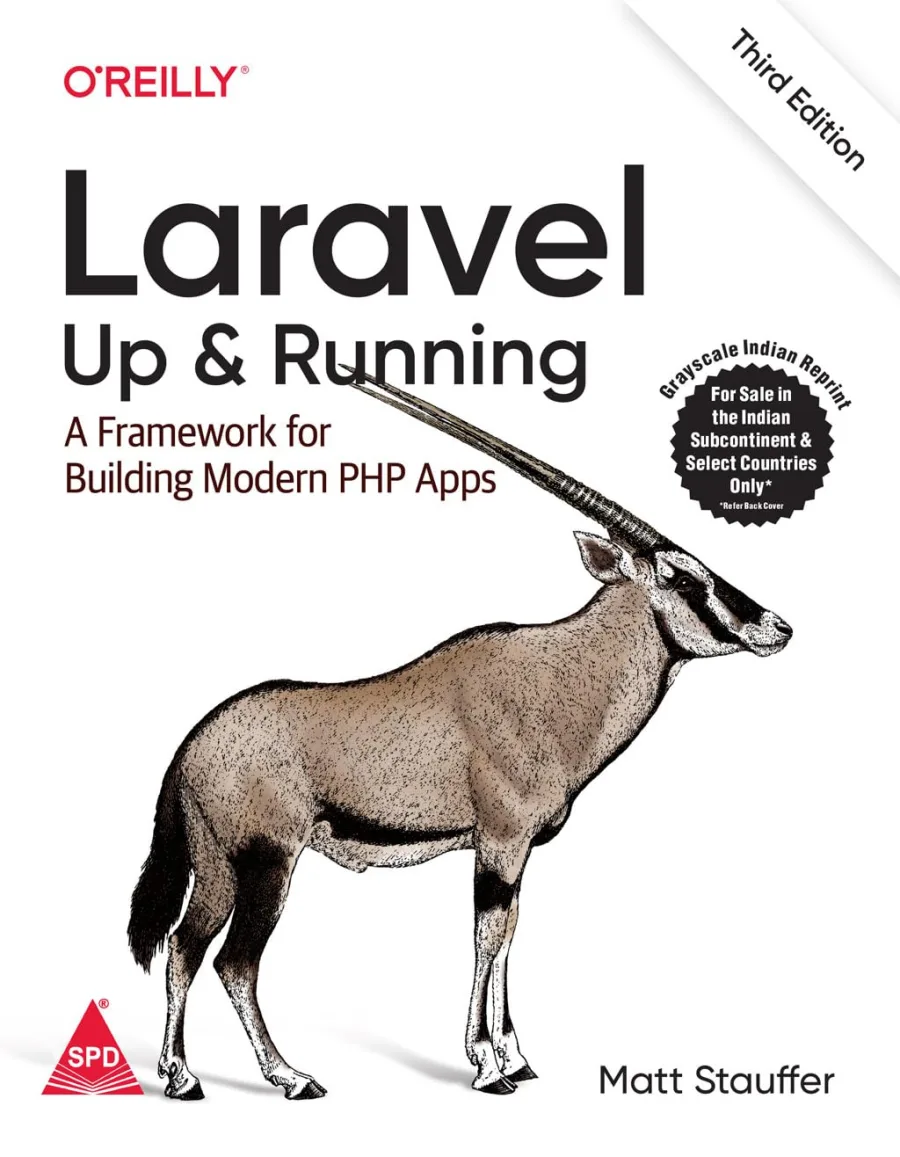
Download Cover Image
Do you want to download the full cover image for Laravel: Up & Running - A Framework for Building Modern PHP Apps, Third Edition?