
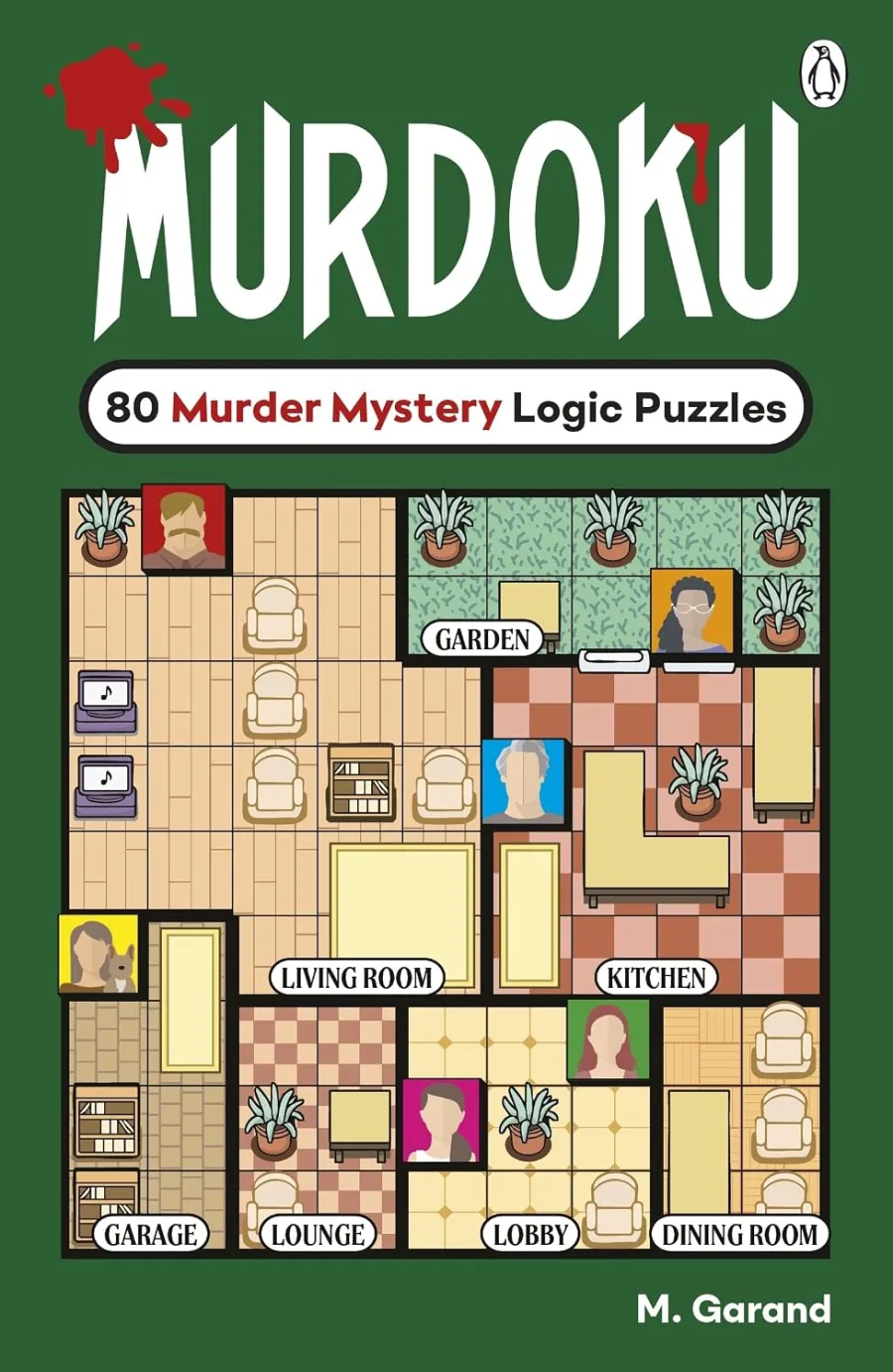
Murdoku: 80 Murder Mystery Logic Puzzles
Paperback
• 208 Pages
• USD 12.74
• English
• 9781405985451
No ratings yet
| Publisher | Penguin |
|---|---|
| ISBN13 | 9781405985451 |
| ASIN/SKU | 1405985453 |
| Book Format | Paperback |
| Language | English |
| Pages | 208 |
| List Price | USD 12.74 |
| Publishing Date | 30/10/2025 |
| Dimensions | 15.3 x 1.9 x 30.7 cm |
| Weight | 474 g |
| Book Code | BD00055280 |
Buy this Book
Amazon Stores
Ebook Stores
Other Stores
Discover Murdoku: 80 Murder Mystery Logic Puzzles by M. Garand. This book is published by Penguin in Paperback format, ISBN 9781405985451, ASIN 1405985453, under Sports and Outdoors, Non Fiction, Puzzles and Games.
Book Description
These visually appealing, addictive puzzles drop solvers into immersive mini murder mysteries, combining the elegant simplicity of games like sudoku with the storytelling of classic logic problems. But Murdoku introduces its own unique element: full-colour visual representations of the characters’ environments, with each element playing into the investigation: rooms, furniture, plants, animals, and sometimes additional rules that add an extra twist. You’ll explore 80 crime scenes including a bakery, a casino, a chess tournament, a farm, an opera . . . the variety is endless. The puzzles start out easy and gradually increase in difficulty to expert level. Do you have what it takes to become a master detective?
Author Biography
Manuel Garand is a puzzle maker from Montreal, Canada, whose puzzles have appeared in the Financial Times. When he’s not inventing new logic puzzles, he’s spending time with his two favourite sidekicks – his two-year-old and six-month-old sons – and his wife, Cindy, who was the first to get hooked on his puzzles and remains his most passionate (and competitive) test-solver.
Editorial Reviews
Editorial Reviews will be added soon…
Book Summary
Murdoku: 80 Murder Mystery Logic Puzzles by M. Garand (Manuel Garand) is an inventive puzzle book that combines the deductive satisfaction of Sudoku-style logic puzzles with the suspense and storytelling of murder mysteries. Instead of simply filling numbers into a traditional grid, readers step into the role of a detective, examine a crime scene, study visual and written clues, determine where each suspect was located, and ultimately identify who was responsible for the murder. The book contains 80 illustrated cases, with puzzles progressing from beginner level toward expert difficulty.
The result is a distinctive combination of logic puzzle, murder mystery, visual deduction game, and brain teaser. It is designed for readers who enjoy solving problems rather than simply reading about detectives solving them.
What Is Murdoku?
The name Murdoku cleverly combines “murder” and “Sudoku.”
That combination captures the basic concept of the book.
Each puzzle presents a miniature murder mystery. You are given a collection of suspects, a crime scene, and a series of clues. Your task is to use logical deduction to reconstruct where everyone was and determine which person was alone with the victim.
The official description explains that the puzzles combine the simplicity of Sudoku with the storytelling of classic logic problems.
However, Murdoku is not simply Sudoku with a murder theme added to it.
The crime scene itself becomes part of the puzzle.
Rooms, furniture, plants, animals, objects, and other environmental details can provide information that helps you solve the case. Some puzzles also introduce additional rules that add another layer of deduction.
Become the Detective
One of the most appealing features of Murdoku is that the reader is not a passive observer.
You are the investigator.
Instead of following a detective through a finished mystery, you have to reconstruct the case yourself.
The basic challenge is to analyze the available evidence and determine the exact position of each suspect.
A clue might tell you that one person was in a particular room.
Another clue may establish that someone was beside a particular object.
A third clue may eliminate several possible locations.
By combining these pieces of information, you gradually narrow down the possibilities.
Eventually, the grid reveals the solution.
The final question is simple:
Who was with the victim?
Sudoku Meets Murder Mystery
Traditional Sudoku relies on logical elimination.
You place numbers according to a set of rules, gradually reducing the possible choices until only one solution remains.
Murdoku applies a similar principle to people and locations.
Instead of asking where a number belongs, you are effectively asking:
Where was this suspect?
The puzzle therefore transforms abstract logic into a narrative situation.
You are not simply solving a grid.
You are reconstructing a crime.
This makes the deduction feel more purposeful and immersive.
The Crime Scenes
The variety of crime scenes is one of the book's strongest features.
The 80 puzzles take place in very different environments, including locations such as a bakery, casino, chess tournament, farm, opera house, coffee shop, beachside condominium, demolition site, and bookshop.
This variety prevents the book from feeling repetitive.
Every new puzzle introduces a different environment.
A bakery creates one type of visual setting.
A casino creates another.
An opera house offers an entirely different arrangement of rooms, people, and objects.
The changing environments make each case feel like a new investigation.
Visual Clues Matter
A particularly innovative aspect of Murdoku is its use of full-colour illustrated crime scenes.
The illustrations are not merely decorative.
Details within the environment can contribute to the investigation.
Furniture may establish relationships between suspects.
Plants or animals may provide clues.
Objects may help establish a person's position.
Rooms and spatial relationships can narrow down the possibilities.
This means the reader needs to pay attention to the entire page.
A clue may be hidden not in a conventional sentence but in the way the crime scene has been constructed.
The result is closer to a visual detective investigation than a standard text-based logic puzzle.
Every Suspect Is Important
Murdoku's puzzles require careful attention to the suspects.
The goal is to establish the exact location of each person.
Because each suspect occupies a different row and column within the puzzle's logic structure, identifying one person's position can provide information about everyone else.
This creates a chain reaction.
One clue may establish a single position.
That position eliminates several possibilities.
Those eliminations can reveal another person's location.
The process continues until the entire scene becomes logically determined.
This is what makes the puzzles satisfying.
The solution is not supposed to depend on guessing.
It emerges from the clues.
From Beginner to Expert
The 80 cases are arranged across different levels of difficulty.
The puzzles begin relatively simply and gradually become more demanding, eventually reaching expert-level challenges.
This progression makes the book suitable for a range of puzzle enthusiasts.
A beginner can start with the easier cases and learn how the system works.
As confidence increases, the reader can move toward more complex investigations.
Experienced puzzle solvers can challenge themselves with the harder cases.
This gradual structure also gives the book a sense of progression.
You are not simply completing unrelated puzzles.
You are developing your detective skills as you move through the collection.
Logic Rather Than Guesswork
The fundamental pleasure of Murdoku comes from deduction.
A successful solution should emerge because the clues make one arrangement logically possible.
This encourages a methodical approach.
You have to consider what you know.
Then you have to consider what that information rules out.
Then you use the remaining possibilities to establish another fact.
Slowly, uncertainty becomes certainty.
This process is particularly satisfying for readers who enjoy logic games, deduction puzzles, Sudoku, grid puzzles, brain teasers, and mystery games.
The Fun of Solving a Murder
The murder-mystery theme adds emotional energy to what might otherwise be a straightforward logic exercise.
In a conventional logic puzzle, you might be trying to determine who owns a particular house or which person chose a particular object.
In Murdoku, the stakes are fictional but much more dramatic.
Someone has been murdered.
Everyone is potentially suspicious.
You need to determine what happened.
The combination of narrative tension and logical deduction creates a distinctive experience.
It gives the reader a reason to care about solving the grid.
A Touch of Cosy Crime
Despite the murder premise, the book is not presented as a dark or disturbing crime novel.
The publisher and retailers describe it as an addictive mix of cosy crime and colourful grid logic puzzles.
The colourful illustrations and playful presentation keep the tone closer to a recreational mystery game than a grim thriller.
This makes it accessible to people who enjoy murder mysteries but prefer puzzles over graphic violence or emotionally heavy crime fiction.
The emphasis is on who did it and how the clues reveal the answer, rather than on disturbing details.
A Different Kind of Brain Teaser
Many puzzle books concentrate on a single skill.
Crosswords focus heavily on vocabulary.
Sudoku emphasizes numerical logic.
Word searches focus on visual recognition.
Murdoku combines several forms of thinking.
You need logical deduction.
You need spatial awareness.
You need careful observation.
You need to remember relationships between suspects and locations.
You also need to interpret clues within the context of the illustrated scene.
This combination makes the puzzles feel more dynamic than a conventional single-format puzzle.
Attention to Detail
Murdoku rewards careful observation.
A reader who rushes through the clues may easily miss an important detail.
The illustrations encourage you to inspect the scene rather than simply reading the text.
This makes the book particularly enjoyable for people who like spot-the-detail challenges and visual reasoning.
The crime scene becomes a visual map.
Every detail potentially matters.
The more carefully you examine it, the more information becomes available.
A Screen-Free Activity
Another advantage of Murdoku is that it offers an engaging activity away from phones, computers, and other screens.
The reader can sit with the book, work through the clues, mark possibilities, and solve cases at their own pace.
This makes it useful for:
Quiet evenings
Weekend puzzle sessions
Travel
Holiday reading
Family game time
Brain-training activities
Screen-free entertainment
Relaxing solo hobbies
The physical format also makes the book easy to return to whenever you want another case to solve.
About M. Garand
M. Garand is the pen name associated with Manuel Garand, a puzzle maker from Montreal, Canada.
His puzzles have appeared in the Financial Times, and his approach to puzzle design is clearly focused on combining logic with creative presentation. According to publisher information, his wife Cindy was among the earliest people to test his puzzles and remains one of his most enthusiastic and competitive puzzle solvers.
Murdoku demonstrates his interest in taking familiar puzzle mechanics and giving them a new narrative framework.
Why Murdoku Is Different From Sudoku
Someone familiar with Sudoku may naturally wonder how different Murdoku really is.
The biggest difference is the narrative context.
Sudoku gives you a mathematical-looking grid and a set of numerical rules.
Murdoku gives you a crime scene.
The grid becomes part of a larger investigation.
You are dealing with people rather than numbers, and visual and verbal clues help determine their positions.
The book therefore feels less like a traditional mathematical puzzle and more like a detective logic game.
Why Mystery Fans May Enjoy It
Readers who love detective fiction often enjoy trying to solve mysteries before the detective reveals the answer.
Murdoku takes that desire and turns it into the entire activity.
There is no need to wait for the detective to explain the solution.
You are the detective.
You examine the evidence.
You test possibilities.
You eliminate suspects.
You identify the killer.
This active role makes the book particularly appealing to fans of murder mysteries, detective puzzles, Cluedo-style deduction, logic games, and whodunit stories.
Why Puzzle Fans May Enjoy It
For experienced puzzle enthusiasts, the attraction is slightly different.
The book provides 80 individual challenges with a clear progression of difficulty.
That makes it possible to treat the collection almost like a personal puzzle course.
You can begin with straightforward cases and gradually work toward more difficult ones.
The visual storytelling also keeps the format fresh.
Even when the basic logical structure remains familiar, the setting and clues change.
A Good Gift for Puzzle Lovers
Murdoku is also positioned as a gift-friendly puzzle book.
The combination of mystery, colourful artwork, and logic makes it suitable for people who enjoy several different types of recreational activities.
It could appeal to:
Sudoku enthusiasts
Murder-mystery fans
Logic puzzle lovers
Brain-teaser enthusiasts
Detective-fiction readers
Puzzle collectors
Fans of visual puzzles
Adults looking for screen-free entertainment
People who enjoy challenging hobbies
Gift shoppers searching for unusual puzzle books
The publisher specifically describes it as a gift for puzzle lovers.
Volume 1 and the Expanding Series
The original Murdoku is Volume 1 of the series.
It was published in 2025 and contains 80 murder-mystery logic puzzles across 208 pages.
The series has since continued with Murdoku Volume 2: Back in Time, which again contains 80 puzzles but introduces a time-travel concept. The sequel takes solvers through historical settings including the Middle Ages, the Wild West, the Stone Age, Ancient Egypt, and the Golden Age of Piracy.
That expansion demonstrates the flexibility of the original Murdoku concept.
Who Should Read Murdoku?
Murdoku is especially suitable for readers who enjoy:
Murder mystery puzzles
Logic puzzles
Sudoku-style games
Detective games
Brain teasers
Grid-based puzzles
Visual reasoning
Deductive challenges
Cosy crime
Whodunit mysteries
Puzzle books for adults
Screen-free entertainment
Challenging recreational activities
Mystery-themed gifts
It is particularly appealing to anyone who likes the idea of solving a murder instead of simply reading about one.
Final Thoughts
Murdoku: 80 Murder Mystery Logic Puzzles by M. Garand offers a genuinely inventive twist on the traditional puzzle book.
It takes the logical structure associated with Sudoku and combines it with the narrative appeal of a murder mystery.
The result is a collection in which every case becomes a miniature investigation.
You examine the crime scene.
You study the suspects.
You interpret the clues.
You eliminate impossible positions.
You reconstruct the scene.
And finally, you reveal the killer.
The book's 80 colourful cases, varied settings, visual clues, and increasing difficulty provide plenty of variety, while the basic rules give the collection enough consistency to make the puzzles learnable.
For readers searching for Murdoku by M. Garand, Murdoku 80 Murder Mystery Logic Puzzles, Murdoku Volume 1, murder mystery puzzle books, murder mystery logic puzzles, Sudoku-style murder puzzles, detective puzzle books, logic puzzles for adults, brain teasers, visual logic puzzles, cosy crime puzzle books, whodunit puzzles, mystery games, grid logic puzzles, or puzzle books for mystery lovers, this collection offers a distinctive and highly interactive reading experience.
Ultimately, the appeal of Murdoku lies in its simple promise:
There has been a murder. Everyone is a suspect. The clues are in front of you.
All you have to do is think like a detective and solve the grid.
The result is a distinctive combination of logic puzzle, murder mystery, visual deduction game, and brain teaser. It is designed for readers who enjoy solving problems rather than simply reading about detectives solving them.
What Is Murdoku?
The name Murdoku cleverly combines “murder” and “Sudoku.”
That combination captures the basic concept of the book.
Each puzzle presents a miniature murder mystery. You are given a collection of suspects, a crime scene, and a series of clues. Your task is to use logical deduction to reconstruct where everyone was and determine which person was alone with the victim.
The official description explains that the puzzles combine the simplicity of Sudoku with the storytelling of classic logic problems.
However, Murdoku is not simply Sudoku with a murder theme added to it.
The crime scene itself becomes part of the puzzle.
Rooms, furniture, plants, animals, objects, and other environmental details can provide information that helps you solve the case. Some puzzles also introduce additional rules that add another layer of deduction.
Become the Detective
One of the most appealing features of Murdoku is that the reader is not a passive observer.
You are the investigator.
Instead of following a detective through a finished mystery, you have to reconstruct the case yourself.
The basic challenge is to analyze the available evidence and determine the exact position of each suspect.
A clue might tell you that one person was in a particular room.
Another clue may establish that someone was beside a particular object.
A third clue may eliminate several possible locations.
By combining these pieces of information, you gradually narrow down the possibilities.
Eventually, the grid reveals the solution.
The final question is simple:
Who was with the victim?
Sudoku Meets Murder Mystery
Traditional Sudoku relies on logical elimination.
You place numbers according to a set of rules, gradually reducing the possible choices until only one solution remains.
Murdoku applies a similar principle to people and locations.
Instead of asking where a number belongs, you are effectively asking:
Where was this suspect?
The puzzle therefore transforms abstract logic into a narrative situation.
You are not simply solving a grid.
You are reconstructing a crime.
This makes the deduction feel more purposeful and immersive.
The Crime Scenes
The variety of crime scenes is one of the book's strongest features.
The 80 puzzles take place in very different environments, including locations such as a bakery, casino, chess tournament, farm, opera house, coffee shop, beachside condominium, demolition site, and bookshop.
This variety prevents the book from feeling repetitive.
Every new puzzle introduces a different environment.
A bakery creates one type of visual setting.
A casino creates another.
An opera house offers an entirely different arrangement of rooms, people, and objects.
The changing environments make each case feel like a new investigation.
Visual Clues Matter
A particularly innovative aspect of Murdoku is its use of full-colour illustrated crime scenes.
The illustrations are not merely decorative.
Details within the environment can contribute to the investigation.
Furniture may establish relationships between suspects.
Plants or animals may provide clues.
Objects may help establish a person's position.
Rooms and spatial relationships can narrow down the possibilities.
This means the reader needs to pay attention to the entire page.
A clue may be hidden not in a conventional sentence but in the way the crime scene has been constructed.
The result is closer to a visual detective investigation than a standard text-based logic puzzle.
Every Suspect Is Important
Murdoku's puzzles require careful attention to the suspects.
The goal is to establish the exact location of each person.
Because each suspect occupies a different row and column within the puzzle's logic structure, identifying one person's position can provide information about everyone else.
This creates a chain reaction.
One clue may establish a single position.
That position eliminates several possibilities.
Those eliminations can reveal another person's location.
The process continues until the entire scene becomes logically determined.
This is what makes the puzzles satisfying.
The solution is not supposed to depend on guessing.
It emerges from the clues.
From Beginner to Expert
The 80 cases are arranged across different levels of difficulty.
The puzzles begin relatively simply and gradually become more demanding, eventually reaching expert-level challenges.
This progression makes the book suitable for a range of puzzle enthusiasts.
A beginner can start with the easier cases and learn how the system works.
As confidence increases, the reader can move toward more complex investigations.
Experienced puzzle solvers can challenge themselves with the harder cases.
This gradual structure also gives the book a sense of progression.
You are not simply completing unrelated puzzles.
You are developing your detective skills as you move through the collection.
Logic Rather Than Guesswork
The fundamental pleasure of Murdoku comes from deduction.
A successful solution should emerge because the clues make one arrangement logically possible.
This encourages a methodical approach.
You have to consider what you know.
Then you have to consider what that information rules out.
Then you use the remaining possibilities to establish another fact.
Slowly, uncertainty becomes certainty.
This process is particularly satisfying for readers who enjoy logic games, deduction puzzles, Sudoku, grid puzzles, brain teasers, and mystery games.
The Fun of Solving a Murder
The murder-mystery theme adds emotional energy to what might otherwise be a straightforward logic exercise.
In a conventional logic puzzle, you might be trying to determine who owns a particular house or which person chose a particular object.
In Murdoku, the stakes are fictional but much more dramatic.
Someone has been murdered.
Everyone is potentially suspicious.
You need to determine what happened.
The combination of narrative tension and logical deduction creates a distinctive experience.
It gives the reader a reason to care about solving the grid.
A Touch of Cosy Crime
Despite the murder premise, the book is not presented as a dark or disturbing crime novel.
The publisher and retailers describe it as an addictive mix of cosy crime and colourful grid logic puzzles.
The colourful illustrations and playful presentation keep the tone closer to a recreational mystery game than a grim thriller.
This makes it accessible to people who enjoy murder mysteries but prefer puzzles over graphic violence or emotionally heavy crime fiction.
The emphasis is on who did it and how the clues reveal the answer, rather than on disturbing details.
A Different Kind of Brain Teaser
Many puzzle books concentrate on a single skill.
Crosswords focus heavily on vocabulary.
Sudoku emphasizes numerical logic.
Word searches focus on visual recognition.
Murdoku combines several forms of thinking.
You need logical deduction.
You need spatial awareness.
You need careful observation.
You need to remember relationships between suspects and locations.
You also need to interpret clues within the context of the illustrated scene.
This combination makes the puzzles feel more dynamic than a conventional single-format puzzle.
Attention to Detail
Murdoku rewards careful observation.
A reader who rushes through the clues may easily miss an important detail.
The illustrations encourage you to inspect the scene rather than simply reading the text.
This makes the book particularly enjoyable for people who like spot-the-detail challenges and visual reasoning.
The crime scene becomes a visual map.
Every detail potentially matters.
The more carefully you examine it, the more information becomes available.
A Screen-Free Activity
Another advantage of Murdoku is that it offers an engaging activity away from phones, computers, and other screens.
The reader can sit with the book, work through the clues, mark possibilities, and solve cases at their own pace.
This makes it useful for:
Quiet evenings
Weekend puzzle sessions
Travel
Holiday reading
Family game time
Brain-training activities
Screen-free entertainment
Relaxing solo hobbies
The physical format also makes the book easy to return to whenever you want another case to solve.
About M. Garand
M. Garand is the pen name associated with Manuel Garand, a puzzle maker from Montreal, Canada.
His puzzles have appeared in the Financial Times, and his approach to puzzle design is clearly focused on combining logic with creative presentation. According to publisher information, his wife Cindy was among the earliest people to test his puzzles and remains one of his most enthusiastic and competitive puzzle solvers.
Murdoku demonstrates his interest in taking familiar puzzle mechanics and giving them a new narrative framework.
Why Murdoku Is Different From Sudoku
Someone familiar with Sudoku may naturally wonder how different Murdoku really is.
The biggest difference is the narrative context.
Sudoku gives you a mathematical-looking grid and a set of numerical rules.
Murdoku gives you a crime scene.
The grid becomes part of a larger investigation.
You are dealing with people rather than numbers, and visual and verbal clues help determine their positions.
The book therefore feels less like a traditional mathematical puzzle and more like a detective logic game.
Why Mystery Fans May Enjoy It
Readers who love detective fiction often enjoy trying to solve mysteries before the detective reveals the answer.
Murdoku takes that desire and turns it into the entire activity.
There is no need to wait for the detective to explain the solution.
You are the detective.
You examine the evidence.
You test possibilities.
You eliminate suspects.
You identify the killer.
This active role makes the book particularly appealing to fans of murder mysteries, detective puzzles, Cluedo-style deduction, logic games, and whodunit stories.
Why Puzzle Fans May Enjoy It
For experienced puzzle enthusiasts, the attraction is slightly different.
The book provides 80 individual challenges with a clear progression of difficulty.
That makes it possible to treat the collection almost like a personal puzzle course.
You can begin with straightforward cases and gradually work toward more difficult ones.
The visual storytelling also keeps the format fresh.
Even when the basic logical structure remains familiar, the setting and clues change.
A Good Gift for Puzzle Lovers
Murdoku is also positioned as a gift-friendly puzzle book.
The combination of mystery, colourful artwork, and logic makes it suitable for people who enjoy several different types of recreational activities.
It could appeal to:
Sudoku enthusiasts
Murder-mystery fans
Logic puzzle lovers
Brain-teaser enthusiasts
Detective-fiction readers
Puzzle collectors
Fans of visual puzzles
Adults looking for screen-free entertainment
People who enjoy challenging hobbies
Gift shoppers searching for unusual puzzle books
The publisher specifically describes it as a gift for puzzle lovers.
Volume 1 and the Expanding Series
The original Murdoku is Volume 1 of the series.
It was published in 2025 and contains 80 murder-mystery logic puzzles across 208 pages.
The series has since continued with Murdoku Volume 2: Back in Time, which again contains 80 puzzles but introduces a time-travel concept. The sequel takes solvers through historical settings including the Middle Ages, the Wild West, the Stone Age, Ancient Egypt, and the Golden Age of Piracy.
That expansion demonstrates the flexibility of the original Murdoku concept.
Who Should Read Murdoku?
Murdoku is especially suitable for readers who enjoy:
Murder mystery puzzles
Logic puzzles
Sudoku-style games
Detective games
Brain teasers
Grid-based puzzles
Visual reasoning
Deductive challenges
Cosy crime
Whodunit mysteries
Puzzle books for adults
Screen-free entertainment
Challenging recreational activities
Mystery-themed gifts
It is particularly appealing to anyone who likes the idea of solving a murder instead of simply reading about one.
Final Thoughts
Murdoku: 80 Murder Mystery Logic Puzzles by M. Garand offers a genuinely inventive twist on the traditional puzzle book.
It takes the logical structure associated with Sudoku and combines it with the narrative appeal of a murder mystery.
The result is a collection in which every case becomes a miniature investigation.
You examine the crime scene.
You study the suspects.
You interpret the clues.
You eliminate impossible positions.
You reconstruct the scene.
And finally, you reveal the killer.
The book's 80 colourful cases, varied settings, visual clues, and increasing difficulty provide plenty of variety, while the basic rules give the collection enough consistency to make the puzzles learnable.
For readers searching for Murdoku by M. Garand, Murdoku 80 Murder Mystery Logic Puzzles, Murdoku Volume 1, murder mystery puzzle books, murder mystery logic puzzles, Sudoku-style murder puzzles, detective puzzle books, logic puzzles for adults, brain teasers, visual logic puzzles, cosy crime puzzle books, whodunit puzzles, mystery games, grid logic puzzles, or puzzle books for mystery lovers, this collection offers a distinctive and highly interactive reading experience.
Ultimately, the appeal of Murdoku lies in its simple promise:
There has been a murder. Everyone is a suspect. The clues are in front of you.
All you have to do is think like a detective and solve the grid.
Sample Chapters
Sample Chapters will be added soon…
Reader Reviews
No reviews yet.
Murdoku: 80 Murder Mystery Logic Puzzles
Download Cover Image
Do you want to download the full cover image for Murdoku: 80 Murder Mystery Logic Puzzles?