
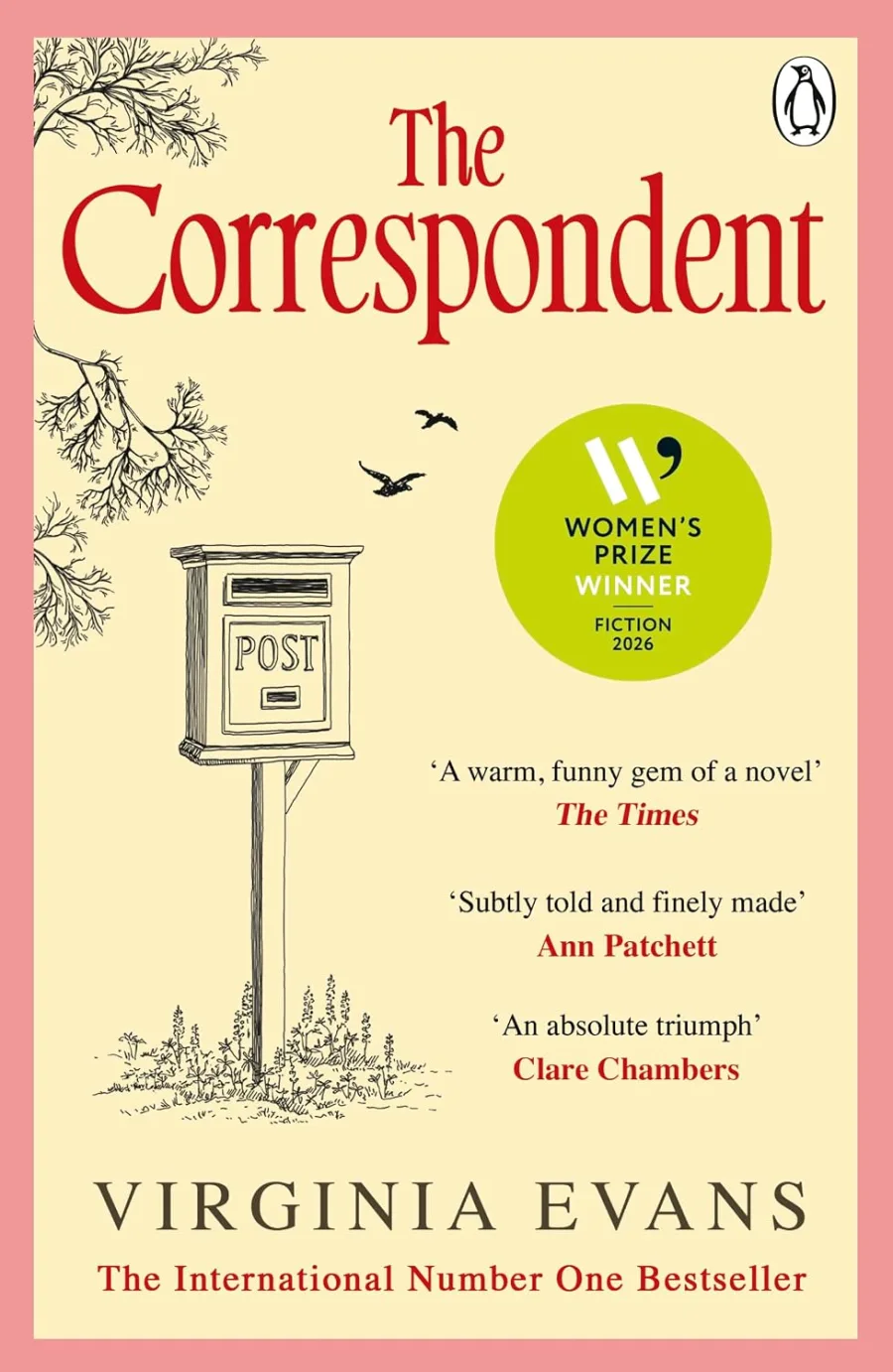
The Correspondent
Paperback
• 320 Pages
• USD 7.99
• English
• 9781405971553
No ratings yet
| Publisher | Penguin |
|---|---|
| ISBN13 | 9781405971553 |
| ASIN/SKU | 140597155X |
| Book Format | Paperback |
| Language | English |
| Pages | 320 |
| List Price | USD 7.99 |
| Publishing Date | 11/06/2026 |
| Dimensions | 12.8 x 2.2 x 19.7 cm |
| Weight | 220 g |
| Book Code | BD00055275 |
Buy this Book
Amazon Stores
Ebook Stores
Other Stores
Discover The Correspondent by Virginia Evans. This book is published by Penguin in Paperback format, ISBN 9781405971553, ASIN 140597155X, under Humor and Entertainment, Women's Fiction.
Book Description
WINNER OF THE WOMEN'S PRIZE FOR FICTION 2026
#1SUNDAY TIMES BESTSELLER
#1 NEW YORK TIMES BESTSELLER
OVER TWO MILLION COPIES SOLD WORLDWIDE
A TIMESBOOK OF THE YEAR 2025
AN IRISH TIMES BESTSELLER
A BBC RADIO 2 BOOK CLUB PICK
'A warm, funny gem of a novel'
LAURA HACKETT, THE TIMES
'Masterful . . . I was delighted and moved'
NEW YORK TIMES
'Immensely enjoyable'
GUARDIAN
'I can't praise it enough. It's an absolute triumph'
CLARE CHAMBERS
'What a novel! Tender, dry, sharp...devastating, but still feel good.'
PANDORA SYKES
'Tremendous'
FREDRIK BACKMAN
'Shows us what a glorious thing growing older can be'
FLORENCE KNAPP
'The year's breakout novel no one saw coming'
WALL STREET JOURNAL
Sybil Van Antwerp is seventy-three, slowly losing her sight and always writing letters . . .
To her children. Her favourite authors. Her ex-sister-in-law. The journalist poking into her past.
Her doctor. Suitors. Kindly neighbours. The infuriating gardening club.
All receive Sybil’s witty, wise correspondence, rich with everyday concerns.
But there is one letter that she has never sent. It concerns the darkest period of her life. To post it, Sybil must find forgiveness within herself.
The hardest letter to write is the one you’d never dare to send.
#1SUNDAY TIMES BESTSELLER
#1 NEW YORK TIMES BESTSELLER
OVER TWO MILLION COPIES SOLD WORLDWIDE
A TIMESBOOK OF THE YEAR 2025
AN IRISH TIMES BESTSELLER
A BBC RADIO 2 BOOK CLUB PICK
'A warm, funny gem of a novel'
LAURA HACKETT, THE TIMES
'Masterful . . . I was delighted and moved'
NEW YORK TIMES
'Immensely enjoyable'
GUARDIAN
'I can't praise it enough. It's an absolute triumph'
CLARE CHAMBERS
'What a novel! Tender, dry, sharp...devastating, but still feel good.'
PANDORA SYKES
'Tremendous'
FREDRIK BACKMAN
'Shows us what a glorious thing growing older can be'
FLORENCE KNAPP
'The year's breakout novel no one saw coming'
WALL STREET JOURNAL
Sybil Van Antwerp is seventy-three, slowly losing her sight and always writing letters . . .
To her children. Her favourite authors. Her ex-sister-in-law. The journalist poking into her past.
Her doctor. Suitors. Kindly neighbours. The infuriating gardening club.
All receive Sybil’s witty, wise correspondence, rich with everyday concerns.
But there is one letter that she has never sent. It concerns the darkest period of her life. To post it, Sybil must find forgiveness within herself.
The hardest letter to write is the one you’d never dare to send.
Author Biography
Virginia Evans is from the east coast of the United States. She attended James Madison University for her bachelor’s in English literature. After starting a family, she went back to school for her master’s of philosophy in creative writing at Trinity College in Dublin, Ireland, where she had the good fortune to study under Carlo Gébler, Eoin McNamee, Claire Keegan, Harry Clifton and Kevin Power. She now lives in Winston-Salem, North Carolina, with her husband, Mark, two children, Jack and Mae, and her Red Labrador, Brigid.
Editorial Reviews
Editorial Reviews will be added soon…
Book Summary
The Correspondent by Virginia Evans is a tender, witty, and deeply moving novel about aging, memory, grief, family, guilt, forgiveness, and the extraordinary power of written words. The story centers on Sybil Van Antwerp, a seventy-three-year-old retired lawyer who has built much of her life around writing letters. Rather than telling her story through conventional narration, Evans allows Sybil's letters and emails to gradually reveal her personality, relationships, regrets, and deepest secret. The novel was first published in 2025 and is an epistolary work, meaning that the story unfolds through correspondence.
Sybil is intelligent, independent, opinionated, funny, and sometimes difficult. She is also deeply lonely, although she does not always admit it. Every morning, she sits down at her desk and writes to people who occupy different corners of her life: her children, her brother, friends, neighbors, authors, doctors, and even people with whom she has complicated relationships. There is also one person who receives a letter from Sybil again and again—but never receives it.
That unsent letter is the emotional heart of the novel.
Sybil's Life of Letters
At seventy-three, Sybil has already lived a remarkably full life.
She has been a lawyer, wife, mother, grandmother, friend, and daughter. Now retired, she lives alone in Annapolis and has developed a carefully organized routine.
Letters give her a way to remain connected with the world while maintaining control over how close people are allowed to get.
She writes beautifully and precisely.
Her correspondence can be humorous, affectionate, argumentative, sarcastic, or surprisingly tender.
Through these letters, readers gradually discover that Sybil has a sharp mind and a strong personality. She does not hesitate to complain when she believes something is unfair. She writes to authors whose books she admires, contacts people who have irritated her, and maintains relationships with people she rarely sees in person.
Her letters are not merely communication.
They are how she thinks.
They are how she remembers.
They are how she organizes the complicated story of her own life.
The novel's publisher describes her correspondence as a way of making sense of the world, while the unsent letter concerns the darkest period of her life.
The Fear of Losing Independence
At the beginning of the story, Sybil's carefully controlled life is beginning to change.
She is gradually losing her eyesight because of a hereditary condition.
She has also had a serious car accident caused by her deteriorating vision.
Yet Sybil initially minimizes what happened.
She does not want her children to worry.
More importantly, she fears that they will decide she can no longer live independently.
This fear is central to her character.
Sybil has spent her entire adult life being capable.
She has been professionally successful and intellectually independent.
The thought of becoming dependent on other people terrifies her.
She therefore hides some of the difficulties she is experiencing.
But aging cannot simply be hidden.
Her declining eyesight forces her to confront a future in which some of the independence she treasures may disappear.
Family Relationships
Sybil's relationship with her children is complicated.
She loves them, but she is not always emotionally available to them.
Her daughter Fiona and son Bruce worry about her.
They want her to accept help and consider a safer living arrangement.
Sybil interprets some of their concern as an attempt to take control of her life.
This creates tension.
Yet beneath the disagreements is genuine love.
Sybil's correspondence reveals that she sometimes finds it easier to express difficult feelings on paper than face-to-face.
The distance created by letters gives her time to choose her words.
It also allows her to reveal things she might otherwise keep hidden.
Her relationships with her family gradually become more honest as the novel progresses.
The Death of Judge Donnelly
Another major turning point is the death of Judge Guy Donnelly, an important figure from Sybil's professional life.
He had been her intellectual companion and an important part of her identity as a lawyer.
His death forces Sybil to confront the passing of time.
People she once considered permanent are disappearing.
The professional world that once defined her is fading.
Her own physical limitations are increasing.
The loss of Donnelly therefore becomes part of a larger realization: the life Sybil knew is gradually disappearing.
She must decide what remains meaningful when career, youth, and physical independence are no longer guaranteed.
The Mysterious Letters
The story becomes more mysterious when Sybil begins receiving letters from someone connected to her past.
The anonymous correspondent, associated with the initials DM, accuses Sybil and Judge Donnelly of having participated in a form of “perfect justice” that caused terrible consequences for another family.
At first, Sybil is defensive.
She does not want to revisit the past.
She has spent decades keeping certain memories at a distance.
But the letters force those memories back into her life.
The past is no longer something she can control simply by refusing to discuss it.
The anonymous correspondence becomes a kind of reckoning.
Someone wants Sybil to remember.
And eventually, she realizes that there are things she has never properly confronted herself.
Sybil's Professional Pride
Sybil's career as a lawyer is important to understanding her character.
She believes deeply in justice.
She has spent years making difficult decisions and judging situations according to evidence and principle.
But the novel asks what happens when a person who has spent a lifetime thinking in terms of justice is confronted by something that cannot be resolved through legal reasoning.
Human beings are not legal cases.
Grief cannot be argued away.
Regret cannot always be corrected.
And some decisions may remain morally complicated even when they were legally justified.
Sybil gradually discovers that her greatest challenge is not determining who was right or wrong.
It is accepting what she herself did and finding a way to live with it.
The Secret of Gilbert
The deepest secret concerns Sybil's young son, Gilbert, whom she affectionately called Colt.
His death decades earlier has shaped Sybil's entire emotional life.
For years, she has carried enormous grief and guilt surrounding what happened to him.
To the outside world, the circumstances may appear to have been a tragic accident.
But Sybil knows that there is more to the story.
Her private memories reveal that she bears a painful responsibility for what happened.
The tragedy becomes the emotional foundation of her later life.
Rather than fully confronting her guilt, Sybil has built a life around controlled routines, professional identity, and correspondence.
She has remained functional.
But she has never truly healed.
Grief That Never Leaves
The novel's treatment of grief is especially powerful because Sybil's grief does not look dramatic from the outside.
She continues living.
She writes letters.
She attends to ordinary matters.
She maintains relationships.
She argues with people.
She jokes.
She grows older.
Yet underneath all of this is the memory of Gilbert.
The story suggests that grief does not always disappear with time.
Sometimes people simply learn how to carry it.
Sybil's life demonstrates the difference between moving forward and moving on.
She has moved forward for decades.
But emotionally, part of her remains trapped in the past.
Theodore Lübeck
One of the warmest relationships in the novel develops between Sybil and her neighbor Theodore Lübeck, an elderly Holocaust survivor.
Their friendship begins quietly.
They communicate and gradually become important to one another.
Theodore understands something about loss that Sybil cannot easily explain.
He has also lived through experiences that cannot simply be erased.
Yet their relationship is not built entirely around sorrow.
There is humor, companionship, intellectual exchange, and kindness.
Theodore helps Sybil adapt as her eyesight worsens, even constructing a magnifying device that allows her to continue writing.
His friendship demonstrates that intimacy does not necessarily require romance.
Sometimes simply being understood by another person can become one of life's greatest gifts.
Love in Later Life
The novel also challenges the assumption that romantic love belongs primarily to the young.
Sybil receives attention from people who are interested in her romantically.
One of them is Mick Watts, a retired attorney who proposes marriage.
Sybil does not simply accept because companionship might make life easier.
She values her independence.
She understands what she wants.
Her decisions reflect a woman who has spent decades learning who she is.
The story treats older people as fully emotional beings with desires, frustrations, hopes, and romantic possibilities.
Age does not make the need for connection disappear.
The Discovery of Family
Another important development occurs when Sybil learns more about her biological origins.
She and her brother Felix were adopted.
A DNA test eventually reveals a biological connection to a woman in Scotland.
This discovery unsettles Sybil's understanding of her own identity.
For most of her life, she has accepted one version of her family history.
Now she discovers another.
The revelation creates unexpected possibilities for belonging later in life.
It reminds Sybil that identity is not always as fixed as we imagine.
We can spend decades believing we understand where we came from and still discover new truths about ourselves.
Fiona and Reconciliation
Sybil's relationship with Fiona gradually becomes one of the novel's most important emotional threads.
Their relationship has been damaged by Sybil's tendency to push people away.
Part of this behavior comes from fear.
Sybil has already experienced the unbearable pain of losing a child.
She has therefore developed a complicated instinct to protect herself from further emotional vulnerability.
She sometimes believes that keeping people at a distance will protect her from losing them.
But emotional distance has consequences.
It can also prevent people from loving us fully.
Eventually, Sybil begins to understand this.
She reconciles with Fiona and acknowledges that her behavior has caused pain.
This reconciliation is not presented as a magical solution.
It is simply an honest step toward healing.
The Unsent Letter
The novel repeatedly returns to the letter Sybil has never sent.
For years, she has written to the person connected to her deepest regret.
But she cannot bring herself to mail it.
The letter represents everything she has refused to confront.
It contains guilt.
Love.
Anger.
Grief.
Responsibility.
Fear.
And the desire for forgiveness.
Writing the letter is relatively easy.
Sending it is much harder.
That distinction becomes one of the novel's central metaphors.
It is possible to understand our mistakes privately while still being afraid to face their consequences publicly.
The Power of Writing
The epistolary form is much more than a stylistic experiment.
Letters allow Sybil to reveal herself gradually.
They also demonstrate how writing can create intimacy.
A letter allows someone to speak carefully.
It preserves a person's voice.
It can survive its author.
It can be reread years later.
It can reach someone who is far away.
For Sybil, letters become a form of companionship.
She writes to people she knows.
She writes to people she has never met.
She writes to people who cannot answer.
And she writes to someone she has never been able to forgive—or perhaps never been able to forgive herself for.
The written word becomes her way of preserving relationships against time.
Aging and Mortality
Sybil's declining eyesight gives the novel an additional layer of urgency.
She has built her identity around reading and writing.
Now the very ability that gives her life structure is threatened.
She must confront the possibility that she will eventually lose the ability to write letters.
This is frightening because writing is not simply her hobby.
It is her voice.
It is her connection to the world.
Her physical decline therefore becomes intertwined with the question of legacy.
What remains of a person when they can no longer perform the activities that once defined them?
The novel suggests that identity ultimately resides not in productivity but in relationships and memories.
Justice and Forgiveness
Sybil's professional life has taught her to think in terms of justice.
But personal life requires something different.
Justice asks what someone deserves.
Forgiveness asks whether we can stop allowing the past to control the present.
Sybil eventually realizes that she cannot change what happened to Gilbert.
She cannot undo her mistakes.
She cannot make the past morally simple.
But she can choose what to do with the remaining years of her life.
This is where the novel's emotional power lies.
Forgiveness is not presented as pretending that nothing happened.
It is accepting that the past is part of one's story without allowing it to determine every remaining chapter.
The Final Confession
As Sybil's life moves toward its final stage, she eventually travels to Scotland, where she can live near her newly discovered family.
The move represents more than a geographical change.
She is leaving behind the carefully controlled life she constructed in Annapolis.
She is entering a new environment at an age when many people might assume that meaningful change is no longer possible.
Yet Sybil continues to change.
Eventually, she writes her final confession to Theodore.
She explains the truth about Gilbert.
The confession reveals that she did not simply watch her son die.
During an emotionally difficult moment, while distracted by work, she told him, “Just go, Colt. Jump!”
She did not know he was standing on a dangerous rock shelf.
Her words had consequences she never intended.
The revelation transforms the meaning of her decades-long guilt.
The tragedy was not deliberate murder.
But Sybil has carried the terrible knowledge that her careless words contributed to her child's death.
That is the secret she has been unable to release.
Sybil's Final Days
Sybil eventually dies quietly at her writing desk.
Her death occurs on November 10, 2021, which would have been Gilbert's fifty-seventh birthday.
The detail is deeply symbolic.
She has spent decades writing toward the truth.
At the end of her life, she has finally put that truth into words.
Her letters survive her.
Her friend Rosalie is left with thousands of pieces of correspondence that together form the record of Sybil's life.
The woman who spent so much of her life communicating through letters has left behind a written legacy.
The Meaning of the Title
The title The Correspondent describes Sybil literally.
She is constantly writing.
But it also describes her emotionally.
She is a person who spends her life trying to connect.
Even when she withdraws from people physically, she continues reaching toward them through words.
The letters become bridges.
They connect past and present.
They connect strangers.
They connect family members separated by distance.
And, finally, they connect Sybil with the truth she has spent decades avoiding.
Conclusion
The Correspondent is ultimately a quiet novel about a very large question:
How do we make peace with the life we have lived?
Sybil Van Antwerp begins the story as a fiercely independent seventy-three-year-old woman who believes she has her life under control.
She has a home.
A routine.
A distinguished career behind her.
Children.
Friends.
Books.
Letters.
But beneath this orderly life is an enormous unresolved grief.
She is losing her eyesight.
She is losing people she loves.
She is being forced to reconsider her independence.
And most importantly, she is being pulled back toward a tragedy she has spent decades trying to contain.
The letters allow the reader to see Sybil from different angles.
She can be funny and irritable, generous and stubborn, loving and emotionally distant.
She is not presented as a perfect elderly heroine.
She is complicated.
She has made mistakes.
She has hurt people.
She has also been hurt.
That complexity makes her feel remarkably human.
Her relationships with Fiona, Theodore, Rosalie, Felix, and others gradually teach her that independence does not mean refusing help and that protecting yourself from pain can also prevent you from experiencing love.
The story's deepest emotional movement is therefore from isolation toward connection.
Sybil learns to acknowledge her mistakes.
She begins rebuilding damaged relationships.
She accepts new forms of family.
She allows herself to be cared for.
And finally, she writes the letter she has spent decades avoiding.
The novel does not offer a simplistic idea of redemption.
Nothing can bring Gilbert back.
Nothing can erase the past.
But Sybil finally understands that forgiveness is not the same as forgetting.
It is the decision to stop allowing an old wound to consume the rest of one's life.
In the end, The Correspondent celebrates the small things that make a life meaningful: a letter from a friend, an unexpected kindness, a conversation with a neighbor, a beloved book, a family reconciliation, and the courage to tell the truth.
It reminds us that a life does not have to be extraordinary to be important.
Sometimes the most powerful stories are found in the quiet lives of people who simply keep going.
And Sybil's thousands of letters ultimately become proof of something beautiful: that even the smallest human life can contain enormous love, loss, wisdom, regret, and hope—and that sometimes the hardest letter to write is the one that finally allows us to forgive ourselves.
Sybil is intelligent, independent, opinionated, funny, and sometimes difficult. She is also deeply lonely, although she does not always admit it. Every morning, she sits down at her desk and writes to people who occupy different corners of her life: her children, her brother, friends, neighbors, authors, doctors, and even people with whom she has complicated relationships. There is also one person who receives a letter from Sybil again and again—but never receives it.
That unsent letter is the emotional heart of the novel.
Sybil's Life of Letters
At seventy-three, Sybil has already lived a remarkably full life.
She has been a lawyer, wife, mother, grandmother, friend, and daughter. Now retired, she lives alone in Annapolis and has developed a carefully organized routine.
Letters give her a way to remain connected with the world while maintaining control over how close people are allowed to get.
She writes beautifully and precisely.
Her correspondence can be humorous, affectionate, argumentative, sarcastic, or surprisingly tender.
Through these letters, readers gradually discover that Sybil has a sharp mind and a strong personality. She does not hesitate to complain when she believes something is unfair. She writes to authors whose books she admires, contacts people who have irritated her, and maintains relationships with people she rarely sees in person.
Her letters are not merely communication.
They are how she thinks.
They are how she remembers.
They are how she organizes the complicated story of her own life.
The novel's publisher describes her correspondence as a way of making sense of the world, while the unsent letter concerns the darkest period of her life.
The Fear of Losing Independence
At the beginning of the story, Sybil's carefully controlled life is beginning to change.
She is gradually losing her eyesight because of a hereditary condition.
She has also had a serious car accident caused by her deteriorating vision.
Yet Sybil initially minimizes what happened.
She does not want her children to worry.
More importantly, she fears that they will decide she can no longer live independently.
This fear is central to her character.
Sybil has spent her entire adult life being capable.
She has been professionally successful and intellectually independent.
The thought of becoming dependent on other people terrifies her.
She therefore hides some of the difficulties she is experiencing.
But aging cannot simply be hidden.
Her declining eyesight forces her to confront a future in which some of the independence she treasures may disappear.
Family Relationships
Sybil's relationship with her children is complicated.
She loves them, but she is not always emotionally available to them.
Her daughter Fiona and son Bruce worry about her.
They want her to accept help and consider a safer living arrangement.
Sybil interprets some of their concern as an attempt to take control of her life.
This creates tension.
Yet beneath the disagreements is genuine love.
Sybil's correspondence reveals that she sometimes finds it easier to express difficult feelings on paper than face-to-face.
The distance created by letters gives her time to choose her words.
It also allows her to reveal things she might otherwise keep hidden.
Her relationships with her family gradually become more honest as the novel progresses.
The Death of Judge Donnelly
Another major turning point is the death of Judge Guy Donnelly, an important figure from Sybil's professional life.
He had been her intellectual companion and an important part of her identity as a lawyer.
His death forces Sybil to confront the passing of time.
People she once considered permanent are disappearing.
The professional world that once defined her is fading.
Her own physical limitations are increasing.
The loss of Donnelly therefore becomes part of a larger realization: the life Sybil knew is gradually disappearing.
She must decide what remains meaningful when career, youth, and physical independence are no longer guaranteed.
The Mysterious Letters
The story becomes more mysterious when Sybil begins receiving letters from someone connected to her past.
The anonymous correspondent, associated with the initials DM, accuses Sybil and Judge Donnelly of having participated in a form of “perfect justice” that caused terrible consequences for another family.
At first, Sybil is defensive.
She does not want to revisit the past.
She has spent decades keeping certain memories at a distance.
But the letters force those memories back into her life.
The past is no longer something she can control simply by refusing to discuss it.
The anonymous correspondence becomes a kind of reckoning.
Someone wants Sybil to remember.
And eventually, she realizes that there are things she has never properly confronted herself.
Sybil's Professional Pride
Sybil's career as a lawyer is important to understanding her character.
She believes deeply in justice.
She has spent years making difficult decisions and judging situations according to evidence and principle.
But the novel asks what happens when a person who has spent a lifetime thinking in terms of justice is confronted by something that cannot be resolved through legal reasoning.
Human beings are not legal cases.
Grief cannot be argued away.
Regret cannot always be corrected.
And some decisions may remain morally complicated even when they were legally justified.
Sybil gradually discovers that her greatest challenge is not determining who was right or wrong.
It is accepting what she herself did and finding a way to live with it.
The Secret of Gilbert
The deepest secret concerns Sybil's young son, Gilbert, whom she affectionately called Colt.
His death decades earlier has shaped Sybil's entire emotional life.
For years, she has carried enormous grief and guilt surrounding what happened to him.
To the outside world, the circumstances may appear to have been a tragic accident.
But Sybil knows that there is more to the story.
Her private memories reveal that she bears a painful responsibility for what happened.
The tragedy becomes the emotional foundation of her later life.
Rather than fully confronting her guilt, Sybil has built a life around controlled routines, professional identity, and correspondence.
She has remained functional.
But she has never truly healed.
Grief That Never Leaves
The novel's treatment of grief is especially powerful because Sybil's grief does not look dramatic from the outside.
She continues living.
She writes letters.
She attends to ordinary matters.
She maintains relationships.
She argues with people.
She jokes.
She grows older.
Yet underneath all of this is the memory of Gilbert.
The story suggests that grief does not always disappear with time.
Sometimes people simply learn how to carry it.
Sybil's life demonstrates the difference between moving forward and moving on.
She has moved forward for decades.
But emotionally, part of her remains trapped in the past.
Theodore Lübeck
One of the warmest relationships in the novel develops between Sybil and her neighbor Theodore Lübeck, an elderly Holocaust survivor.
Their friendship begins quietly.
They communicate and gradually become important to one another.
Theodore understands something about loss that Sybil cannot easily explain.
He has also lived through experiences that cannot simply be erased.
Yet their relationship is not built entirely around sorrow.
There is humor, companionship, intellectual exchange, and kindness.
Theodore helps Sybil adapt as her eyesight worsens, even constructing a magnifying device that allows her to continue writing.
His friendship demonstrates that intimacy does not necessarily require romance.
Sometimes simply being understood by another person can become one of life's greatest gifts.
Love in Later Life
The novel also challenges the assumption that romantic love belongs primarily to the young.
Sybil receives attention from people who are interested in her romantically.
One of them is Mick Watts, a retired attorney who proposes marriage.
Sybil does not simply accept because companionship might make life easier.
She values her independence.
She understands what she wants.
Her decisions reflect a woman who has spent decades learning who she is.
The story treats older people as fully emotional beings with desires, frustrations, hopes, and romantic possibilities.
Age does not make the need for connection disappear.
The Discovery of Family
Another important development occurs when Sybil learns more about her biological origins.
She and her brother Felix were adopted.
A DNA test eventually reveals a biological connection to a woman in Scotland.
This discovery unsettles Sybil's understanding of her own identity.
For most of her life, she has accepted one version of her family history.
Now she discovers another.
The revelation creates unexpected possibilities for belonging later in life.
It reminds Sybil that identity is not always as fixed as we imagine.
We can spend decades believing we understand where we came from and still discover new truths about ourselves.
Fiona and Reconciliation
Sybil's relationship with Fiona gradually becomes one of the novel's most important emotional threads.
Their relationship has been damaged by Sybil's tendency to push people away.
Part of this behavior comes from fear.
Sybil has already experienced the unbearable pain of losing a child.
She has therefore developed a complicated instinct to protect herself from further emotional vulnerability.
She sometimes believes that keeping people at a distance will protect her from losing them.
But emotional distance has consequences.
It can also prevent people from loving us fully.
Eventually, Sybil begins to understand this.
She reconciles with Fiona and acknowledges that her behavior has caused pain.
This reconciliation is not presented as a magical solution.
It is simply an honest step toward healing.
The Unsent Letter
The novel repeatedly returns to the letter Sybil has never sent.
For years, she has written to the person connected to her deepest regret.
But she cannot bring herself to mail it.
The letter represents everything she has refused to confront.
It contains guilt.
Love.
Anger.
Grief.
Responsibility.
Fear.
And the desire for forgiveness.
Writing the letter is relatively easy.
Sending it is much harder.
That distinction becomes one of the novel's central metaphors.
It is possible to understand our mistakes privately while still being afraid to face their consequences publicly.
The Power of Writing
The epistolary form is much more than a stylistic experiment.
Letters allow Sybil to reveal herself gradually.
They also demonstrate how writing can create intimacy.
A letter allows someone to speak carefully.
It preserves a person's voice.
It can survive its author.
It can be reread years later.
It can reach someone who is far away.
For Sybil, letters become a form of companionship.
She writes to people she knows.
She writes to people she has never met.
She writes to people who cannot answer.
And she writes to someone she has never been able to forgive—or perhaps never been able to forgive herself for.
The written word becomes her way of preserving relationships against time.
Aging and Mortality
Sybil's declining eyesight gives the novel an additional layer of urgency.
She has built her identity around reading and writing.
Now the very ability that gives her life structure is threatened.
She must confront the possibility that she will eventually lose the ability to write letters.
This is frightening because writing is not simply her hobby.
It is her voice.
It is her connection to the world.
Her physical decline therefore becomes intertwined with the question of legacy.
What remains of a person when they can no longer perform the activities that once defined them?
The novel suggests that identity ultimately resides not in productivity but in relationships and memories.
Justice and Forgiveness
Sybil's professional life has taught her to think in terms of justice.
But personal life requires something different.
Justice asks what someone deserves.
Forgiveness asks whether we can stop allowing the past to control the present.
Sybil eventually realizes that she cannot change what happened to Gilbert.
She cannot undo her mistakes.
She cannot make the past morally simple.
But she can choose what to do with the remaining years of her life.
This is where the novel's emotional power lies.
Forgiveness is not presented as pretending that nothing happened.
It is accepting that the past is part of one's story without allowing it to determine every remaining chapter.
The Final Confession
As Sybil's life moves toward its final stage, she eventually travels to Scotland, where she can live near her newly discovered family.
The move represents more than a geographical change.
She is leaving behind the carefully controlled life she constructed in Annapolis.
She is entering a new environment at an age when many people might assume that meaningful change is no longer possible.
Yet Sybil continues to change.
Eventually, she writes her final confession to Theodore.
She explains the truth about Gilbert.
The confession reveals that she did not simply watch her son die.
During an emotionally difficult moment, while distracted by work, she told him, “Just go, Colt. Jump!”
She did not know he was standing on a dangerous rock shelf.
Her words had consequences she never intended.
The revelation transforms the meaning of her decades-long guilt.
The tragedy was not deliberate murder.
But Sybil has carried the terrible knowledge that her careless words contributed to her child's death.
That is the secret she has been unable to release.
Sybil's Final Days
Sybil eventually dies quietly at her writing desk.
Her death occurs on November 10, 2021, which would have been Gilbert's fifty-seventh birthday.
The detail is deeply symbolic.
She has spent decades writing toward the truth.
At the end of her life, she has finally put that truth into words.
Her letters survive her.
Her friend Rosalie is left with thousands of pieces of correspondence that together form the record of Sybil's life.
The woman who spent so much of her life communicating through letters has left behind a written legacy.
The Meaning of the Title
The title The Correspondent describes Sybil literally.
She is constantly writing.
But it also describes her emotionally.
She is a person who spends her life trying to connect.
Even when she withdraws from people physically, she continues reaching toward them through words.
The letters become bridges.
They connect past and present.
They connect strangers.
They connect family members separated by distance.
And, finally, they connect Sybil with the truth she has spent decades avoiding.
Conclusion
The Correspondent is ultimately a quiet novel about a very large question:
How do we make peace with the life we have lived?
Sybil Van Antwerp begins the story as a fiercely independent seventy-three-year-old woman who believes she has her life under control.
She has a home.
A routine.
A distinguished career behind her.
Children.
Friends.
Books.
Letters.
But beneath this orderly life is an enormous unresolved grief.
She is losing her eyesight.
She is losing people she loves.
She is being forced to reconsider her independence.
And most importantly, she is being pulled back toward a tragedy she has spent decades trying to contain.
The letters allow the reader to see Sybil from different angles.
She can be funny and irritable, generous and stubborn, loving and emotionally distant.
She is not presented as a perfect elderly heroine.
She is complicated.
She has made mistakes.
She has hurt people.
She has also been hurt.
That complexity makes her feel remarkably human.
Her relationships with Fiona, Theodore, Rosalie, Felix, and others gradually teach her that independence does not mean refusing help and that protecting yourself from pain can also prevent you from experiencing love.
The story's deepest emotional movement is therefore from isolation toward connection.
Sybil learns to acknowledge her mistakes.
She begins rebuilding damaged relationships.
She accepts new forms of family.
She allows herself to be cared for.
And finally, she writes the letter she has spent decades avoiding.
The novel does not offer a simplistic idea of redemption.
Nothing can bring Gilbert back.
Nothing can erase the past.
But Sybil finally understands that forgiveness is not the same as forgetting.
It is the decision to stop allowing an old wound to consume the rest of one's life.
In the end, The Correspondent celebrates the small things that make a life meaningful: a letter from a friend, an unexpected kindness, a conversation with a neighbor, a beloved book, a family reconciliation, and the courage to tell the truth.
It reminds us that a life does not have to be extraordinary to be important.
Sometimes the most powerful stories are found in the quiet lives of people who simply keep going.
And Sybil's thousands of letters ultimately become proof of something beautiful: that even the smallest human life can contain enormous love, loss, wisdom, regret, and hope—and that sometimes the hardest letter to write is the one that finally allows us to forgive ourselves.
Sample Chapters
Sample Chapters will be added soon…
Reader Reviews
No reviews yet.
The Correspondent
Download Cover Image
Do you want to download the full cover image for The Correspondent?